
Mental Health at Work Is Smart Business | Melissa Doman | 722
The Leveraging Thought Leadership podcast is created by Peter Winick and Bill Sherman and produced by Thought Leadership Leverage.
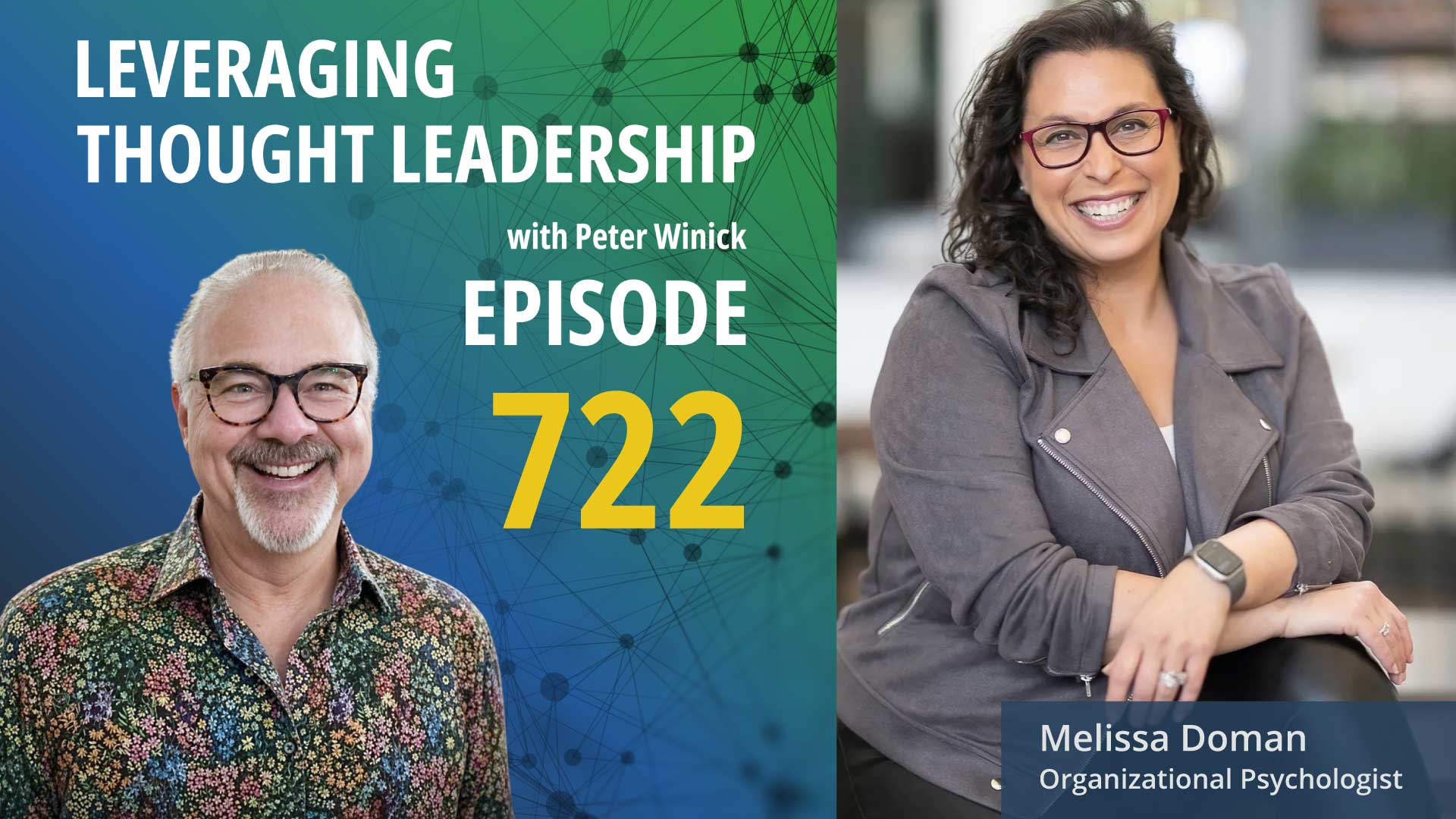



Melissa Doman on bridging the gap between clinical language and business results
An organizational psychologist and former clinical therapist explains how she accidentally built a thriving thought leadership practice around workplace mental health — and why the real business case was there long before anyone was willing to listen. She reveals how reframing clinical expertise in business language unlocked corporate doors, and why staying in your lane builds more credibility than chasing trends
Most professionals who make the leap from clinical therapy to the corporate world stumble on the same obstacle: they speak the wrong language. They know the science cold. They understand what’s happening beneath the surface in any dysfunctional team, toxic culture, or burned-out leadership group. But if they can’t connect those insights to the metrics that actually keep executives up at night — retention, productivity, profitability — they get dismissed as well-meaning outsiders.
Melissa Doman figured this out the hard way and built a thriving practice on the other side of that realization.
In this episode, Melissa — organizational psychologist, former clinical therapist, LinkedIn Top Voice, and author of Cornered Office: Why We Need to Talk About Leadership Mental Health — traces the winding path from her 2013 exit from clinical practice to becoming one of the most recognizable voices in workplace mental health. She was doing this work before the pandemic made it fashionable, before the term “psychological safety” softened the room, and before companies started putting mental health line items in their budgets.
Peter and Melissa dig into the mechanics of what actually made her thought leadership land: not a grand strategy, but a relentless commitment to sharing what she knew to be true, in language her audience could use. When a mental health workshop she designed for 12 people drew 100, she took notice. When the pandemic hit, she was already positioned — right message, right moment.
The conversation gets sharp when they examine the difference between a like button and a buy button, how COVID created a temporary bonanza that threatened to make her work feel like a trend, and why she’s still thriving six years in. Melissa also unpacks how she learned to meet business leaders where they are — speaking to “the emotional toll of leadership” instead of “leadership mental health” depending on the room — and why social proof matters more than pressure in closing a sale.
If you’re a practitioner trying to turn expertise into a real business, or a thought leader wondering how to sustain relevance after the hype dies down, this episode is the blueprint.
Three Key Takeaways:
- A like button is not a buy button. Organic content traction and market validation are not the same thing. Melissa’s true signal came when a 12-person workshop jumped to 100 attendees — proof the market was ready, not just scrolling.
- Language is the bridge between expertise and income. Clinical, academic, or technical vocabulary can shut doors in a corporate setting. Melissa describes intentionally switching from “leadership mental health” to “the emotional toll of leadership” depending on her audience — same idea, radically different reception.
- Evergreen topics still require timely delivery. Mental health, communication, and team dynamics will always be relevant, but staying in demand means talking about them in ways that match what organizations are actually experiencing right now. Evergreen content plus contextual fluency is the long-term monetization formula.
If this conversation sparked something for you, there’s a natural next step. In our episode with Minette Norman, we go deep on psychological safety — the organizational conditions that make honest mental health conversations possible in the first place. Melissa Doman showed you how to have the conversation; Minette shows you why some teams can and others can’t. Together, these two episodes give you both sides of the equation. Don’t miss The Power of Psychological Safety with Minette Norman.
Transcript
Peter Winick And welcome, welcome, welcome. This is Peter Winick. I’m the founder and CEO at Thought Leadership Leverage. And you’re joining us on the podcast today, which is Leveraging Thought Leadership. Today my guest is Melissa Doman. She is an organizational psychologist, a former mental health therapist. She’s author of two books, The Cornered Office, Why We Need to Talk About Leadership, Mental Health, and Yes, You Can Talk About Mental Health at Work. She’s the founder of the Workplace Mental Health Model. And she’s worked with all sorts of cool companies and been on all sorts media. And she’s got a new book out, which is Cornered Office. Nobody ever says I have an old book out. I need like a better way to say that. But anyway, welcome aboard.
Melissa Doman Thank you. Thank you, I appreciate it. I’ve been looking forward to it.
Peter Winick Yeah, so let me start with the how the hell did you get here question, right? So how did this all happen? I get the being a therapist part right in a mental health professional. That’s usually linear, logical, whatever. Yeah. But this whole thought leadership thing, author, speaker, whatever, where the hell does that happen?
Melissa Doman You know, uh, I left clinical in 2013 because it felt like I was treating clients in a broken system and a broken narrative. And I was like, this is not going to cut the mustard. I think as, as hard as it is to leave this work, I need to, if I want to make an impact larger than this. And I transitioned into very traditional, you know, orc psych work. And I still do that work around emotional intelligence, essential communication, helping people share their toys at work. But then I noticed over the years that when I would still say mental health, that people would like proverbially hiss at me. I was like, that’s weird, cause it’s not a dirty word. And then I started subspecializing in mental health at work oddly enough when I lived in London, because in the UK they were eons ahead of the US for talking about it specifically in the workplace, not how Americans talk about medication and therapy. Like we’re talking about the weather outside of work. And then I noticed that it just really kind of burned my ass how people were talking about mental health is important and we all have mental health I go great what are people supposed to do with that how are they actually supposed to have conversations how are we supposed to create any change which by just by saying something is important. And so
Peter Winick Let me ask you this, but some of it is, words matter, right? So mental health still feels like, oh, it’s that, right, like, Oh, mental health, wink, wink whatever. But then, and I think, when we started using the language like psychological safety, it’s more of a welcoming term at least to say, tell me more or I’d like to create an environment in the workplace that is more welcoming that way or whatever. But I did see Fringe Space there.
Melissa Doman No, you know what’s so ironic is because mental health is literally a medical term. Yeah, it’s our baseline, social, emotional and cognitive functioning. I will never forget. I was doing a keynote in London and some guy came up to me after and we were talking or whatever, and then he literally leans over and whispers to me and says, I have mental health. I said, do you mean you have a mental illness? And he goes, yeah, and I said you don’t need to whisper about either. So I understand, I’m a huge stickler of language. And whenever people start having that reaction, I go, it’s really just a medical term about an organ that governs who we are, how we act, et cetera. So I started being very, very active on LinkedIn and in my work, just trying to really set the record straight and make sure more, make it more of an action oriented conversation instead of a heart led one.
Peter Winick Which doesn’t do anything. So you move from clinical to organizational and you talk about that like, oh, that was just like switching jobs. That’s not an easy ship, right? Oh.
Melissa Doman Owes very hard.
Peter Winick Yeah, because most it’s like pick a lane, you know, your one or the other.
Melissa Doman And that was before everybody did it and now everybody’s doing it like it’s the best thing since sliced bread i did that in 2013 before most people were doing that before they were like whoa whoa whoa you’re in clinical i go it’s the same skill set it’s just a different population guys so but now everybody and their mother is jumping from clinical into orc psych it’s a very common thing now so no Someone helped me. Back then. And these days, every week I get a message, show me how you did it. And I go happy to help you skip all the blood, sweat and tears I had to go through.
Peter Winick So then, even though you still have a foot in the orc-side space, now you’re in the fought leader space, which is another totally different set of rules and cadence and all that. How did you start to sort of cross over to the dark side, if you would? The dark side? It’s not the dark.
Melissa Doman Oh, there can be because so many people are very like virtue signaling, self aggrandizing types which make me kind of vomit in my mouth a little bit. Because if you’re going to put something out there, don’t pretend like it’s for other people if it’s really just for you. Don’t don don’t go through that exercise. And to be honest, I didn’t know I was in the thought leadership space till other people pointed it out.
Peter Winick No, but that’s a good thing, right?
Melissa Doman Yes, it wasn’t a conscious effort. It wasn’t conscious effort!
Peter Winick Yeah, anybody in the world, according to me, that goes out there and calls themselves a thought leader is somewhere between a jerk and a narcissist. Possibly both, yeah.
Melissa Doman Yeah, and I didn’t even know that was happening until my husband was like, you do realize like this is what it is. I was like. Nope. And then LinkedIn reached out to me and made me part of their top 10 voices on mental health globally. And I like ugly cried into my coffee because I wasn’t expecting that. Like, I wasn’t trying to do that. And then it just kind of happened. And I get messages from people on LinkedIn and I’m still not used to this. Somebody messaged me last night, because I messaged them to thank them. They were saying the whole leadership team worked through my book together, and I was like, oh, that’s great. So I messaged, I was, like, hey, man, that so great. I’m so happy to hear this. If there’s anything I can do to help further, let me know. And he responds saying, I’m actually kind of starstruck that you messaged. Me, I’m like, why?
Peter Winick Really? Oh, that’s funny.
Melissa Doman It’s just, why? But no, it wasn’t a goal, it just kind of happened.
Peter Winick And that’s fairly common where it’s just serendipitous, reactive, one thing kind of leads to another, whatever. But now there’s a part of your business that’s based on it, right? And you have to figure out what I’m gonna need. So how did you figure that piece out, right, because now, add entrepreneur, add a whole bunch of other things, you have, because sometimes the market responds to the ideas. Yes. But it doesn’t mean they’ll support you with dollars, right. And those are the rest. A like button is not the same as a buy button. So tell me how to figure that piece out or are you?
Melissa Doman I know the market was telling me back in 2018 that it was ready for this because I was working on a people in leadership development contract, a very traditional work site contract, and they were like, Hey, you used to be a therapist. Could you do a mental health awareness campaign? I was like, yeah. And so normally their workshops get 12 people. This one got a hundred. I was, like, okay. Might be on to something here. And so, I just started sharing what I know to be true. And I found that if I shared what I knew to be true with no personal goals in mind, with education that I was trying to spread for the sake of making sure that people knew helpful things, that’s all it took. And then the pandemic hit and it was right place, right message, right time, right service. And the market responded, extremely well because there was a need there was a need where people were like oh my god
Peter Winick Stay there a second. So I think about when I’m looking at someone’s work, there’s sort of two things, right? One is there’s the evergreen nature of your work, right. So it doesn’t matter who’s in office in the White House, did the stock market go up a thousand points today, are we in a recession, like whatever. These truths are true. Gravity is gravity, right, that’s a truth, right but then there’s things that are happening Opportunistically, that make it more relevant or less, right? So like COVID happens and that decreased demand for a lot of things and increase. Like we were doing less like corporate off sites, like zero. We were doing like, oh, how’s the food? And you’re like, a lot of that stuff went to zero. But then it was like, Oh, how do we do this work remote thing? How do we keep a culture remotely? How do we retain top talent in a remote? Like there was all that phase. How do it not internally?
Melissa Doman Combust during all of this.
Peter Winick Right, so now that we’re clearly post-COVID, so it doesn’t mean everybody’s all fine and dandy now, but the craziness of the demand where it’s like, poof, you know, this is on fire, you’re not the pet rock anymore, right? So how do you sustain it?
Melissa Doman That’s a very good question. And the thing is there are plenty of companies who have reverted back like they’ve learned nothing. Yeah. And there are a plenty of companies where they took it as a long-term sustainability wake up call. So while 20, 21 and 22 were banner years for our business, I’m entering year six and I’m doing just fine. And it’s because the conversations have to evolve. As the systems evolve where those conversations are happening. So I talk about three things. I talk mental health, communication, and team dynamics in the workplace. Those will always be relevant, but you have to talk about it in a way that people actually give a damn about at the point in time in which you’re talking about it.
Peter Winick But stay there for a minute because if you were to put those three things on a whiteboard i think a lot of people would say wait mental health like okay the other two I hear a lot about blah blah blah yeah yeah yeah but wait you’re we’re doing this through the lens of mental health? What does that mean? What is that look like? Why?
Melissa Doman Well, to me, I basically go, we spend the most time with people at work each week, and it’s really tough out there and really tough in here. So wouldn’t it make more sense to have the conversational literacy to talk about the struggles you’re having, the support you need so you can be productive and function and perform for the company?
Peter Winick Well, and so I would say yes, and if you’re asked people to say, let’s talk about the last five issues, however you choose to define that you’ve had at work in the last year, it’s probably not technology. It’s probably not a system. It’s probably not a process. It’s it’s probably a people thing. We might call it politics or something politically correct or whatever. We might call it something else, but it’s usually people driven.
Melissa Doman Oh, I look at the workplace as just an adult playground. We just have different toys and different kings and queens of the jungle. Jim and people, we don’t share their toys. So it is always an evergreen topic and it’s just how you name it. For example, when I work with certain leaders, I may not talk about leadership, mental health. I may talk about the emotional toll of leadership because the optics of those words need to change depending on who you’re talking to. And the thing is… All the data has been proven about lost business dollars due to poor mental health and poor cultures of mental health. This is all, this is all proven information.
Peter Winick Stay there for a bit, because I would argue that when you were coming up on the clinical side, that language probably didn’t exist, right? In terms of the business impact of mental health in the corporate world. But like your business-
Melissa Doman 2013? Nooo.
Peter Winick Yeah. So…
Melissa Doman So no, no.
Peter Winick So you had to retool and say, I gotta meet them where they are, because guess what, at the end of the day, there’s only, you know, life isn’t that complicated, six or eight things that every company cares about, right, their profit, are they growing, are they satisfying, like, you now, whatever. We can put that checklist there. Those haven’t changed, those will never change. Now we’re talking about AI now, we’re talkin’ about things we weren’t and whatever, whatever, but you’re looking at those things, right, so you’re basically meeting them where they are saying the impact of people much. Getting along well not collaborating not communicating honestly, whatever. Here’s how it impacts your bottom line That’s really the brilliance of the thought leadership from my two cents here
Melissa Doman Well, thank you, sir. And that’s why I literally tag, I trademarked the tagline, the workplace mental health method where I was, I’m not remembering my tagline where mental health meets smart business, right? Because it is smart business. My God, like it has been proven in endless studies in the past, like, six to eight years, literally showing here are the billions, trillions of dollars lost globally. Or in the United States, from people who don’t feel supported at work, they are going on sickness absence, like it’s all there. So if you see the data and you want narrative and bias to override dollars and logic, then you’re being stupid.
Peter Winick Well, let me ask you this then. So I’ve worked with lots of folks over the years and I’m thinking of someone in particularly now who is an amazing clinical guy. He was one of my mentors, right? His name was Dr. Mark Goldstein and wrote a bunch of books, whatever. He was a clinical guy in LA and kind of got bored with the clinical thing. And then being in LA a bunch of his clients were CEOs and they started to talk to him about their issues in the workplace. And they’re like, hey doc, could you come in and help me? I was like, I don’t know. A profit from a loss. I don’t know any of that and then he was able to reframe it and say well actually You know a leadership team is really kind of like a family. They’re just dysfunctional There’s a bunch of people that are forced to be together in this environment
Melissa Doman It’s the same skill set. Yeah, it’s the same thing.
Peter Winick But yeah, this was like, you know, years ago, and it’s like, oh, they’re just a dysfunctional entity, right? They don’t they’re not really like blood.
Melissa Doman It’s an ecosystem of organisms that are driving or not.
Peter Winick So my question for you is really, where did you go and how did you pick up sort of the business savvy language to meet them where they are? Cause there are other strengths that you pop into sort of the corporate world.
Melissa Doman We don’t use the S word theater.
Peter Winick Or therapist. Yeah, that’s right. But there are other mental health professionals that get popped into the corporate world. And they could be as smart or smarter than you or whatever. But because they’re not fluent in business, they get discredited as, oh, that outsider. And academics do this too. How did you realize like, Oh, I better learn some business stuff.
Melissa Doman Through my own meandering experiences and mistakes. I actually listened to people when, you know, when I was trying to explain certain things, I can’t even remember who they were at this point, but they were like, you have to speak to people who are not in your profession. Yeah. And I was like, oh my God. And so I really learned how to take myself out of clinical, flowery, esoteric, high-level language, to very concrete, logical, action-oriented, business-application-focused only language.
Peter Winick But you didn’t go to school for that. You had to learn on my own. Yeah.
Melissa Doman Before AI I learned I learned on my own with no help from AI or anything or is that the new
Peter Winick So as I learned it before I the new like our grandparents used to you know I walked to school uphill in the snow both ways is that maybe.
Melissa Doman I think it’s the new flex, it’s a new flex. I did undergrad and graduate degree and licensing and boards and two freaking books with my own brain and no AI, that’s the flex.
Peter Winick That’s so retro.
Melissa Doman Oh, so retro me as an elder millennial being like, I did it before this help was available. Help crutch, whatever we want to call it. No, but I learned it on my own. Like, you know, I don’t learn this in my master’s and counseling degree. And there’s still plenty. I have attended sessions of clinicians that try to do workplace stuff. I can’t even sit through it because it’s so esoteric and hard to follow. Yeah, yeah. Like this isn’t an academic conference, you can’t speak to these people the same way.
Peter Winick Yeah, and I think some of the greatest thought leadership out there happens at the seams or at the cross-pollination of two disciplines. If you go back to behavioral economics, the behavior folks, their thesis is people are crazy, and the economist is there’s this one thing called rational man, which no one’s ever met, right? Like, no one, like, ever met that. And then they got together and basically said, well, actually, we’re both kind of right. Like, what if economics is based on ration, but you’re dealing with people that aren’t any rational, logical, whatever, right. And those two things had to come together, but they learned each other’s language.
Melissa Doman Right? Oh, yeah. And they’re both right. Yeah, I reference the East model, which is a behavioral economics model in my new book. Yeah. If you want people to do stuff, you have to make it easy, attractive, social and timely. Yeah and I build that into how I work with companies. It has to be easy, attractive, and timely and I think that there’s such a marriage of those things and psychological theory, sociological theory, it all works together. You know, how do you think people love Brene Brown? I mean, she made her social work and sociology accessible and cool and interesting to understand that she’s honest. Yeah, yeah.
Peter Winick Well, it was the vulnerability that was probably her secret sauce of why people leaned in early on and then underneath it, she had the good. She’s smart, right? So she’s extremely smart. Yeah.
Melissa Doman So I think that it’s, you got to, and you have to figure out how you’re going to solve an actual problem in a way that’s demonstrable, not just by talking about and observing the problem.
Peter Winick Well, not just demonstrable, in a way that an organization is willing to pay money for. Yeah. Right, because you could solve, there’s lots of problems that I could solve but like, do they have any value in the marketplace is really the other question.
Melissa Doman I have found when I speak to companies that if you make it feel more like an advisory conversation based on best practices, because people want an expert in their field, they don’t they don’t generally want a generalist. And so if you Make it clear that you are the expert in this one thing, and this is I’m advising you. This is best practice. That’s a totally different.
Peter Winick And you stay in your lane. And you’re staying in your la-
Melissa Doman stay in your lane exactly the value in a lot of ways proves itself as opposed to being like well you need this because no people don’t like to make decisions under pressure you know it’s uh you know when i’ve seen these problems occur here’s what my clients have found have worked right with me right social proof yep so.
Peter Winick As we start to wrap here, what would you, what would Melissa today tell Melissa of 2013 to make the journey quicker, easier, maybe skin your knees left, falling off the bike on the ride?
Melissa Doman Ugh, you’re making me think about childhood in the 90s.
Peter Winick No, don’t go that far back. No, I’m not, no, I, I am not your friend.
Melissa Doman No, no, no. No, I know what you mean. No, because I heard falling off a bike and skinning your knees. And it just reminded me of doing that as a kid. So I would tell her. The transition is going to be really hard, but you have no concept how much it will be worth it 13 years from now. Still with it.
Peter Winick Great stuff.
Melissa Doman I never would have dreamed that I would have gotten to this point, let alone having my own team and writing two books and like, you know, speaking at Google and Dow Jones and progressive. I’m like, what? But it happened. It’s happening. So I feel grateful.
Peter Winick Well, this has been fun. I appreciate your time and your candor. This has been great. Good to talk to you.
Peter Winick To learn more about Thought Leadership Leverage, please visit our website at thoughtleadershipleverage.com. To reach me directly, feel free to email me at peter at thoughtleadershipleverage.com, and please subscribe to Leveraging Thought Leadership on iTunes or your favorite podcast app to get your weekly episode automatically.
