
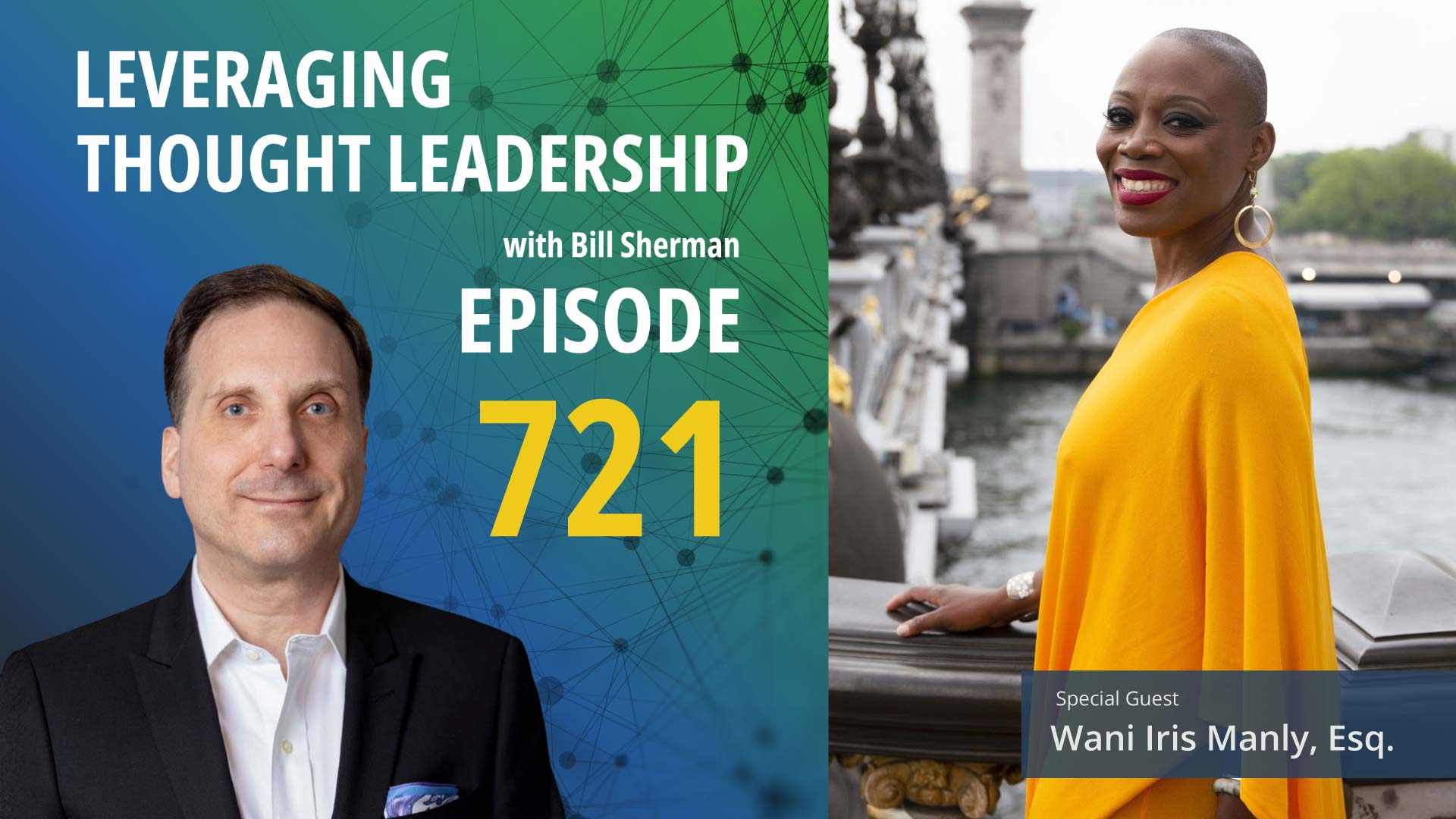
From Attorney to Speaker: The Identity Shift That Changes Everything | Wani Iris Manly, Esq. | 721
The Leveraging Thought Leadership podcast is created by Peter Winick and Bill Sherman and produced by Thought Leadership Leverage.



An attorney turned international speaker on shedding one identity and claiming another
A corporate attorney leaves Miami for Paris on little more than a hunch — and discovers that changing your circumstances isn’t enough. True transformation demands a shift in identity. This conversation explores what it really takes to move from a groomed professional role to authentic thought leadership, and why internal change always precedes the external.
What happens when you’re wildly successful at a life you didn’t consciously choose?
Wani Iris Manly, Esq., grew up groomed for one thing: the law. She did the work, built the firm, drove the Porsche. And then, on New Year’s Eve in 2010, she sat alone and took an honest look at the gap between the life she had and the life she actually wanted. What followed was one of the more audacious pivots you’ll hear about — selling her car, her apartment, and most of her belongings, and moving solo to Paris without a plan, without French, and without a single contact in the city.
That’s where the story gets interesting — because Paris didn’t just change her circumstances. It cracked her open. Books started pouring out of her. An article for an expat magazine led to speaking invitations at salon-style soirees. And what began as storytelling
became something with structure, depth, and demand: a framework around change, identity, and what it actually takes to stop surviving and start living deliberately.
In this conversation, Bill Sherman and Wani explore the layered journey from attorney to thought leader — and it’s anything but linear. She talks about the very specific cognitive dissonance of having to affirm a new identity every morning when your subconscious has spent 22 years believing it’s a lawyer. She gets candid about the differences between the US and European speaking markets — where she earns her fees, where she adjusts her rates, and how geography can quietly shape your perceived value as a speaker. She reflects on what it means to carry a message professionally that you’re still personally living through.
The through-line Wani keeps returning to is this: external change — new city, new title, new audience — doesn’t stick unless the internal identity shifts first. That’s the work. And in a field full of change management frameworks, her version carries unusual weight because she didn’t just study it. She did it. Repeatedly. Often at considerable personal cost.
If you’re a practitioner of any kind — speaker, author, consultant — navigating a career transition or wondering when the momentum finally arrives, this one’s worth your full attention.
Three Key Takeaways:
- True change is an inside job. Wani’s central framework is clear: no external shift — new job, new city, new role — will hold unless your internal identity changes first. Waiting for circumstances to rearrange themselves is a recipe for staying stuck.
- Building thought leadership takes time, and the signals come slowly. Wani spent years speaking at Parisian soirees, cold-pitching podcasts, and doing TED talks in Northern Ireland and Canada before landing a 2,000-person stage in Monaco. The work precedes the visibility by a wide margin, and staying in the game long enough to be found is part of the strategy.
- Identity is stickier than circumstance. Transitioning out of a high-status professional identity — attorney, doctor, executive — requires more than a career pivot. Wani describes needing to affirm her new identity as a speaker daily, because the subconscious defaults to the self-concept it’s held for decades. The rebranding is internal before it’s external.
Both Wani Iris Manly and CB Bowman know something most high achievers won’t say out loud: claiming a new identity before the world validates it takes a specific kind of courage — and it’s a skill you can build. In this episode, Wani talks about affirming “I am a speaker” daily for years before the stages matched the vision. CB Bowman’s conversation takes that same tension and goes deeper into what courage actually looks like as a practicing thought leader — when to hold your lane, when to change it, and what it costs either way. If Wani’s story resonated with you, CB’s episode will give you a framework to go with the feeling. Listen to Courage in Thought Leadership with CB Bowman!
Transcript
Bill Sherman Can one decision change the trajectory of an entire life? For Wani Iris Manly, the answer is yes. What began as a personal search for greater freedom and fulfillment eventually led her across the Atlantic, away from her successful legal career and towards a calling as a speaker, author, and advocate for transformation. Along the way, she discovered that the most powerful lessons weren’t about changing circumstances. They were about changing identity. Her thought leadership journey is a story of courage, reinvention, and trusting a vision before anyone else can see it. I’m Bill Sherman and you’re listening to Leveraging Thought Leadership. Let’s begin. Welcome to the show, Wani.
Wani Iris Manly Thank you for having me, Bill. It’s good to be here.
Bill Sherman So we’ve been talking and you shared with me just before we started recording. You’ve got some news, something that has you excited. What is it?
Wani Iris Manly Well, I am actually speaking this summer in Monaco, one of my favorite principalities in South of France, and I’m gonna be speaking from 2,000 people. That will be the largest audience I’ve ever spoken in front of. So it really hasn’t quite set in yet, but yeah, it’s in writing. It’s in my LinkedIn DM, and I am just like blown away by it. And I’m super excited.
Bill Sherman So let’s stay in that news for a moment. What does it feel like? What are the emotions you have as you’re thinking about that largest audience?
Wani Iris Manly It feels like it’s about time, you know, because I’ve been speaking for quite a bit. And when I first got the vision of me being a speaker, it was literally, I saw myself speaking in stadium size audiences, I kid you not, like football fields, you know, and up until date, the largest have been like 300, 400, like my Ted talk that I did in Northern Ireland and then another one that in Canada, but I’ve never been in for that large of a crowd and I’m so ready for it, you And it’s like I’ve been cold pitching for so long. I’ve been doing so many podcasts, I’ve done so much putting out there for thought leadership and everything, and you’re just like, where’s my stuff?
Bill Sherman Well, and there’s a couple layers, right? It’s sort of like the musician, the dreams of playing at Wembley Stadium and knows they have a bunch of, you know, small venues, music halls and bars and that to build up and momentum to, right?
Wani Iris Manly Yeah, 100% is like, you know, you just like, you’re ready for big time or you were meant for magic or meant for so much more than what you’ve been playing at. But I really understand as well too, there is a process, you now, in terms of like, you know universal order and things have to line up the way they actually have to lineup. And so I’m really quite excited about that. And I’m also grateful as well, too. So I’m not that arrogant in a sense of like you know but it’s like, yeah, it’s about time.
Bill Sherman Well, and this is one of the things that I want to probe really is the journey, right? So with that, let me start with one question. You’re an attorney by training. Yeah. How did you come to be living in Paris, doing thought leadership and speaking because that wasn’t the life that you started down, right.
Wani Iris Manly No, not at all. You know, I actually thought I was going to be a lawyer since I was a child, just based on my family background. And really, it was really one decision that I made abruptly on a New Year’s Eve in Miami of decided I had to go out and party with my friends during the New Year, but to really sit and to analyze and to look at what I had done the year before. This was New Year even 2010. And that decision that day, I literally looked at my life of, okay, what went wrong? What went right? Then looking at, okay, what were my beliefs about myself? And they’re just really like, you know, future cast and whatever they wanted to experience B2 and half, not just in 2011, but just like the trajectory of my life. At the time when I was writing that day, I never said that I wanted to leave Miami, but I was yearning for a big change. I was just like, oh my God, please give it to me. Like I’ve done this already. And three days later, like my entire world became invaded all of these signs about Paris, Paris, France. And at the time, I wasn’t. You know, typical American, all like cuckoo for cocoa, crazy puffs about anything that’s just made in France. And I had my family’s from Liberia, West Africa, which isn’t a Francophone country, so it just didn’t make any sense at all. So long story short, over like after receiving like one year of daily signs, I sold my apartment, I sold car, I gave all my things to different charities in Paris, moved there down low in a single person, not one word of French, not having any plan A, B, C, D whatsoever. And that I didn’t know I was, when I got to Paris, I was just in the turning, which I’ve been on my entire life. And so what ended up happening was I just became infused inspiration. Books started being, you know, poured out of me. I got published in a magazine like for expats and people sort of recognized, oh my gosh, like you’re the-
Bill Sherman And I’ll want to go through the journey, but let’s stay back on that New Year’s Eve journaling. What did you say in that? Because I can envision one version which would be prophetic in terms of the, okay, I want to be a speaker talking in stadium sized arenas, right? Was that in your New Year sort of description or what was the vision then? As you were turning.
Wani Iris Manly At that time, speaking was not in my vision at all, even though I had met someone years back in a retreat in Miami who said to me, you belong on stage, like what’s his lawyer thing you’re doing? And like, I see doing like a TED talk, you know? But at that time it was like I said, from two years old, you now in my thirties, like it’s just being practicing your laws. So for me at the time, I was struggling. I had just started my law, my new brain law firm. I came from a mid-sized law firm where everything was provided for you. Semi-corner office, driving a Porsche, marble building, everything was there, like lunches provided. And so there I was like sort of my own thing, didn’t know anything about, you know, how to be an entrepreneur, but just how to be a lawyer and was like the breadwinner, was a rainmaker, was having to go out there. And it was very, very difficult. And so for me, I want a financial freedom. I wanted to make at least the same amount of money as I was making up the firm. Um, I wanted like a steady clientele. I just, I want a stability because at that time I was like, Whoa, I love that. But I just kind of threw myself into the wolves. And so for me, it was like a better quality of my life. It was, you know, it also just to have more freedom. It’s funny because I left the firm because I wanted time freedom, but then now I have the time freedom and the money freedom was, was gone as well too. So I wanted that back, but I just wanted to fly, you know, I wanna to store. I wanted to. There was a sense of being a lawyer was just too small for me. Like it was just like too small of a box, but I didn’t know what else there was because I have been groomed, like I said, like my entire career, God.
Bill Sherman And I want to pull that forward, right? You said you were groomed to be an attorney. You trained, you were practicing in a mid-size firm. And then you pick up and you go to Paris. And almost in every country I’ve landed in, you fill out the landing card and you have to declare occupation. And I’m betting you didn’t write thought leader on the landing.
Wani Iris Manly I don’t even know what it was at that time. That term never came in my, you know, in my sphere. No, not at all. Not at all- Right.
Bill Sherman Right. So you mentioned that, Hey, I started writing for an article and for it was for other expats. Let’s talk about that story. And I really want to dial in on how the transition from an attorney journaling on new years to, Hey I’m speaking, I’m writing. I’m doing these frameworks. That’s a transformation, so… Let’s stay in the transformation. Yes, so what in there in Paris? There’s a cafe, it’s a lovely time. What’s going on in your world, Wani?
Wani Iris Manly At that time, what happened was that when I got there, I literally just like books just started being, just coming out of me and like meaning like I, my first book was just downloaded to me. I was like writing like crazy. I was being awake at two o’clock in the morning and just like writing books. And so I would go to cafes where I literally was like writing on the napkins. I couldn’t stop it, you know what I mean? I was in the zone of genius, which was very weird because I was never a writer before. So it was just all very brand new to me And so I did what every expat do when we go overseas, you just run a bunch of expat groups. And so, I happened to be one of the largest ones called expats, you know, living in Paris. And so the editor, he was from the UK, I just happened to see a post that says, hey, I’m looking for really interesting stories about why you moved to Paris. I don’t wanna hear about because I’m following my husband or I came here to work, like something like, you now, off the cuff or just kind of, that’s okay. And I say, hey, I raise my hand and I say hey, Kevin. … I, this is my story, movie following science, New Year’s Eve. And I say, I just had this like a blogger write a blog about me in New York. I sent it to him. He was like, Oh my God, can you cut it down to like 600 words and give it to me in 24 hours, which for a lawyer, that’s very difficult. I was up all night trying to be less verbose and so it got
Bill Sherman Legal brief? Yes. Self-reflective article?
Wani Iris Manly Yeah, and so it was because he wanted to publish it like in the December issue. And so I was published and that particular magazine was distributed all across Paris, at the Starbuckses, at The Embassies, at just like, you know, very key strategic places. And so people just sort of like recognized when I would step out in Paris like, oh, and I would just be being reached out to me, hey, I saw your store in X Patron magazine, can you come and speak with my soiree? So I sort of- And that involved one of the embassies didn’t it? No, it was, there was a woman, the very first time I spoke was a woman named Patricia LaPlante Collins, like a very, an angered black American in Paris, lived there for like, I think like 40 years. And she basically created this event called Patricia Soirees where every Sunday she would invite like a guest speaker to come and speak to her, you know, to the, to, the audience. People would pay I think, like 12 euros and it was like for the dinner and for the wine and so that was like the whole… So she was the first one, but then like that was the beginning of the first of many. So I just sort of speaking like different soirees because people saw my story. And that’s how I started speaking and starting to thought leadership and started writing. It was crazy. So.
Bill Sherman You’re telling your story in the expat magazine. You’re tell your story at Suarez. When does it start migrating to thought leadership and you have a thing to say, a topic to talk about? Because that’s a shift between let me tell you my story and here’s my framework that you can use, right?
Wani Iris Manly Yeah, it really came to me because I had the problem where a lot of I feel like high achievers have where like we just do things extraordinary or we have something extraordinary to say, but we don’t think of it that way because it’s just like, it’s just me, right? And so it really came down from people requesting me. Like I just became in demand for people wanting me to come and to speak. And I was like, wait a minute, there’s something is here, you know? And so it was just more of like what the world was reflecting upon me. And I was like, maybe there’s something here. And then I also started looking at how I actually felt when I was sharing that. How much joy I was actually feeling. Then say, for example, when I drafting a contract, which you see like my first love, like you could have put me in a room with no windows for eight hours and I would just draft my heart away. But I was like, boy, I feel more alive. I feel in spirit, more inspired when I’m speaking and sharing these thoughts. And people are saying, me too. So that’s an interesting.
Bill Sherman Transformation. Behind the laptop, drafting documents, doing calls with clients, different skill set than standing up in front of a room of people listening. We’re trying to persuade them about an idea. Contracting is usually, or at least contracting and documents I think, much more as the record of and you may be guiding. Talk about that shift in advocacy, because you could think of thought leadership as being a zealous advocate for an idea rather than for a client.
Wani Iris Manly Does that work in your world? Does that make sense in the land? It does because, you know, I actually created a business called Women’s Question Meets Law and it exactly was connecting consciousness, thought leadership, spirituality, and business with the law. And so I actually, because that’s who I am, I’m very much, I have a foot in both worlds of the law, the legal, the money part, but then also to, in spirit, consciousness, thought leadership sharing, speaking. And so for me, I think what I was getting on with the thought leadership and the speaking part was like, I felt like I was connecting to people’s hearts because on the wall side, I was talking to CEOs all the time and it was just, okay, just get it done. I’m happy. You know what I mean? It was just very less business people, you know? Where…
Bill Sherman There’s a reason it’s called transactional law, because it feels transactional, right, rather than relational.
Wani Iris Manly Yeah, exactly. So the other part was just relational, and it was just like a very natural flow to it, even though there’s a different flow, because I’ve been a lawyer for so long, there’s flow with that. But then on the other side, it was just like, there was a flow, there was a feeling behind it, like, oh, wow, like this just feels like what I’m supposed to be doing.
Bill Sherman So how do you define yourself currently. I mean, there’s many different labels you could pick from, or roles that you could say that’s me, but how do you see yourself?
Wani Iris Manly At this point. I see myself as someone who’s just living the life that she really wants, you know? And it’s not just because I wrote a book on it because I realized what’s most important in this world is actually being happy. You know, and I really love the story about John Lennon and story about how, you now, his teacher gave the assignment, like, you know, what do you want to be when you grew up? And everybody wrote doctor, lawyer, X, Y, and Z, and he wrote, I want to happy, and the teacher’s like, you don’t understand the assignment. And he goes, no, you don’t understand life. And so for me, it’s more of like, and that’s my single central goal. And so, okay, and everything that I’m doing every day is in alignment for that. And so to take the path and I actually, you know, I, I look, I I’m very intentional about it is what I’m. Putting me in that alignment with me being ultimately happy, which means doing with what I really love and having a thought leadership, the speaking and the sharing and the writing, which is, yeah, it is an alignment of all that.
Bill Sherman I love the answer and I love how you framed those as an outgrowth of that. One of the things that I sort of anchor to on thought leadership is it is work. It’s hard work. And like you were talking about before, hey, I’ve done a lot of speaking events. I’ve had the dream and finally, right? The phrase I use a lot is, do the work, find the joy for thought leadership. And whether it’s seen in those moments of connection, when someone comes up to you after a talk or they send you an email because they’ve read your book and it landed or they watched a Ted talk, there are so many ways that you get signals back. Yeah. That the ideas have landed, that they’ve made impact. And I’ve heard many practicing thought leaders say, that is part of the joy is the signal coming back. Is that true for you?
Wani Iris Manly 100%, which is why I love podcasting. And the view of podcasting, having this conversation is that you never know who’s listening. You never know there is no attachment to what’s gonna happen from this conversation today. But how I’m feeling right now, it’s just palpable. It’s like there’s a hope my heart is open. It’s there’s like a connection here and you just can’t package that.
Bill Sherman There’s an immediacy and a presence that’s live, that even though the artifact will be a published podcast, we are here talking and exploring unscripted. And so let’s talk about the future for you, Wani. What are the dreams? What are aspirations? We’re next. What are you striving for?
Wani Iris Manly We’re next. On a professional level, the legal background will be put to rest, 100%. And it’s taking me work to get there. I think for those of us that are in these regular professions and in these CFOs, C-student executives, where we sort of think that we have this one role in life to play, and life is so you’re going to have many different roles, but because we worked so hard for it. And if you were educating the United States, it’s very expensive. I mean, most lawyers come up with six figure loan debt. So letting go of all of that and also to like the identity of it has been quite the process. And so eventually that will be, I will be like a Yenly Vinson, like Yenla Vinson I don’t know who she is, but she’s a lawyer. Mer Robbins is a former attorney as well too. So it’d just be something like that to where it’s just all me speaking and it’s not this, the law firm is not existing anymore. And it’s just writing books and making speeches.
Bill Sherman You talk about the former attorney identity and that transition. My wife also went to law school, practiced, and then set that aside. And she went through a process where she went from I’m an attorney to I was trained as an attorney to I’m a former attorney. And there’s really an identity shift. And I can’t even imagine with you, like you said, You were… Developed to become an attorney from childhood, that piece of the identity has to be sticky.
Wani Iris Manly It’s not even a piece, it’s the entire identity, you know? It’s literally as my skin, you just cannot tell me that I’m not a lawyer, you it’s so ingrained in me to the point where there’s so many reasons to ask me, how does it make a shift to being a speaker? And I literally have to affirm myself every single day, I am a keynote speaker and change, I am speaker. I literally happen to tell myself every day because that’s a whole different identity that served the subconscious mind, has to get along with, what do you mean we’ve been doing this for 22 years? What do you mean you’re a speaker, you know, it’s work.
Bill Sherman What do you mean? It’s a speaker, mom, dad, or family look at you and go, but wait a minute. What are you doing over there?
Wani Iris Manly That’s exactly, that’s a whole nother part of the whole issue as well, too. Because like, yeah, because a lot of it too was like, it’s their dream or it’s their, it was their intention, right? Like, and so you don’t want to fail them. And so that’s part of a hard part of letting it go. It’s like, you don’t want to let down your family, your parents and like, cause they’re so proud of you, you know, but it’s like. I’m doing something else.
Bill Sherman Mm-hmm. So there’s a difference between the North American speaking market and the European speaking market. And while we’ve often had guests that play in one or the other, you’re active in both. Yes. What differences do you see? And let’s talk about them for a moment, because they are very different markets for speaking.
Wani Iris Manly Yeah, they are. So even though I do both, I am primarily in the U.S. Market because the U S market pays more for that. They pay more. And so there’s not this, you know, there’s a thing of it as a profession, whereas in the European markets, like, oh, just come and share. And I’m like, this is a business. Like this is the company behind this that’s paying taxes. And you know you have to understand when I’m preparing to speak, I’m not billing somebody else. It’s like, so there is like more having to. Advocate for your fees and more having to push for that. Um, and fees are still much, much lower. And I feel like a lot of it too, it’s just been, and it just may be what I’m actually, the circles I’ve actually been with, but it’s more of an inspiration thing, like, oh my God, your journey is so nice and so inspired. Whereas like over here in America, I feel good. Come and train my people. Come and shift common act.
Bill Sherman We want your framework. We want the ahas.
Wani Iris Manly Exactly, yeah. The frameworks are just easier to sell in the United States than it is in the continent of Europe. And I would say the UK is a little bit better in terms of like, because they, you know, we pretty much kind of follow each other. But everywhere else, like say Germany or, you now, or France, or yeah, it’s, it works. It’s hard work getting…
Bill Sherman Well, and sometimes I wonder how much that’s influenced by, especially U.S., but North American or even Anglo, individualistic culture, right? And we, as Americans, tend to skew much more individualistic and to be able to be direct and say, this is my speaking fee. And rather than other in other countries, because I know that American based speakers, if they go to Europe or other places overseas. There’s a different perception. And I wonder, since you’re based in Paris, if you’re evaluated more as European rather than an American coming over to deliver a speech.
Wani Iris Manly Nope, I’m an American and it’s with the Paris connection as well too. So I am, it’s the American speaker living in Paris and then my story.
Bill Sherman The question I was asking though is are you perceived and judged on the European scale rather than the American scale for speakers coming over? And I think the answer might be yes. Yes. Yeah. And that’s just the challenge of geography and the choice of, of home. Yes. So you wind up spending more time on planes coming back to the States.
Wani Iris Manly Exactly, exactly. I do. And so it’s just guy, you know, I was talking to because like one of the big companies there is like Orange, you know, which is like their big.
Bill Sherman Yeah, yeah, telecom.
Wani Iris Manly And so, um, you know, I, you know, some, someone in HR, she wouldn’t get me to speak there. And like, when I just showed my AP, she was like, whoa. And she was like, the market here, she’s like, unless you’re a celebrity and it’s like, they just like, even if you’re a celebrity, they just want to come to this church. I’m like, are you fricking kidding me? Like, this is like, so it’s just a separate different market. And so you just kind of like knowing that I just know where to play. I know where to pitch. And I, and I, luckily for me, I love being on airplanes Anyway… So I don’t mind. And so, yeah, if it’s local and I, and if it, I do have the, you do have to look to adjust your face unless you’re a celebrity, like a Tony Rock, like that, but you know, everyone else, you do you have to kind of like, you know drop your face a little bit too, you know to get some payment.
Bill Sherman Now, you also mentioned, and this is a question I don’t know the answer to, North American Europe. You mentioned you have Liberian ancestry. Have you done any speaking on the African continent, and if so, what is that market like?
Wani Iris Manly I have not been, so my family’s from Iberia, but I was born in the United States. And then I was, I was raised in both countries and then also to educate in Europe. I am actually been pitching African diaspora podcasts because I do want to tap into that market because I, do you want to, I do you wanna speak there. I have done some pitches to South Africa. It just, nothing came out of that. I was approached to speak in Liberia, but they just weren’t even, like, it would have to be like 100% stuff on the trip, and I just couldn’t meet them, and I was like, there’s gotta be some type of something.
Bill Sherman Right, how do you make this work? Yeah.
Wani Iris Manly Exactly. So as I come to me, what do you have when you have a budget or something, because it just can’t be a hundred percent where I’m, I’m self-funding it. And so, but I will like, I would like to go there. So for me, for now, it’s actually, reaching out to African podcasters and so, and making connections that way.
Bill Sherman So, you talked about jesting on podcasts, but I think I just heard you also say, hey, I’m interested in an African diaspora podcast. Are you thinking of becoming a host?
Wani Iris Manly You know, this has been, I’ve been guided to do a podcast, but I don’t quite know what it would actually be about just yet. You know? If it’s just gonna be about change. I just, because one, I tend to be impulsive. I tend just to like jump in and then like.
Bill Sherman Which is the only way that you pick up from Miami, go to Paris and sell the sports car, right?
Wani Iris Manly Yeah, but I’m also a business person as well, too, so it’s like, you know, it just has got to be like there’s a business aspect to it. So I really have not sat down yet to really, to say, okay, what’s the business model for this and what’s an angle that I do want to take? Because as much as I do speak, you now, speak and train on change, the Paris story for me is a big seller in terms of like, it’s a big, and because of the resilience part is pieces for two because.
Bill Sherman It answers the question, why you, right? There’s a lot of people on change. You’ve got an amazing story.
Wani Iris Manly Yeah, so it’s just like dude because the resilience piece is just as in demand too because like for example I want there was a period of hell, you know, it wasn’t just all like You know just drinking champagne and eating croissants and you know all honky-dory. So I lost a lot of my
Bill Sherman So not Emily in Paris, one in Paris
Wani Iris Manly Not at all. I mean like literally like my mantra was it’s not working is not an option like that’s my resilience mantra that I came up with. Like there’s no going back, you know what I mean? So eventually I will be, I will create my own podcast, but right now I just enjoy what I’m doing right now because I love the connections I’ve been making with people like you. Like I’m in Houston right now recording this. I’ve done two podcasts in Houston. I actually met the host here in Houston, so I love The Connection, so the connection piece of it.
Bill Sherman So let’s wrap up and I want to end with asking you question You’ve chosen to carry a message around change, resilience, and you’re working on creating impact in people’s lives. If you were to distill that message down into one sentence, maybe two, what is that idea that you’re carrying that you want others to hear?
Wani Iris Manly It is that change is internal. You know, it’s, you know, we’re all waiting for the X, something on the outside to change, to change our lives, to change the organization. Just like, no, we have to become a different person for whatever change, whatever one in our lives we have had to change for it to become so. That’s what Paris is all about for me. That’s why when I, the framework of change changes everything, it really is identity shift has to change within your own self or whatever else on the external for you want to change until. You be changed internally, whether it’s just perspective, whether is how you react, whether it’s what you’re believing, whether its what you are feeling inside, nothing on the external is going to actually change. Whether if it’s a business, in a marriage, whatever love you’re trying to do, it’s not going to work unless you become a different person.
Bill Sherman Wonderful. Wani, thank you for joining us today and sharing your journey.
Wani Iris Manly Thank you for having me. Thank you to your listeners.
Bill Sherman Okay, you’ve made it to the end of the episode, and that means you’re probably someone deeply interested in thought leadership. Want to learn even more? Here are three recommendations. First, check out the back catalog of our podcast episodes. There are a lot of great conversations with people at the top of their game in thought leadership, as well as just starting out. Second, subscribe to our newsletter that talks about the business of thought leadership, and finally, feel free to reach out to me. My day job is helping people with big insights take them to scale through the practice of thought leadership. Maybe you’re looking for strategy or maybe you wanna polish up your ideas or even create new products and offerings. I’d love to chat with you. Thanks for listening.
