
Cracking the Greatness Code in Professional Services | Alan Guarino | 720
The Leveraging Thought Leadership podcast is created by Peter Winick and Bill Sherman and produced by Thought Leadership Leverage.
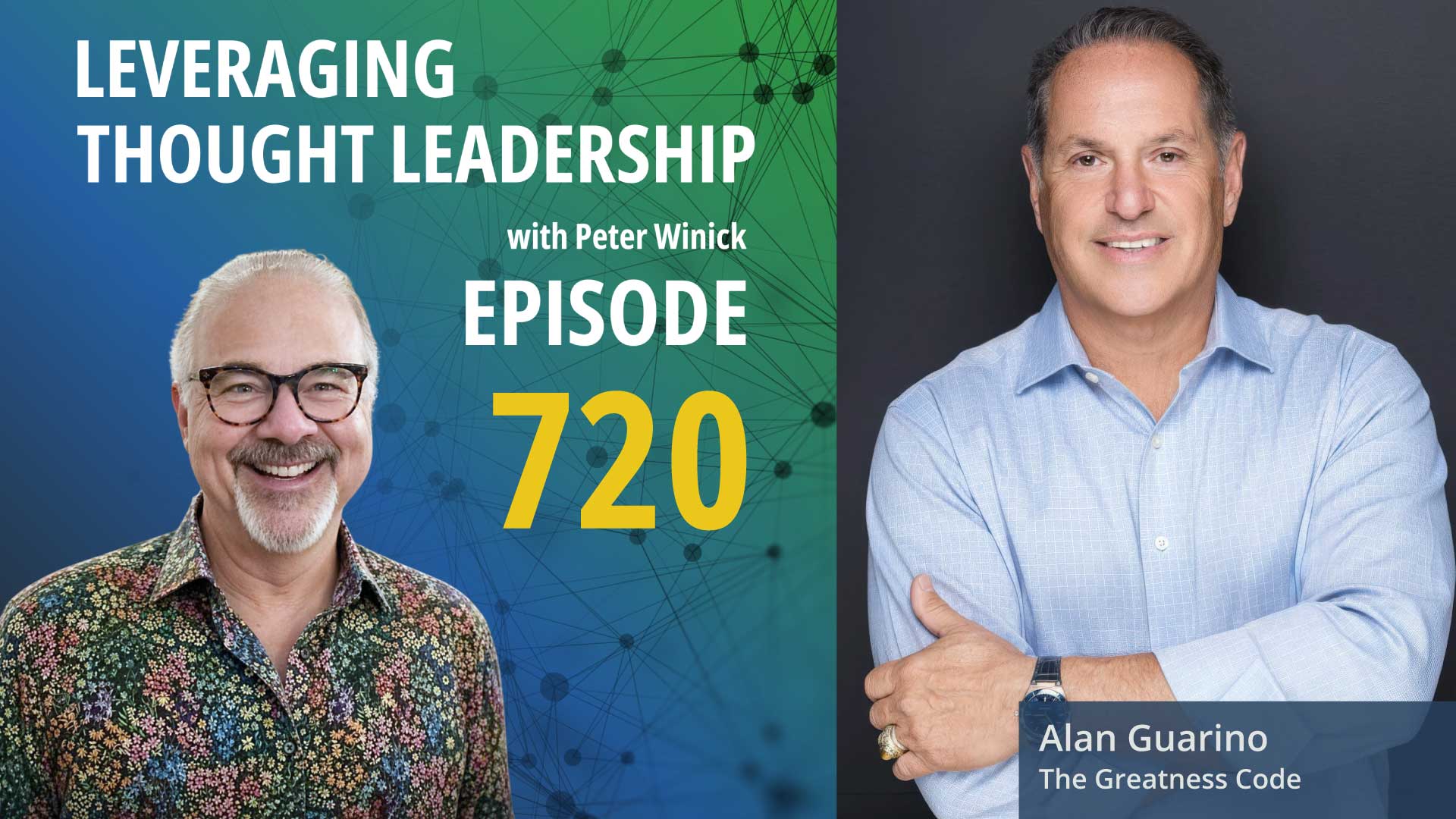



Alan Guarino on Lifelong Learning, Social Capital, and the Formula Behind Unstoppable Success
A leadership crisis is quietly driving even the highest-paid executives to misery. This episode unpacks what separates the top 1% of professionals, why authenticity is non-negotiable in thought leadership and career success, and how intellectual curiosity is a professional obligation — not a nice-to-have.
What does it look like when someone making $10 million a year calls you and says, “Get me out of here”?
For Alan Guarino, Vice Chairman of CEO and Board Services at Korn Ferry, it happens more than you’d think — and it’s exactly what pushed him to write The Greatness Code: The Formula Behind Unstoppable Success.
Alan has spent decades at the intersection of executive search, C-suite coaching, and talent strategy. He’s seen it all: brilliant people in toxic environments, leaders who suck the oxygen out of every room, and — on the other end of the spectrum — a rare few whose leadership style is genuinely awe-inspiring. That range of experience is precisely what gives him the standing to write about greatness, and it’s what makes this conversation so grounded.
Peter and Alan start with a question that doesn’t get asked enough: why would someone at Alan’s level — running a globally dominant practice, advising Fortune 500 boards — invest serious time in writing a book and building a public voice? The answer is practical and principled at once. Thought leadership isn’t a side hustle for people like Alan; it’s a core part of how you stay relevant, how you earn trust before you’re even in the room, and how you differentiate in a world full of smart people doing similar work.
One of the sharpest moments in the conversation comes when Alan offers what he calls his “secret sauce” — the one thing all top 1% professionals have in common. It’s not pedigree. It’s not a particular skill set. It’s the ability to be impressive, authentically. And as Peter quickly unpacks, there’s a right way and a wrong way to do that. The blowhard keynote speaker reads as exposure. The quiet practitioner whose work speaks for itself reads as visibility. Alan knows the difference firsthand.
The conversation also covers the lifecycle of thought leadership — from white papers and CNBC appearances to publishing with Wiley — and what intellectual curiosity has to do with all of it. Alan’s advice to younger professionals considering this path is unusually direct: if the idea of documenting, sharing, and defending a point of view doesn’t excite you, find a different career.
If you’re a practitioner in professional services trying to figure out how ideas scale your business — or a leader trying to stay on track in a difficult environment — this one’s for you.
Three Key Takeaways:
- There’s a leadership crisis hiding in plain sight at the top of organizations. Alan regularly hears from executives earning $700K–$30M who are miserable — not because of the work, but because of their leaders. The problem isn’t exclusive to middle management; it runs all the way to the C-suite
- The top 1% of professionals share one defining trait: they find a way to be impressive authentically. It’s not about self-promotion or personal branding for its own sake — it’s about doing the work at such a level that the conclusion becomes obvious. The key word is authentically; people see through anything else immediately.
- Thought leadership isn’t separate from your day job — it is your day job. Alan frames intellectual curiosity, documentation, and sharing a point of view as professional obligations, not extras. The analogy he uses is sharp: a plumber who never walks the supply store aisles ends up with outdated tools. The same applies to any practitioner who stops engaging with the evolving ideas in their field.
Enjoyed this episode? Check out Episode 471 with Raoul Davis.
Alan talked about how thought leadership builds credibility and puts you at the front of the line with clients. Raoul Davis goes deeper on the strategic side — specifically how executives and CEOs build intentional brand equity that drives real business results. Same audience, same problem, different lens. Worth the hour.
Transcript
Peter Winick And welcome, welcome, this is Peter Winick. I’m the founder and CEO at Thought Leadership Leverage. And you’re joining us on the podcast today, which is Leveraging Thought Leadership. Today my guest, I’m excited about this one, this is gonna be interesting, is Alan Guarino. He is the vice chairman of CEO and board services at Korn Ferry. He’s a graduate of West Point. He is author of The Greatness Code, The Formula Behind Unstoppable Success. And he’s done a bunch of other Interesting things so welcome aboard today Alan. How are you?
Alan Guarino Peter, I’m fine. Thanks for having me. Great to be here.
Peter Winick So I wanna talk a little bit about sort of the why for you. So you’re a busy guy, you’re in a busy role dealing with boards and the things that you do at Corn Ferry to get people placed at the top of the house across the world. So I’m gonna guess you weren’t sitting around one day saying I have so much time on my hands, what could I do to fill it with? Why did you decide to sort of dive into thought leadership, write the books, do the speaking, do the things you do as a thought leader? Well.
Alan Guarino I actually feel like thought leadership has to really be part of the day job. And, you know, I wrote a book called smart is not enough published by Wiley back in Oh seven and I thought I’d write a book every few years. That was 17 years ago, but along that 17 years I’ve published quite a lot, but I never had anything that I was passionate enough about that required 60,000 words other than smart is, not enough. So I did a lot of, of white papers and various other, you of thought leadership. But the book greatness code, the formula behind unstoppable success actually came from what I do every day. And, you know, while we do fill jobs, that’s about a third of my day. Okay. You thirds is helping executives execute their strategies through optimizing their people in various ways from coaching to, you know, top team effectiveness, compensation, performance management, all of that stuff. And yes, we fill jobs too, and we’re the biggest in the world.
Peter Winick Stay there for a second. So you’ve got, you know, when people come at this space, it’s like the blind man and the elephant. Everybody’s got their perspective, right? So you could have a leader that’s been leading and had a stellar career for 30 years and saying, okay, this is the world according to me. And it worked when I was at company X. You could have the academic that says, well, and I’ve studied this for years and this is what I think. I’m biased as a consultant, but I love being sort of in the arena, working with lots of different people in lots of situations and scenarios, which is kind of. A parallel to your world. Absolutely.
Alan Guarino The book happened pretty much because of that perspective, Peter. The reason I got passionate about it and had 60,000 words is because I think we have a crisis today in the quality of leadership. And corn is very developed thousands of leaders around the world. That’s a big part of what we do, but there’s millions out there. And so I started over the last half decade, getting a lot of inbound from very senior people to mid-level people saying You got to get me out of here. I hate this place. And the common theme, and I’ll- And these are-
Peter Winick And these are smart. I just want to give the content. These are people.
Alan Guarino At the house game, making anywhere from no, you know, 700000 bucks a year to upwards of 20 and 30 million.
Peter Winick Okay, so they’ve got the brass ring and then some so from the external everybody looking in saying, well, they’ve got it. They’ve got it all right. And then inside, they’re telling you get me the hell out out of here, Alan, I’m miserable, right?
Alan Guarino And very often what they’ll first say is, you know, I’d like to know how things, how’s the market and the first thing I say to them after I finally got sensitized to this, I came up with a census. These calls were generated by basically look, I’m I’m, I’ve lived a very simple life when it comes to how I think about things, I try to stay very black and very white and I try and make things very, um, universal. So bottom line was my thesis was people are calling me because they work for. Horrible boss. And by the way, that could be a CEO who has an issue with their board chair. So it goes hard. And so bottom line is the first thing I would say to them is, so when you wake up in the morning, you know, are you excited to go to work? This is before they told me I hate hate it. They call me and say, I know the answer. The answer is gonna be, if they’re truthful, well, kind of that’s why I’m calling you because I hate this. Yes, gotta get out of here. And then from there, I started to move forward through why and then it came to My boss is tone deaf, my boss is toxic, my boss sucks the oxygen out of the room. And by the way, you know, there’s takes two to tango and there’s always two sides to the story.
Peter Winick But this is an epidemic and I have. So stay there a minute though, because if I were to just sort of look at what you just said as a transcript and say, give me the context of what this gentleman’s talking about, I would typically think, oh, that sounds like the gripes of middle management, you know, we don’t, blah, blah blah, right? Like that’s kind of the stuff that you hear at middle management. And then you say, well, maybe they should be more miserable because they have less agency, they have more control, they have to report to. But it’s kind of alarming when it’s coming from the top of the house. I mean, these are the people that are setting the strategy, setting the direction, have everything there is to offer in life at the top of their game, and they’re miserable too for the same reasons, right? It’s people reasons.
Alan Guarino I spend most of my time to be fair for your, for your audience to have context at the CEO level, the direct reports into the CEO and the level below them. So let’s call that minus two. Okay. So these are people who are late thirties to the top of their game, you know, mid fifties, you know, hitting their peaks and they’re in environments increasingly more abundant where they are working for people that suck the oxygen out of the room. Right. Right. And that’s what motivated me to write the book. I said, look, we can’t we can we don’t we don’t have the scope and we know that, you know, there aren’t enough enlightened clients that are going to have every leader trained by us. There’s millions of people. So I said I need to arm people with a formula who are in tough environments to stay on the on track and achieve their personal greatness. And that staying on track sometimes requires failing forward, pivoting a bunch of other things that are covered in the book. And by the way, The good news for the book is if you’re in a great environment, you had an awesome boss. And I’ve got a couple of clients right now that I think are case studies in some of the best leadership I’ve seen in my entire life. Also happening quite a con quite a, quite a dichotomy, right? How are leaders in high abundance and some incredible leaders that are just blowing me away with what they’re accomplishing. I won’t mention their names with if they’re listening to you, what they probably want to talk about. And so if you were in one of those environments, that’s even that’s even better because my four more is going to give you, you know, rocket fuel, right.
Peter Winick So how much of your thinking, your thought leadership, because if I think about sort of the archeology of your think, I’m imagining there’s some foundational things that go back to West Point. Yeah.
Alan Guarino Everything I think ultimately goes back to being raised by an immigrant dad and being first generation and a very wonderful working class family. Yep. And, uh, knowing that there was an opportunity to, to, to go after this thing at those, in those days called the American dream. Yeah. And, you could do whatever you set your mind to. And from that foundation, you know, you go on the journey and you take the and You zig and you zag and you get beat and you win and ultimately end up where you are and West Point was probably the most, the most significant institutional step from leaving the neighborhood and ultimately getting on to what was a professional track, right? Sure. Sure. Love that.
Peter Winick Talk a little bit about, you had to find something to double down on for the book. So that’s the greatness code, right? Give me a sense of, from a business standpoint, and I think professional services and the corn fairies of the world get this more than most, the value of the time that you invest in that in terms of differentiating yourself to your clients, getting their attention, you know, and I mean you can’t. Necessarily say and that yields X dollars a year, but how does that Get people to think about you and and corn fairy a little bit differently relative to maybe competitors
Alan Guarino Well, any of these things, whether you’re on TV morning, you know, business broadcasting or talking with people like yourself or writing a book. It’s all about branding at its core, but you have to have the content. You know, there’s an old, there was an old army captain who told me, you know, he said, Lieutenant Garino, there is a fine line between visibility and exposure. And so if you, if you go ahead and venture into going on morning TV for business, talking to people like Peter Winnick on a podcast, writing a book published by Wiley, you know, if, if you don’t have the content, don’t do it because it’s exposure. It’s not the
Peter Winick Yeah, if I was unsure whether you have anything to say, now that I heard what you have to say I’m like, oh, okay, no need to call that guy. But I’m going the other way with you saying, okay, when people, you sort of fast forwarded through, oh yeah, I did a bunch of white papers. I would imagine you’ve done dozens of those sort of things over the years, right? And those more short form, topical, something going on today. And that’s thought leadership in a big way, right. So when it comes to you, They know that you have a… Point of view, you have a way of thinking, right? I think that’s really what, because, you know, generally speaking, there’s lots of people that do what you do. There’s lots people that do it, everybody does, right. But when somebody comes to you, they kind of have a sense of, well, this is what Alan’s about. And that’s why I want to work with him because I admire his values, I admire the way he thinks, he’s thoughtful, he’s smart, based on what he’s written and what I’ve read, he gets my situation. That’s kind of where I’m going. And that puts you at the front of the line, or at least.
Alan Guarino You’re spot on, Peter. You know, I talk to people and now at this point in my life, I have, you know, the honor to do some mentoring. Right. And one of the things I landed on probably 20 years ago, and it’s actually what I used as my own strategy. And that was at the end of the day, when you’re in professional services and I don’t care whether that’s a lawyer, uh, an investment banker for that, yeah. What I realized was the people that end up in the top 1% of those industries have actually one thing in common. Now, this is my secret sauce. I don’t tell to me, you’re putting it on, on podcasts, but when I tell the folks I mentors, you have to do one thing very, very quickly because every one of these people that is a top one percenter does this. And by the way, if I put them all in a room, they would be a neglected group of people that you would say have nothing in common other than that they’re driven. And here’s what they do. And it goes right to what you’re asking. They find a way to be impressive. Yeah. And if one finds a way to be, impressive, authentically, people conclude what you just said. I want to work with Peter.
Peter Winick But stay there a minute because I’ve seen sort of two versions of that Those that are trying to be impressive to a fault and and and it’s really all look at me Look at me ego ego ego, ego, you know, whatever that repels it attracts some people but by and large People can can sort of sift through that. We’ve all seen that the you know Sort of the rock star keynoter or the blowhard or the whatever. I think it’s the other side of that right though the ones that are that are doing it and going I want to be around that person, right? I want learn from that person. I admire that person but they’re not saying.
Alan Guarino Right There you go. Yeah. So, so I talked to you about the what, which is you must find a way to be impressive. You just beautifully outlined the wrong way to do it. So there’s, then you got to get into the how. And that’s where I say, you can’t do it the way Peter does it. You got to do the way you do it, or you’re not authentic. And by the way, there’s a reason people end up in the top 1% or let’s even be more liberal, the top 5%. Sure. They actually have the juice and it’s very different. And so there’s 95 percent of people that will aspire to do it who won’t be able to. That doesn’t make a bad people. But if that’s what there is.
Peter Winick But stay there on the juice I was listening the other day to a podcast and they were interviewing Jeffrey Katzenberg, right? So clearly at the top 1% of his game, right? And part of what he was saying on this is, listen, when people worked for me, there was an expectation and it wasn’t for everybody. You know, and it was, we’re gonna be here Saturdays, I’m gonna call you at all crazy hours of the day and night. And I get it, if that’s not for you, that’s cool, but then you’re not for me. Right? So if you need work-life balance, if you this, that and the other thing, I get that, I understand that, I appreciate it, respect it, I don’t accommodate that. That’s the way we roll, right. And I’m not saying everybody has to have that, but you do say they have the juice. And I would say that there are sacrifices that those make. And I think you’re also dealing with folks on the other side of that saying, okay, now is a bit of a different time, right?
Alan Guarino Oh, it’s a very different time. You know, that leadership style is, um, is obsolete actually. Now I say that with a caveat and I’ll just use an example, like a seal team six, right, there are environments where that leadership is needed. It works in the people that are there wanting a leadership style that people want is the right style. However, Let’s talk about reality. The norm is that people are looking for very different things from their leaders than they were a generation ago and for good reason.
Peter Winick Yeah, that’s right. That’s right cool So I want to go down a different path for a moment. Most people when it comes to follow leadership, particularly at the organizational level, think rationally, logically, and linearly, right? Here’s an idea that I want put out in a, in an article, a white paper, HBRP, whatever the case may be. So I’m going to do the following. I’m gonna do the research. I’m to write it. Maybe I get some help along the way, whatever, then I’m going to publish it. And then rainbows and unicorns, right? Like good stuff’s gonna happen. I think there’s a better way, which is during the process of creating high quality thought leadership, interviewing others that look like the people that you’re trying to get to read it and deliver to you the rainbows in unicorn. So it’s easy for someone like you to say, hey, I’m writing an article on X or I’m reading a book on Y or whatever. Can I grab 20 minutes of your time because I want to get your take on this issue today because I admire the way you think and all that. Oh, and by the way, I’m talking to people like this, that, and the other one. That reignites a relationship, right? Because your business one could argue placement could be considered transactional, that piece of the business. So how do you keep the relationship going when there’s not a need? Well, it’s stuff like this. You stay connected through thought leadership. You’re able to flex your muscle without saying, hey, look at me, look how smart I am. It’s pretty clear like, wow, So it’s really cool that you’re. Researching this piece thinking about this piece because that is something that we’re all thinking about today
Alan Guarino Yeah. Oh, for sure. You know, so, uh, but again, authenticity is everything. People know if you’re gaming them. So sure. I’ve always gone out of my way and quite frankly, probably, probably been beat a few times because I didn’t want to be too forward or presumptuous in pushing the relationship further. And I’ll give you context because people who know me will go, Oh my God, that’s not possible. Cause I am pretty lean forward. Okay. I’m a self aware enough to know that I can be too lean forward. But even with that, I lean back a lot because quite frankly, I’ll give you an example, like when I’m doing a lot of work with the client and it’s a very committed partnership, there’s still other work to be done at that company, of course we stood and could be doing, but I don’t want to overreach and then sometimes they’ll bring in a competitor to do that particular work and I’ll say to myself, man, that they don’t do it as well as we do. I blew it. I’m not doing the class.
Peter Winick The service but overreach overreach is subjective your definition of overreach like different than mine right so but that goes back to the authentic
Alan Guarino Yeah, being self-critical and not wanting to be too grabby. But anyway, that’s another.
Peter Winick But isn’t that an extension of the authentic? I think it is, yeah. Exactly. So, and your authentic’s different than mine is different than the next person’s, right? So I like the idea of authenticity because I think sometimes people take on a role, whatever that means, right, like, hey, now I’m an author, so I’m gonna act like what I think an author acts like. Well, that doesn’t, like… No, you’re still you, you just wrote a book, right. Like you’re, you know.
Alan Guarino Exactly. Yeah.
Peter Winick Very cool. What would you, what advice would you give, you said you’re doing some mentoring now, to someone on the trajectory that you’ve been on, maybe 15, 20 years ago, saying, hey, you know, I know I’m in professional services, I’m doing really well, I haven’t really embraced thought leadership yet, convince me why I should, in an authentic way.
Alan Guarino Well, I’ll do it in a bit of a smart ass way. If they’ve listened to the first, if they listen to this podcast up into this moment and they ask that question, I want to find an alternative career. The reason is for all the things you brilliantly brought out in the conversation. First of all, lifelong learning is essential. I was so lucky I landed in capital markets as a headhunter early on. And the part of capital markets I landed on was disruptive financial tech before people knew the term FinTech in the mid nineties. And I landed there like most entrepreneurs by accident because a client landed in my lap and in those days, if you had a checkbook and you had a reasonably good business, you were qualified to be my client. Sure. I bootstrapped a company as a startup with my wife and anyway. So. By landing in FinTech, it was a blessing because if I had to spend my career doing recruitment for investment bankers, and I have great friends that are bankers and there’s a very admirable field and we cover that beautifully in our firm, but I’m listen, I’m probably ADD before the days when it was diagnosable. I know I’m just like, I’ve been diagnosed for that. So I need to be moving into new and different. So I landed in FinTech, which brought me to electronic trading before we had electronified the equities markets. And so as a result, I got deeply into studying that because at the core I’m an engineer. So bottom line is I landed it in the right place. So the first piece of advice I give them is make sure you’re doing something you can really get passionate about that you have a strong massive intellectual curiosity for, and study it really hard. Right. Um, right. That’s that. So from that study, naturally you’re going to want to document it. You’re going want to share it. You’re gonna want to put forth hypotheses and, and points of view and, and, get it out there and take a position. So it’s like asking a, you know, it’s, it it’s like asking the plumber why they should actually go to the occasionally and walk through the aisles and pick out the stuff themselves, instead of sending one of their helpers, it’s part of the job.
Peter Winick I like that analogy, right? Because the plumber that got their license 25 years ago and never went to the supply store on their own is missing new tools, new ways of thinking, conversations you have, like all that stuff, right. And, and therefore their tools aren’t as sharp, if you will, in terms of their ability to be the best plumber they can be loved that this has been great, I appreciate your time and your thoughtfulness and your authenticity. Alan, thank you for sharing some time today.
Alan Guarino Thanks for having me on Peter. Appreciate it. And I hope greatness code, uh, helps those folks that are in those tough environments, because it’s a journey. If you look at the cover of the book, uh it’s the pathway through the woods, the strong trees on the left and the right. Yeah. We didn’t cover it, but those strong trees represent the other part of the formula, which is that key group of people around you, mentors, uh friends, people that are there to speak well of you when you’re not in the room. That network of people gets you the full distance. If all you bring to work is your ability and your tenacity and your stamina, courage, resilience, and passion, you’ll get far, but you won’t get the full distance without that network of people around you to be helping. Yeah.
Peter Winick Yeah, and that will never change, right? Regardless of AI and tech and all the things we’re dealing with today.
Alan Guarino Might be more important.
Peter Winick Yeah, I believe that. Good stuff, thank you. Good to talk to you today.
Alan Guarino Thank you, Peter.
Peter Winick To learn more about Thought Leadership Leverage, please visit our website at thoughtleadershipleverage.com. To reach me directly, feel free to email me at peter at thoughtleadershipleverage.com, and please subscribe to Leveraging Thought Leadership on iTunes or your favorite podcast app to get your weekly episode automatically.
