
Why Authentic Stories Matter More Than Ever in an AI World | Gabrielle Dolan | 719
The Leveraging Thought Leadership podcast is created by Peter Winick and Bill Sherman and produced by Thought Leadership Leverage.
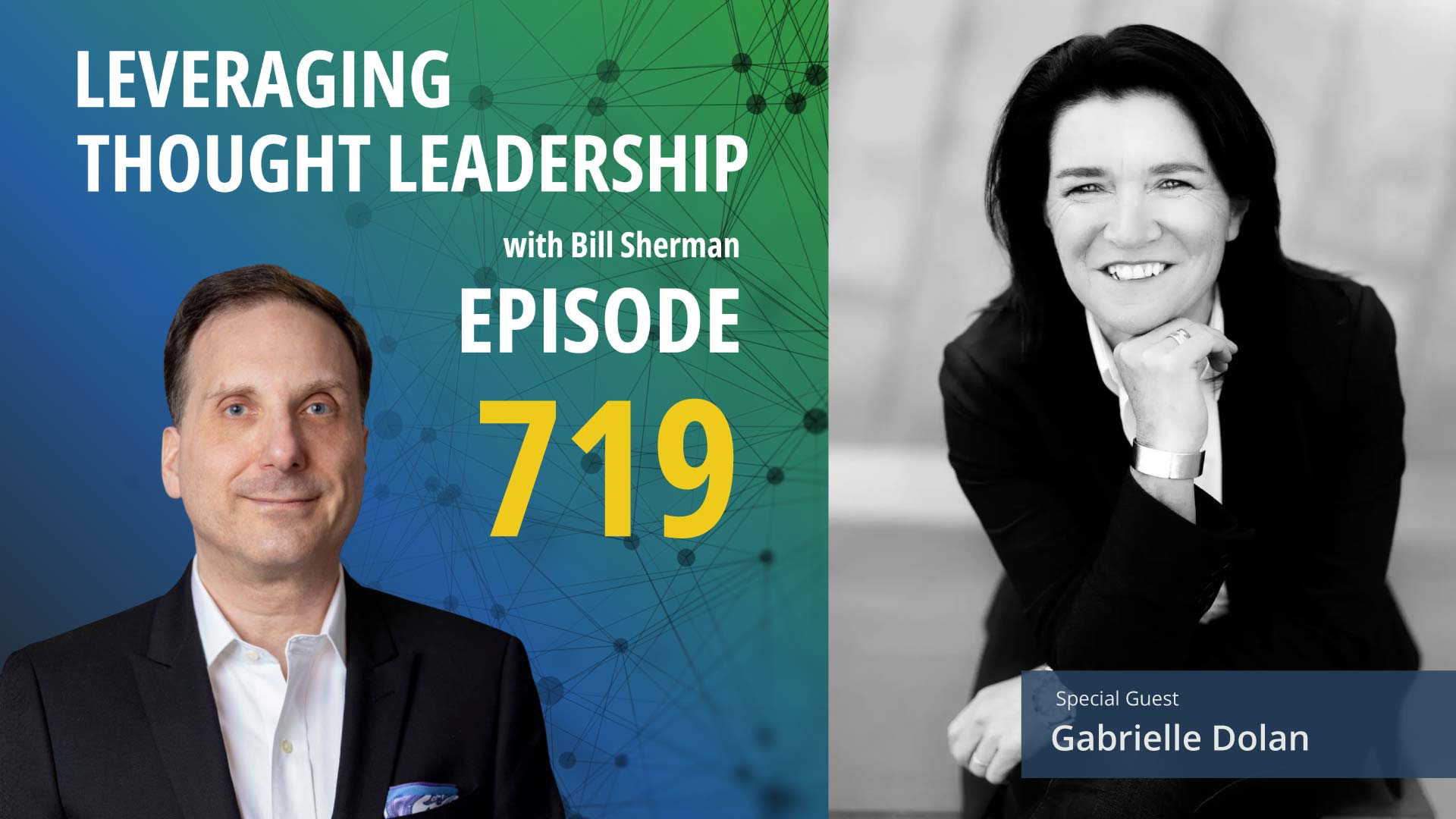



How Gabrielle Dolan built a 20-year thought leadership business around business storytelling
Gabrielle Dolan spent 20 years building a thought leadership business around an idea the market wasn’t ready for. In this episode, she and Bill Sherman explore what it takes to persist through a slow start, how original IP develops over time, and why authentic storytelling matters more — not less — in an age of AI-generated content.
What do you do when you’ve found a powerful idea — but the market thinks it’s silly?
Gabrielle Dolan (known to almost everyone as “Ral”) noticed something in the corridors of corporate Australia: the leaders who moved people, who made change land, who made ideas stick — they all told stories. The data nerds and slide-deck merchants were losing the room. The storytellers were winning it.
So she did something that seemed a little mad at the time: she left a senior role at National Australia Bank to teach business storytelling professionally. The reaction from the market? Something between skepticism and outright dismissal. Clients who hired her asked if they could quietly call it “influencing skills” instead — because saying “storytelling training” would guarantee no one showed up.
In this conversation, Bill Sherman draws out the full arc of Ral’s journey — and it’s one every thought leader building something new should hear. There were nearly nine months with no clients. A business partner she eventually parted ways with. Years of revenue that barely registered. And then a turning point she still can’t fully explain, when sales quintupled in a single year — triggered, in part, by her husband’s quiet confession that he was desperately unhappy in his corporate job. That gave her a reason to run faster than she thought she could.
The conversation gets particularly rich when they dig into what it actually means to develop original thought leadership. Ral is clear: you’re never starting from scratch. You’re always standing on someone else’s thinking. What makes ideas yours is where you push back, where you adapt, and how you deliver concepts in your own voice and with your own experience. She describes this with a perfect cooking metaphor — Jamie Oliver’s slow-roast lamb, tweaked until it becomes your signature dish.
And then there’s AI. When Ral started hearing workshop participants ask whether AI would replace storytelling, she was alarmed. Her latest book, Story Intelligence, is her answer to that question — and it’s more nuanced than a simple “no.” AI can help you find and refine your stories. What it cannot do is replace the authenticity that makes a story land. In a world where everything is starting to sound the same, your own voice is the one thing that cannot be replicated.
For anyone building a thought leadership platform around an idea that isn’t obvious yet — this episode is a masterclass in what it takes to stay the course.
Three Key Takeaways:
- Educating the market is part of the job. When Ral launched her storytelling practice in 2005, she spent nearly a year with no clients — not because the idea was wrong, but because the market didn’t believe it yet. If you’re building thought leadership around an idea ahead of its time, selling and educating are the same work.
- Your thought leadership starts with “yes, and” — not from scratch. Ral never claimed to have invented storytelling. She read everything, absorbed the best of it, and then pushed back where it didn’t fit the corporate world she knew. Original IP isn’t about starting from zero. It’s about finding where you genuinely disagree, and going deeper there.
- Authentic stories are your competitive edge in an AI world. When workshop participants started asking whether AI would replace storytelling, Ral was alarmed — and that alarm became her latest book. AI can help you refine a story. It cannot replace the trust that comes from a story only you could tell. In a world of AI-generated content that’s starting to sound identical, your voice is the one thing that can’t be replicated.
If this conversation sparked your thinking about storytelling as a leadership skill, check out our episode with David Hutchens — CEO of Mythos Global and author of Story Dash. David has spent his career building the practical tools that make business storytelling teachable and repeatable: his Taxonomy of Stories and Story Deck frameworks help leaders find and activate the stories they most need to be telling. Where Ral’s episode is about the conviction it takes to build a thought leadership platform around storytelling, David’s is the hands-on how.
Transcript
Bill Sherman What do you do when you see a leadership skill that everyone uses, but almost no one takes seriously. More than 20 years ago, Gabrielle Dolan, she goes by Ral among her friends, noticed the most effective leaders, presenters, and change-makers all had one thing in common. They told stories. The challenge was that few people believed storytelling belonged in business. In this episode, we explore how Ral built a thought leadership platform around an idea that many at the time dismissed and how her persistence, curiosity, and conviction helped her change the conversation. I’m Bill Sherman and you’re listening to Leveraging Thought Leadership. Let’s begin. Welcome to the show, Gabrielle, or as you like to be known,
Gabrielle Dolan Raoul? Yes, Raoul. Everyone calls me Ral except my husband and my mother when I’m in trouble.
Bill Sherman That second one everybody has the name that you cringe when you hear from your mother, right?
Gabrielle Dolan Yeah. Yeah. In fact, now it’s even my kids. I probably don’t get in trouble from my mother that much these days, but my kids, you know, if I do something, they’ll go, Gabrielle was like,
Bill Sherman So I want to begin with your origin story into thought leadership. You were working in corporate in Australia and you noticed there was a gap that nobody was really focusing on. What was it and what did you do?
Gabrielle Dolan Yeah. So, um, in, in a nutshell, the gap was storytelling training. So I worked in corporate Australia. I was in a senior leadership roles. My last, my last couple of roles, probably the last two or three years was in change management roles. So, you know, rolling out major digital transformation, although we didn’t call it digital transformation and we think you just called it technical change, but rolling out, you don’t massive change that would affect every employee. And, um… You know, so you’d have a change manager that would have to go out to the business units and talk about why we needed to change and what they needed to do. And as you would probably know, implementing change in organizations is hard. And what I started to notice is it, I sort of shared a story once. It was just sort of a personal story about why we needed it to change. And it wasn’t a silver bullet, but I sort of noticed that people tended to get the message better. They tended to not be as defensive. And then I started to notice all the really good leaders that I thought were really good leaders when I heard them speak were sharing stories. That the brilliant presenters, you’d think back and look at the brilliant presenters and they were sharing stories even when I did, you know, I did an MBA and I think back to the great lecturers I had, they were all sharing stories so I was starting to think that storytelling is a skill. And just like it, it’s, you know, it, uh, it an influencing skill. It’s a communication skill. It’s the leadership skill. And just any other skill that could be, you know, taught and learnt. And, but there was this thing going on in my mind. It was like story. When I spoke people about storytelling in business as a leadership skill, the reaction would be like, what the hell has storytelling got to do with business? Like why, you don’t, we’re, we numbers, we data, we blah, blah, blah.
Bill Sherman Or, oh, that belongs in marketing, rather than…
Gabrielle Dolan Yes. Yeah. Or they go, Ooh, once upon a time. Um, and I came across a book written by Stephen Denning and it was called the organizational guide to storytelling. And Stephen Dening, he was actually born in Australia, but he lived most of his life in the U S and he was a ex senior executive at the world bank, so an ex senior exec at the World Bank, and he had written this book on storytelling. And when I read it, it made complete sense to me that this was a leadership skill and a, you know, a communication skill and the fact.
Bill Sherman And if anyone was going to be a finance person, it was going somebody at the World Bank. Right.
Gabrielle Dolan Yeah, yeah. And the fact that a senior exec and ex senior exec at the world bank had written a book on storytelling, just gave it legitimacy to me. I just thought if, you know, if a senior exact is writing a book on this is there’s something in it. And I, you don’t in previous roles in, in corporate, I had been in, um, learning and development roles. So I had the skills and experience to design leadership programs and deliver leadership programs. And I had done that. So. I knew I had those skills and I just thought, I think I could be the one that teaches people storytelling. So that was, that was sort of, that was 21 years ago. I made that decision and, uh, have been doing it ever since. And, uh yeah, it was a bit of a, bit of a risk, but you know, here we are.
Bill Sherman So you talk about making that decision. Did you do some of that work internally within your company or was this, and I need to step out and make this my own thing and how did you make that decision?
Gabrielle Dolan Yeah. So I must admit, I had started to experiment a little bit with storytelling myself, just sort of testing it out and, you know, in my job. But I guess that the decision was, so I had this sort of idea brewing in the back of my head, but the decision, was almost forced upon me because the organization was going through a massive restructure and it, you know, and I, but I had applied for the job, so, I still hadn’t decided to Leave. And I applied for, it was like the head of the head of learning and development for the organization. And, and Bill, I was so sure I was going to get the job. And like so many other people told me, oh, you’re a shoo-in. Anyway, I didn’t get the job and I still, I still remember the meeting sitting across the table from the manager who was telling me who, who I was, you know, really respected and had known really well. And she just said to me, she said, well, I’m not going to offer you this job. And she, she explained why, which all made sense. And she said, what do you think you’re going to do? And I just said, I think it’s time to go. And I still remember her putting her hand over the table and like touching my hand and said, I think It’s time for you to go to that. You’ve always, you’ve always said you wanted to sort of do something on your own. Like take this as an opportunity to go So I remember walking out and I remember ringing my husband who worked, who literally worked across the road, but it was very unusual for us to talk to each other during work and he said, Oh, what’s happening? I go, I’ve just decided to leave, leave a national Australia bank. That’s where I worked. And he went, Oh okay. He goes, well, knowing you, you’ve probably thought about it for a while. And I’ll, you know, if that’s what you want to do, I’ll support you. And I’m thinking, haven’t thought about for that much, but It’s like. I guess I had thought about it, but this was the push. So I saw that as the push, I was working on a project. So I was in those change management roles and I, and I said to my manager, look, this I will leave, but I will stay on the project till it rolls. It was rolling down. So I stayed on for another three or four months and be like, kept waking up every day over those three or 4 months thinking there’s going to be one day I go, what the hell are you doing that day? So tell me about that day. No, it didn’t happen. That day never happened. It never happened of, you know, when I thought, what am I doing? What am I? Doing? It didn’t happened. And I guess, because I was still working and had three or four months to start preparing for this, um, it, didn’t, it didn’t feel like a, just the decision, I guess the decision. When I say the decision was forced upon me, I could have stayed and got another job, so I could’ve done that. And I just kept thinking, you. I’ll just give this a go. If it doesn’t, our children were two and five at the time. So even though we had made, you know, a big decision for me to leave and, you know, I, my husband was working and he was on good money, I was on more money. So we, we still made a decision to drop our income by about 60%. But we were, we were still okay. And I had, there was a retrenchment package there. So there was, a bit of financial security. And I just thought I will just give. And if the kids are two and five, and if it doesn’t work out, I will at least been at home with the kids for a while and I can always go back and get another job. So that was, that’s where I sort of started and it would be fair to say it was pretty slow for.
Bill Sherman So let me ask a few questions. You have an interest in storytelling. You say, okay, let me give it a go. What were you thinking? Were you thinking I’m going to do research? I’m gonna write a book. I’m to speak. I’m go to do workshops. What was that initial concept that you thought you were doing?
Gabrielle Dolan Yeah. So my initial concept was going to run training workshops. So that’s what I knew. So when, you know, when you talk about like thought leadership, it’s like what your ex, what is your expertise?
Bill Sherman Right. And how do you deliver your–
Gabrielle Dolan And then how do you deliver it? So I always knew I was going to deliver it in training workshops. And then, you know, so I was, I devoured then every book. So I devour Steve Denny’s book and Annette Simmons wrote a book. So there was other books coming out. I had, I sort of knew what worked and what didn’t incorporate how, you know good ways to teach it. So I sort have had this workshop, like sort of like, it’ll be a one day workshop and I’ll teach people storytelling and I will save the world. And how’d that go? Uh, well, it’s… Well, it actually went all right. The workshop, it took a while to get a client because remember this is going back 21 years ago when I would say, I’m teaching people storytelling and everyone would go, hang on, you left your senior job at national Australia bank to teach people storytelling, like are you mad? Like what, what is this about? This is, this is crazy. So I had to spend a lot of time. Educating the market that this was a legitimate skill. And in fact, some people- When you say a lot of time, how much? So my first, I remember I left in February of 2005. The first client was November that year and the first client. So that’s a, that’s almost a year of no sales. My first, it felt like it felt, like, Oh my God, this is maybe. This is not, this is not going well. I mean, I knew it would be slow, but I didn’t think it would be that slow. And also the first client was my previous manager from years ago. And he, I loved him as a manager and he’s, he had an executive coach and his coach had mentioned storytelling as a skill. So he, he brought me in and when, when I started the company, I started with another person as well. Those two of us. So he brought us in, but there was, so it was great. We had our first sale, but that was a bit of part of me, Bill going, maybe he’s just feeling sorry for me. And he’s like giving me, so even though it was a first sale and it was with a great, like a great organization, there was a part of my going, or maybe, maybe this is a one-off because he’s feeling sorry.
Bill Sherman Like it’s sale number two–
Gabrielle Dolan Will I get sale number two? And then, you know, I did get sale number two, but it was, it was still very gradual. I would have then afterwards, um, clients say, look, I know we really need to teach our leaders storytelling, but can we call it something else? Can we call that communication skills? Can we, call it influencing skills? I mean, this is, this is how sort of like almost dirty the word storytelling. Can we not use the S word? Yeah, not use to S word because they knew. If they said we’re doing storytelling training, no one would turn up. But if they said, we’re, doing influencing training, they would. And I said, yeah, you can. And I was happy with that because it is influence and skills and it is communication skills. They’re just going to learn to do that by storytelling. That, so that was 21 years ago. That was the environment we’re in, which is very different to now, but that was the environmental for a long time.
Bill Sherman Okay, so you’ve gotten your second client, you’re getting people asking, can you do things? Did it pick up, continue to pick up? Was there a moment of, did you get to that moment of okay, what am I doing? And when did that happen?
Gabrielle Dolan Yeah. So it gradually went along. So again, like I said, there was, there were two of us and we were gradually, sales were sort of coming in, but like nowhere, nowhere near what I expected. And I, maybe this is a foolish thing to do, but I kept reflecting on what I was earning in corporate Australia and what I was earning now. And it was nowhere near that. Now I know that’s only one measure that I had a lot of flexibility. And like I, I said I was, I was home with the kids. The kids were two and five. You know, I had a lot of time to drop them off to school and do all that stuff. So that, that was there. It happened that that probably went on for about seven or eight years. What happened? It was probably a year at the turning point was probably a year where me, me and my business partner initially had a five year plan. We would do this for five years. You know? I think we had great gram plans that we’d build up this training company and sell it, and that clearly was not happening. And That was our five year plan. And after about seven, seven years, it was, um, you know, our priorities, I guess, were slightly changing where, you know, I wanted to do some stuff. She wanted to do other stuff. And so we just decided, you know what, this is probably run its course and we’ll separate and I’ll keep doing storytelling. You keep doing storytelling, but I, I added other stuff like I added presentation training and even at one point thought leadership training and doing other stuff, so now I was out on my own. And My husband who fully supported me previously to leave my job was becoming increasingly unhappy working in corporate Australia. So he, he was just, um, and I remember he came home and said to me once, he goes, I just don’t want to do this anymore. And he said, I would, I will be more fulfilled and more happy. If I was a handyman, that’s what I want to. And I remember at the time going, uh, I’m not sure we can afford you to leave. Moment, because remember I was still earning like not a, not a lot of money. And I said to him, give me 12 months, just give me twelve months. And I think it was a combination because people often ask what happened then because in that next 12 months I, um, quadrupled my sales. In fact, it went five times. It went, like it went, I don’t know, like about 120,000 to 720,000 in. In, in one year and, and people have what happened. And part of me, I don’t even know, but I think what I could put it down to is with where my husband said he’s really unhappy. And I, I just thought, okay, I’ve got to take this really seriously now. And you know, I probably was taking it seriously before, but it was like ramped up, you know when you sort of go, it’s like when you’re running, when you run in and you think you’re run in the fastest you can. But if someone goes, go faster, you can actually go faster. I’ll see you. Thought you were running as fast as you can, but you weren’t. And then I think it was that plus that I was on my own and I was just doing stuff that was I wanted to do and felt, I dunno, just felt more aligned and things could move faster. And so there was that. And then it got to the point where I think, it was actually after about nine months, I said to him, you know what, we’re financially, we are super cool, if you want to leave, you can leave. And uh So, you know, it took a few months for him to work through a few things, but he left.
Bill Sherman And how did it feel knowing that you were basically now the breadwinner and, you know, through thought leadership?
Gabrielle Dolan Yeah. So it was one of those, a couple of things happened because, because my business had grown so much. I was now in a position where I needed like a, you know, an assistant, a executive assistant to help me. And so, um, one of the teachers that taught my kids, she, and I had sort of become to know her. And so I’m, you, we’d sort of became friendly and she, once she made a funny comment about, oh, if you ever need an assistant or, you know, maybe I could do it. And I was writing out the job description and I sort of just kept thinking, she actually would probably would be pretty good at this. So I offered her the job and that, you know, again, this took a few months for her to decide, but she actually decided to leave her teaching career and come and work for me, it was in the exact same week that Steve put in his resignation and I, Bill, I remember this day so clearly I went to the accountant, I had to meet him with the accountant for some reason, and it was the same week. And my accountant said to me, he went, and he probably said it as a very flippant comment, but he said, gee, you better make sure this works now. You’ve got two people response, like you’re, you’re responsible for two people. And I remember coming home thinking, I remember actually feeling physically sick. And I’m not, I’m, not exaggerating that. I actually felt like I was going to vomit because I thought. She’s left her teaching career to come work for me and yes, she could always go back, I guess, and my husband, I guess, could always go back and get another job. But he left and I was now, you know, people often talk about the primary breadwinner. Um, I’ve got a, I’m got a very strong appreciation for the heavy weight that can happen. And I just remember feeling physically sick and I, I was, I was doing a bit of one-on-one coaching at that time. And I remember I had a mentoring session. And I Instead of me mentoring this guy, I was just going, my mom was like going out of it. And I still remember him saying to me goes, Oh, and I, and because I was talking to her all the self doubt. What if this doesn’t work? What if people, what if people just suddenly stop buying this? What if, what, if, if I was going into a spiral of self doubt, which is very unlike me, very, very unlike me. Um, people would probably say that I’m the one of the most confident people they know, and still remember. Him saying. He said row. Please don’t tell me you have self doubt because if you have self doubt, we are all screwed. It was just like, and I think it was what I, I just needed. I just, what I needed. Um, and then I was fine, but it was, but I said I can still remember that physical feeling.
Bill Sherman I want to turn our question, Ralph, to you starting out in storytelling where you said, hey, I can absorb stuff. And you said I got this book and I got that book. And you were taking other people’s ideas and building a workshop around it. Yep. At what point during the journey did you start saying, oh, and my ideas go in here? When did you make that transition from synthesizing others? Yep. To really developing your own work?
Gabrielle Dolan Yeah, look, I think that happened from the start. And I think when I look at thought leadership, you always, like, you never starting from scratch. It’s not a storytelling precedes written writing. Exactly. Like, you know, I didn’t, I did not invent storytelling. Right. Um, I always liken it, uh, build to, um, you know, i, I love cooking and I’ve got some dishes that people refer to it as like on my, Raoul’s bloody, Raul, your slow roast lamb. It was like, well, it’s actually a Jamie Oliver slow roast lamb and I just tweeted and added a few, it, it it’s just like any good chef will tweak it. So. That’s what I think of thought leadership. So, so right from the start, even when I was designing day one and reading these books, I was going, yes, I agree with that, but I don’t think this will work in a corporate setting and I’m going to change it. So it was all the classic thought leadership, yes. And, or yes, but, I, I. Was doing that from the staff. I came across eventually we, we had some mentors and they suggested writing a book. So that’s when you have to sort of go deeper and go and what is this really about? But I remembered I was speaking to a client, I don’t know, this, this might have been about like six or seven years in, and I said something about, well, you know, I want to be known as a thought leader in this space. And he said, you already are the thought leader. And I still remember this conversation. I was like, why did you not tell me that before? You know, because people don’t tell you that, but it was, but so in answer to your question that happened from the start. And then gradually i think. You know, it just weaves over the 21 years that this is genuinely all my IP, but I would be saying that was even years ago. And of course, attribute fully attribute, uh, other stuff, but yeah, you know, now, now I’ve got to, I teach a framework of storytelling and people would know that, that that’s Gabriel Dolan’s framework. That’s, uh you know my IP. So I think if you, anyone stepping into the thought leadership space, you got it. You got to understand you’re standing, you know, on the shoulders of giants, but what the
Bill Sherman conversation has been, what it is currently, sort of get a sense of where it’s going and then figure out whether there’s something you disagree with or something you want to amplify or say, no one’s ever asked this question. And you find your own lane, I think, through that process of engaging with the past.
Gabrielle Dolan Yeah. Yeah. And, uh, you know, I, I say to people, it’s like, it your ex, no one’s had the exact same, your experience, you’ve got a different experience. You’ve got different stories. You’ll got a different take on thing. You’re got a, you’re a different way of expressing your thought leadership. So mine was, you know, and I know when I left, I knew storytelling was professional. I wanted it to be seen as professional because again, I was getting pushed back. I like, oh, once upon a time, like fairy tales. I was like, no, it It’s not about that. This is not fluffy. Yeah. Right. It’s, it’s professional. It’s a professional skill that, you know, good luck to you if you don’t want to learn it, right. But I also knew it was different. And so without knowing it, I wanted to adopt my brand to be like that. That storytelling was professional, but different. And so that was, you, I sort of took that on in the way I presented my thought leadership. Like, you. People tell me I’m really funny. The amount I do keynotes now as well. And the amount of time, so like this would happen probably every single keynote I do, I would have a handful of people come up and say, have you ever thought of being a standup comic cause you’re so funny and so I’m delivering it because I truly believe if you can entertain people and educate them at the same time, that’s better than educating them and boring them.
Bill Sherman So if you can be funny and engage and keep the momentum on the timing, which is its own challenge and skill, but it’s all about how do you connect with someone and bring them into an idea? Yeah. Humor is a good way to do it. If you, if you
Gabrielle Dolan Yeah, yeah. Well, I don’t think there’s a saying that the closest connection between two people is a laugh or something. So if you can get people laughing, they’re connecting with you. And then of course, storytelling is a brilliant way to connect with people. So I’ve got, I’ve, I feel like I’ve gotten the two happening in my keynote. So I’m telling stories, which people are loving and connecting with it. And I’m being funny, which they’re loving and connecting with and they’re walking away learning something.
Bill Sherman Ron Chernow, in his biography of Mark Twain, tells the story of Twain giving his first keynote speech or his first speech. He rents out a hall in San Francisco, hires a couple people to sit in the audience to be shills and laugh. And he thinks, okay, this will work because he’s got to pay off some debts. He comes out on stage, stands stock silent for about a minute and The hall is silent looking at him going, Oh, this is awkward. This is self-consciousness. He’s paralyzed, right? And then he said, well, this was my first time doing public speaking. And quite honestly, it’s probably going to be my last. I’m sorry. He then goes on to be one of the first, you know, true global keynoters around the world in the age of steamships, but he too had to find the way to break that connection and bring that humor to the audience. Yeah, yeah.
Gabrielle Dolan I did know that. And that’s a great example of starting a speech with both authenticity and humor. Like you probably genuinely felt that, but I’m sure the audience would have laughed. Exactly.
Bill Sherman He was ready to go, this was an experiment that won’t work. I got to come up with something else. So you’ve now written books, you’ve got your own frameworks. You do keynotes, both in person and virtual. What lights you up these days? What do you love doing about the thought leadership work?
Gabrielle Dolan And why? Yeah. Thank you, Bill. That is such a great question. I had a bit of a health scare last year, like about a year ago. It was, um, it was breast cancer. It was pre-cancer. So I, I feel like I got the, um. You know, when people have those, I got those life changing moments. I feel I had one of them, but without, without the fear of dying. Which is the best way to have one of those. Which is, the best to have, one of, but it was still, it was, I, you know, I’ve always had a very good. Strong work-life balance and, and, you know, if I don’t want to do stuff, I don’t do it. But this, this took it to a whole new level. And so I, um, you, know, and I, and I turned 60 next year. So what I’m excited about, it’s almost like I had 20 years in corporate. I had twenty years running storytelling, storytelling. Yeah, yeah, yeah. And I’m really excited about what the next 20 years will be. It is still, it will still be storytelling. I know that. So I, I love getting the opportunity. To do keynotes around the world. Like I, you know, I’ve been in quite, you know, recently been asked to speak at a conference in Milan and, um, do work in Morocco and like five years ago, I would have been going, oh, I think financially I would’ve been doing, it’s not really worth it. Um, and I’m away and now I’m going, yay, let’s go for it. Great opportunities. I’m very excited about the latest book I’ve written because I feel like. I genuinely feel this would probably be the last storytelling book I write, but I did, I did think about that the last book I said that as well, but I feel like this is the 20 years of my thought leadership career. So this is the capstone. This is the, yeah. And, and I just want, I just want as many people to understand the power of storytelling and learn how to do it. And so I’m excited about talking about storytelling and story intelligence and bookin’. By people like this, by you giving me the opportunities. And what I’m also excited about as well is, um, I have my own podcast and it’s called keeping it real with Jack and Raoul and, you know, I’m the Raoul, obviously. And we have so much fun doing that. And you know it’s once a week, it’s all around career advice and you know, insights and tips around leadership or just career development. And I love doing that and I, I, what I, in fact, just this week, I was speaking with Jack, my cohost, and we were talking about, did we discuss our goals? And it goes, my goals were to have fun. To once you, once you’ve decided it’s almost to expand your thought leadership. So like, if you’re coming up with a new podcast episode every week, you’ve got to do it. So like that’s exciting, expanding my thought leadership and I said, yeah, the other one is this is a legacy you’re leaving. And whether it’s, whether it is a business thing, but you know, our great, great, great grandkids who are never going to meet us, they can at least listen to us and go, Hey, great, great, Great grandma was pretty cool and funny. And so that what lights me up.
Bill Sherman So there’s a thread of storytelling there, even in terms of telling stories to people that you may never meet directly, whether those are the people that you train and they go on or they learn something from a book and they go on to tell stories. It’s making an impact your stories generationally even through the podcast audio is you said if you’re grandkids.
Gabrielle Dolan Yeah. Yeah. I mean, you know, and that’s what the, again, the power of storytelling. It can, it can go from generation to generation to generation, whether it’s just in an organization as such, or whether it’s in, you, know, a whole culture.
Bill Sherman So you’ve studied storytelling now and practice storytelling as a thought leadership area for 20 years. How has your perspective on storytelling changed over that time? And why does it matter? What, what is it that lights you up? Because to talk about anything for 20 years takes exceptional passion about the subject.
Gabrielle Dolan Yes, it’s, it does. So I think my thoughts on storytelling haven’t changed. I still believe it’s one of the most powerful leadership communication, parenting skills you could have, like whenever you’re trying to influence and communicate. What happened about two years ago that I guess re-sparked my passion is that I would be running workshops and I’d have more and more people say to me, will AI replace storytelling? And Bill, seriously, the fact that people were even asking me this question horrified me. It was like. Why, why would you think that AI would replace your storytelling and that, you know, where you can just get AI to write a story and, and. So I was seriously horrified and, and I just thought in a world of distrust. So we are, we are in such a world. Of distrust, like there’s, we don’t trust governments. We do, we see things online. Is it like, you know, AI has ruined, ruined the pet videos, the animal videos that used to go, Oh my God, that’s so cute and amazing. Now you go, is that AI? And so they’ve just destroyed it. It’s just destroyed that. And in a world of AI-generated content, It’s, I truly believe that our authentic stories are needed now more than ever. And so that that’s my passion. It was like the other question I got, Bill was, can you use AI to help with your storytelling? And initially my reaction was like, no, that’s cheating. It’s it won’t be real. It won’t authentic. But I, as my publisher actually said, well, you know, if you’re the, if you’re, the expert in this, you probably need to, you know, start looking into it. And I did look into it and I, my, my mind changed on that. That you can use AI to help with your stories, help find them, help refine them. And I talk about that in the book, but you don’t want to lose your voice. And more and more now I’m seeing the biggest danger with AI is that people are losing their voice and what they’re doing is they’re putting stuff out there and it’s AI generated. They, you know, they might tweak one or two words, but it’s still sounding like AI and then it’s all sounding the same and And that to me is a real danger that they’re putting, we’re putting efficiency ahead of effectiveness and, and yes, AI can be helped, help you. And I think thought leaders can really fall into this trap where it’s really good to generate content, but is it your own, does it sound like you in the first place and is it you, is it, can you explain that because you’ve got to take responsibility and accountability for every single thing. That comes out of your mouth or keyboard. And if it’s a bit of AI stuff in there that you go, Oh, that’s not really me or I can’t explain.
Bill Sherman You said there were seven points last time. Now you’re saying there are four and it’s a two by two matrix. What are you talking about? I don’t know. That was what came out of AI today.
Gabrielle Dolan Yeah, exactly. Yeah, yeah. Exactly. Oh, I thought you were asking me that question. I’m going, I can’t remember that. No, no, no. But I’m saying in general, you got to be account. I was over Easter. It was Saturday night. We were sitting there and Anchorman was on, you know, the old Anchorman movie and there was, you know, this scene where the, um, San Diego stay classy and, and Veronica Corningstone, she’s told he will read anything on the teleprompter. And so she puts on, go F yourself, San Diego, and he just says it. And then his whole career is destroyed. And I thought, oh my God, that, that reminded me of the mind.
Bill Sherman Of him just going into.
Gabrielle Dolan A classic, but that reminds me of heat, like AI. If we just put stuff out there and it’s AI and we, it was still reflect badly on you if it comes out of your mouth. So yeah, we don’t, we, don’t want to sign off with go F yourself, San Diego.
Bill Sherman And I think to your point on storytelling, it’s one of the longest running legacies that we as humans have. I mean, go back to the epoch of Gilgamesh, 5,000 years ago, if I’m remembering right. And those stories still echo down. Yeah, the question is, will an AI story echo any more than three minutes?
Gabrielle Dolan No, probably not because it’s missing something. And I ran a test in the book to test my stories against AI, but yeah, yeah. I even, I always reference our, you know, I’m from Australia, our first nations people, we’ve got the oldest culture in the world going back 60, latest is 65,000 years and their dream time stories, the messages have stayed through those stories and they’re talking about stories that have been passed down for tens of thousands of years. And the messages remain the same, but yeah, that’s AI stories will not replicate that. No, I sort of feel, you know, Bill, I feel like, you know, you and I are both old enough to remember when PowerPoint came in. Remember PowerPoint came and we got so excited with this new technology and thinking, Oh my God, all the, you can, you know, move the things and sound effects. 1990S visual websites. Bing bang clip art. And so we got sort of sucked in. That this is going to make our presentations better because of the technology. And of course it didn’t, you know, the death by PowerPoint came about about. And I think this, I think we’re in a similar spot where we’re thinking AI amazing technology, which it is, is going make everything better and make our stories sound better and our content be better. And it’s not, if you hand over control to it, it’s.
Bill Sherman I think that’s true not only in business. What is the story of the business? What’s the story the leader? What’s story of customer? What’s a story of a person who’s interacting with the customer? And it’s. Absolutely true. And thought leadership. Yeah. What is your story? Yeah. What’s the story of the idea that you are carrying for a period of time? Like you said, Hey, I started this 20 years ago. I know there’s a time that I will set my thought leadership of storytelling aside. Yep. Story will continue. It’s how we carry the ideas that matters. Yeah, yeah, definitely.
Gabrielle Dolan Definitely. We’re on the same page.
Bill Sherman I wanna thank you for a great conversation. Thank you for joining us today.
Gabrielle Dolan Thanks Bill and I really appreciate the opportunity and loved your question.
Bill Sherman Okay, you’ve made it to the end of the episode, and that means you’re probably someone deeply interested in thought leadership. Want to learn even more? Here are three recommendations. First, check out the back catalog of our podcast episodes. There are a lot of great conversations with people at the top of their game in thought leadership, as well as just starting out. Second, subscribe to our newsletter that talks about the business of thought leadership, and finally, feel free to reach out to me. My day job is helping people with big insights take them to scale through the practice of thought leadership. Maybe you’re looking for strategy or maybe you wanna polish up your ideas or even create new products and offerings. I’d love to chat with you. Thanks for listening.
