
The Opus Way: Fueling Ambition Without Burnout | Janine Mathó | 718
The Leveraging Thought Leadership podcast is created by Peter Winick and Bill Sherman and produced by Thought Leadership Leverage.
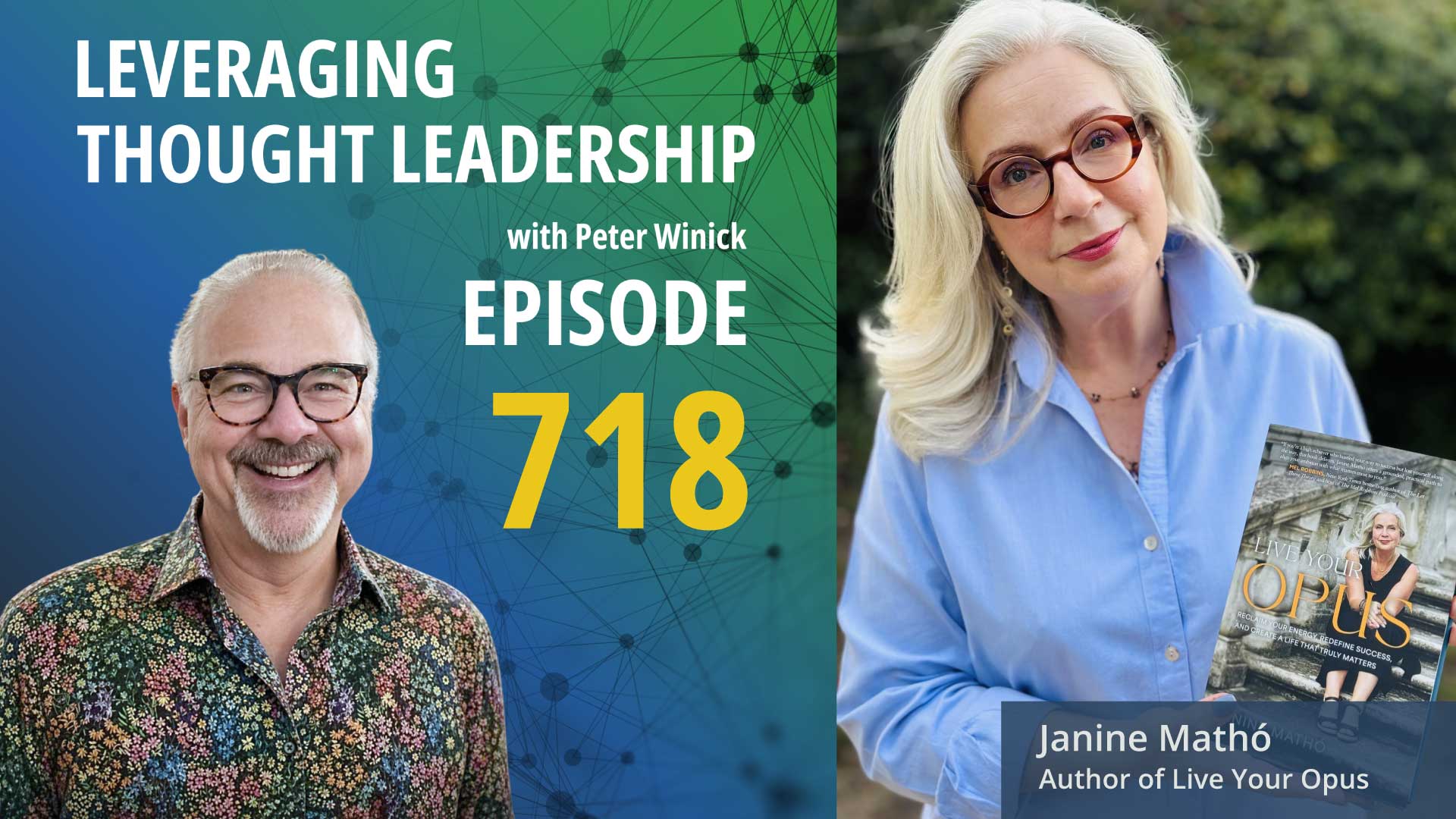



How the Opus Way Helps Leaders Perform Under Pressure Without Burning Out
Ambition does not have to come at the cost of energy, health, or meaning. This episode explores sustainable high performance, the role of energy in leadership, and how frameworks for change, pressure, and burnout can help individuals and organizations build capacity without lowering their goals.
What if ambition is not the problem—but the way we fuel it is?
In this episode of Leveraging Thought Leadership, Peter Winick speaks with Janine Mathó, author of “Live Your Opus”, about the Opus Way: a framework designed to help high achievers build healthy, meaningful careers without lowering their ambition.
Janine challenges the old tradeoff between success and sustainability. Her message is clear. You do not need less ambition. You need the energy, systems, and self-awareness to support it.
Her work helps leaders understand how they operate under pressure. It gives them practical language for stress, change, burnout, and performance. It also helps teams see where energy is being spent, where it is being drained, and how leadership behavior shapes culture.
Janine also shares how her tools are evolving from individual development into organizational capability. Her diagnostics, change continuum, and Opus 8 energy framework help leaders identify what is happening beneath the surface. Why decisions stall. Why teams struggle. Why people overextend. And why performance cannot scale when energy is ignored.
Peter and Janine explore what it takes to turn thought leadership into a business model. The book serves the individual. The advisory work targets the top of the house. The bigger opportunity is helping organizations build internal capacity, embed the frameworks, and eventually use the work without Janine in every room.
This conversation is about more than well-being. It is about leadership strategy. It is about sustainable ambition. And it is about creating tools that help people perform under pressure without losing themselves in the process.
Three Key Takeaways:
- Ambition needs energy to sustain it. The episode reframes burnout not as a reason to lower goals, but as a signal that energy, pressure, and performance need to be managed differently.
- Leaders need shared language for change and stress. Frameworks like the change continuum and energy archetypes help teams talk clearly about pressure, resistance, overextension, and how people respond differently to change.
- Well-being is not separate from leadership strategy. Sustainable performance requires systems, tools, and leadership behaviors that build capacity across the organization—not just individual self-care.
Transcript
Peter Winick And welcome, welcome, welcome. This is Peter Winick. I’m the founder and CEO at Thought Leadership Leverage, and you’re joining us on the podcast today, which is Leveraging Thought Leadership. Today, my guest is Janine Matho. She is the author of Live Your Opus, and we’ll talk about the Opus way, which is a framework. She has held interesting leadership roles at Harvard, Pearson, and the C-suite, twice. And she’s raised three children, which I don’t know which is more difficult. Anyway, well, and you know, I’ve got to say she’s. Talking to me today from the south of France. So, cue the music there. So anyway, welcome, Janine. How are you?
Janine Mathó Thank you, Peter, and it’s a beautiful day here. Really beautiful spring day.
Peter Winick So how did all this happen right like how did what was the path that led you to? Where we are today.
Janine Mathó The path that led me to where we are today started at least six years ago when I had been working, I was actually VP for thought leadership and corporate affairs at Pearson. And we’d gone through reorg after reorg, I had some changes in the C-suite, things were getting more intense than usual. And actually, I think I didn’t have language, but I would say I was already at the beginning stages of burnout. And I didn’t have the language for that. I just thought, well, this is like ongoing stress more than usual, a lot less sleep, even more than usually, too much work, even more than the usual. But I thought, Well, it’ll pass, right? Just kind of work comes with the job. And I did realize how intense it was. And then I would say a few weeks after I’d kind of come to that realization, my mom was killed in a car crash. And within a month, those things kind of really collided. And it was January 6, 2020, and I. Couldn’t get out of bed for the first time in my life, couldn’t work, couldn’t function, hadn’t slept in about nine weeks, wasn’t really eating, and was put on time off from work, mental health leave from work. And I think, you know, I was one of those classic high achievers, overachievers, who just kept climbing. And I thought that I was invincible. You know, I just thought it’s the next job, its next promotion, it’s this next move. And I never really thought that I would be someone who would if you come to something like burnout or have any mental health challenges. And so for me, that process of being, stepping out of work raised a lot of questions. Like, who am I without my affiliation? Who am I?
Peter Winick Stay there a minute, because…yeah, because I think we’re all subject to that, right? So one is everyone around us is doing the same crazy stuff, you know, get up at all hours of the night working, late at night work, like, so it’s normal, right, and it’s actually kind of the, what got you here thing, right. You didn’t get here by being lazy, sitting around, you know sipping tea in the middle of the day and all that sort of stuff. But at some point it’s like, wait, there’s a line between I’m achieving and I’m, you know deteriorating, right Yeah. You know, and, and even though I might be putting the points on the board, the, the part of the balance sheet where we don’t show the cost is on the personal side, health stress, wellness, et cetera. So, so how did that lead to, or bridge that to the Opus way? Cause now like, you know, fast forward through COVID the last six years, whatever, they’re awful. Okay. And, and all the free stuff, the book would have been possible about that.
Janine Mathó Yeah, no, the book would not have been possible without going through that and everything that came after it. And the Opus way is sort of, I guess, an answer to a question that stuck with me during burnout recovery, which was how can ambitious people create healthy, meaningful lives with and careers, obviously without losing themselves or what matters most. And there is a line between, as you said, kind of overwork and deterioration. I just didn’t know what it was. And so for me, the book is my attempt to answer. That question, it’s an attempt to help people to reclaim their energy, help people see actually how much agency you actually have within the context of stress. And actually, frankly, we all just weren’t prepared for this, right? Like, most of us didn’t think we’d be ending up working under such intense pressure in corporate jobs when we were in, say, fifth grade.
Peter Winick Yeah. And it’s not slowing down. So it used to be it was like one from column A or one from column B, incredibly successful or healthy, meaningful life. And you’re saying no, it’s one from A and one from B, right? And agency is an interesting word because, you know, a lot of us say, well, the only way to achieve agency is go out on your own, do your thing, whatever. So that’s an interesting piece. Give me a sense of, I’d say the business side of But who is this written for and what are you hoping? Changes either at the individual level, the team level, the org level as a result of embracing that idea.
Janine Mathó So this book is written more for individuals, although it can be used with teams. And it’s written for people who are feeling depleted. It’s written from people who were at a pivot point, maybe some inflection point, maybe they’re just saying, when am I gonna start feeling as successful as I’m supposed to look, like as I look, right? Or maybe people think I am, you know, is this it? Is this is what I’ve been working this hard, is this is it? So that’s kind of who it’s for. And I think the big change I want people to see is that Energy needs to rise to the level of your ambition. You don’t need to drop your ambition, there’s a lot of talk about like, oh did you take care of yourself so you have to slow down, you have pause, you have pull back. I mean sometimes, right, but I’m not advocating and I think for people like how I was and how I am, super high achieving, that doesn’t work. So I’m saying lower your ambition I’m say you need to power that. So how are you gonna power that? And the book is an attempt to help people do that. It takes people through a 12-week journey, so you can take it from different directions. But that’s the gist of it. That’s the big change I want to see.
Peter Winick So let’s go to business models for a bit. Seems like a bit of a shift, but that’s kind of what we do sometimes. Okay. So who’s exactly paying for what here? What are the underlying business models in this next chapter for you, if you will?
Janine Mathó Uh, for the, for me, yeah, question. So I have been working with senior leaders and sometimes with teams or small groups to help them operate better under pressure and with significant change. So I’ll still do some of that, but I’m actually more interested in the bigger question, which is, when are we gonna start changing how we prepare people so that when they are in these situations, they know how to be different, right? So they know to handle pressure. So they’re taught. I mean, there’s just so many things that we’re not taught, if you will, in school that we need in leadership. And so I’m interested in working with a very small number of organizations who are really ready to take their team’s energy to the next level. So it has to be organizations that have ambition.
Peter Winick So that work, so let me push on that. I could see that playing out in a couple of ways. One is sort of at the top of the house and an advisory consulting level. Let’s create the systems and processes and such so that people here can adhere to this, right? And then the other end of that continuum is doing team or group workshops or coaching. Is it the first or what’s the first?
Janine Mathó I’m more interested in top of house and or something more like and I’m calling it embedded retainers So something a bit more like working really closely with the leadership team that wants to also influence the full culture across the org So yes workshops and coaching would be part of that, of course They’re part of anything, but my idea is actually more to build the capacity internally So that I work myself out of a job.
Peter Winick Right, right. No, so I, we just came full circle from the standpoint of when I, when I asked you who’s it for, you’re like, yeah, the individual, no doubt. Like you, you’ve got a book. Yes. Right. So the book is for the individual. But then you’ve Got this suite of services, similar IP, same IP, same methodologies and such as in the book. But I want to go bang right at the top of the house and say, okay, here’s, here’s the things. And I would imagine it’s sort of a classic, let’s take a look at what you’re already doing. Oh, this is wrong. This is good. This is better. Let’s install this stuff. Let’s develop the capabilities. Rinse, lather, repeat, get the heck out of there, right?
Janine Mathó Absolutely. Yeah, I’m one of those people who actually really likes to help people build capabilities and and work myself out of a job even in coaching I think I think there’s too many of us who sort of stick around for too long. And I think the idea is to build the change and build the capacity.
Peter Winick Yeah. So the building of the capacity piece, there’s lots of ways that that could happen, right? It could be certification, it could be licensing, it could be training. So like, how do you if I said to you, okay, great, sign me up, I’ve got an organization with 20,000 people. And how do I build build the capacity across 20,000 people.
Janine Mathó Yeah, I think I would start at the top and yes, we can do train the trainer. Yes, we do sort of, yes, we can all the things you said, but I mean, I think it’s starting at the talk and figuring out what’s happening. And I also have some really interesting diagnostic tools that I’d love to use with senior leaders that help pull out and pinpoint what’s really happening underneath the surface. So why things might be looking the way they look, why decisions are taking too long, why people are showing up the way that showing up, why teams aren’t getting along.
Peter Winick So stay there for a minute to tell me a bit about the tools, how they came to be, and how you take them into the marketplace. Sure. I’m a tool nerd amongst them.
Janine Mathó Yeah, and I’m at the beginning of this journey. So I have I have tools I have a lot of tools that I’ve shared in the book, right? Okay, but when I turn those towards Organizations, it’s a little different So I do have sort of diagnostics of what I call some executive leadership diagnostic tools that really take a look at How people are expending their energy and nurturing their energy? And taking a look, at how is that supporting their leadership or not, right so first on individual But once you do that, so for example, I’ve done that in a context where I did it over like 100 people, then you’re getting a picture of the culture. Then you’re a bigger picture when you’re looking across all of the leadership, for example. So that’s one of the tools I have. I’ve got, in the book I have a set of energy principles. We do use, I bring those into my work. But it isn’t sort of like, here, take this and go use this in this order. In the book it is for individuals. When I’m in an organizational context, it’s different.
Peter Winick Different because every organization is different and where they need to start and then so it’s almost like a triad, right? Like you go…
Janine Mathó Yeah, and I think I mean, you asked me from a business point of view, and I think that’s one of the things that I’m interested in proving is how can I take the tools I have in the more complicated organizations and then set them up so actually they could be more easily than adopted by another organization without me. Right? So I know how that works on the individual level. I have a sense of how it works on an organizational level, but that’s still where I want to go and prove.
Peter Winick Yeah. And I love that because I’m just making some no tears. We’re talking. I love that because if you’re the only way you can get your ideas embedded in an organization requires you to be in the rumor in the zoom. Congrats, you have a practice. You don’t have a right. Exactly. And there’s nothing wrong with the practice. Doctors do a lawyers do whatever. But it’s limiting because if we’re talking to me right now, then you can’t be helping somebody else. But right now as we’re talking, these tools can be deployed. I want to ask you of them. Well, let me frame it this way. On the one hand, I would say there’s probably a self-selection piece to this, right? The organizations, the companies, the people that lean in are probably going, yeah, this makes sense, I feel this, I sense this. I might not have the vocabulary or the data to back it up, but something smells funky here, right. So there is a self selection piece. But I think the other side of this, because you have the tools, is if the green visored CFO comes in, everybody’s worst nightmare, right, and says, show me the money. What’s the who cares if they’re burning out, who cares if they are miserable and going mom, the dog, show me the ROI. How would you respond other than you’re a jerk?
Janine Mathó Do you have ambition for this company? Do you, how long is that ambition? And if so, let’s juice up the people, right? Let’s power them up so that they can hit that ambition so that can be with you in a sustainable way. Let’s so they’re with you for the long view, right. Not just for this moment, this now. So, it doesn’t mean that teams…
Peter Winick So there’s something counterintuitive there. One is the retention piece makes sense, but the ambition, because I would assume, and obviously wrongfully so, that it’s about cutting back a little bit, but you’re saying, no, let’s not throttle them. Let’s have them be as ambitious as they can be, which will be more performant, right? Will increase performance better?
Janine Mathó I think there may be and there probably are organizations in which we there would need to be cutting back, right? There are but I would say if you’re talking about the use of self-selection So in the quote-unquote right kind of organization where they have the priorities fairly clear where they understand that The environment there the folks are working in then then yeah.
Peter Winick Got it. Got it. And if it’s not self-selection, and this is something I find, sometimes those that could use it the most of the least to come to you, right? But how are you, we don’t wanna spend a lot of time and energy converting people, you know, that this is, like, you spend some, and you’ve read your case, and they either get it or they don’t, right, is that kinda where your head’s at?
Janine Mathó Yes. I think if folks think that wellbeing is quote unquote wellbeing and it sits over there on a shelf, then that’s, that’s probably not an organization that I’m going to work with because I’m talking about so much more than wellbeing, right? I’m taking about how are you actually going to power people’s energy? How are you going to actually have leaders who know how to steady themselves and others over and over and over repeatedly under pressure, right. And so it’s more than well being. It’s more and well-being its leadership strategies. And so if the organizations are saying, oh, it’s wellbeing that sits over there, yeah, then you’re not for me.
Peter Winick So that leadership strategy framing is interesting because we know everything we’ve learned in management leadership is that you have to model it, right? If I’m a leader and we’re teaching people how to be candid or resilient or give feedback, and I don’t do any of those things, I could put my people, there are as many programs as I want, but when they watch and say, what gets rewarded here, how do the high performers behave? How do the leaders behave? That’s actually what they’re going to replicate. So if you don’t sort of develop those capabilities in the leaders to say, oh. So-and-so is able to do this, so-and so actually behaves like that. And then I want to go to some of the language and the models because.
Janine Mathó Let me just, let me say one thing real quick. I think for me, the place I come from is I’ve been working with individuals more than organizations. And you can work with individuals who are very, very senior or in the C-suite, but alone, they cannot change everything.
Peter Winick Right?
Janine Mathó Yes.
Peter Winick Well, then that’s really therapy, right? Like, oh, right. Like which, you know.
Janine Mathó You know, it’s great that they sort of seem that they have more tools and more frameworks that they can use with themselves. Some of them take that into their teams, some of their teams I work with, but that still leaves them in the context of the wider organization. If the wider organizations is struggling, the team is still going to struggle. They’re not going to have the tools.
Peter Winick Right, so that’s agency with an asterisk, right? As an individual. Yeah, absolutely. So let’s talk about the models and the framework. I think oftentimes the power of great thought leadership inside of an organization is you’re giving people models and language and such. Because I think the way you describe this, a lot of people say, yeah, I get that. I get, that I get. But then if we want to embrace that in an organization, talk about how the models, and the language, and all that to help scale it.
Janine Mathó Yeah, I have a couple of different models. So one of the models is looking at, it’s the change continuum. So obviously lots of organizations are bringing change in, change is constant. So this is a fairly, what I consider to be fairly basic, just so we’re super clear, my MO is always to use all of the sort of academic research and then tailor it down so that a 15 year old can understand it. So you will never hear me talking about academic research in an academic. Way. I have worked at Harvard. I’ve done that chapter of my life. I don’t find that that’s very useful in this context. So I have what I consider to be a very easy to use change continuum. It helps people identify where they’re at. How are they feeling about change right now? How are the feeling about the change in the context of maybe one particular initiative at work versus another, something going on at home, something else in their life.
Peter Winick Let me pause you there for a minute. So now we’ve got this change continuum, and now let’s say I’m in a team, let’s just start at a small unit, and we’ve all been exposed to that. Now I can have a conversation with a colleague or my boss or whatever and say, hey, you know what, here’s where I’m feeling it on the change continuum. And just the power of saying, look, I’m over here, we all know what these words are and we’d been taught this, whatever. Then the leader can say, oh, I get it. Okay, so that’s not a great place to be. Right, and you want to get to this part, let’s talk about how we get you there versus exactly you don’t have that the even just the framing of that conversation. It could be awkward, could be difficult, could cause more anxiety than saying
Janine Mathó Exactly, and it’s paired so the change continues paired with something else, which is around energy So it’s an energy framework called opus eight So it sort of says if you’re this archetype and you’re feeling this way Like if you were if you are a catalyst and you are energized and you love moving fast and you loved change Here are the things you need to look out look out for right and burnout is one of those things, right? How do you overextend yourself? So maybe you’re a catalyst. Maybe somebody else is a hesitator Like the catalyst has brought in the change initiative and you’ve got three hesitators on your team. Okay, well, how do you gonna bring them to where you need them to be, right? What can we value in them, first of all, because there’s value in being hesitator sometimes. And then what do you need to do to help move them? Maybe you need move in a little or they need to move up a little. So how do we help move people? And it’s not a static continuum and the energy piece is not static either, but it’s more to give you a sense of how you deal with it.
Peter Winick Yeah. And I think that’s really cool because it gives the leaders and the managers, because if I’m a hesitator, whatever, right, I’m going to think everybody’s like me because why wouldn’t they be? That’s the greatest thing to be. Right. But then I realized like there’s other people that operate differently and I said, Oh, okay. You know, Janine’s more like this one is more like the, okay, get it. There’s a, there’s a way that people operate. That’s different to me. So if we were to schedule a time to talk a year from that. Okay. And the book’s been out a while and you’re doing more organization work, whatever. What would be different and what would be outcomes that you’re hoping for?
Janine Mathó For myself, from a business point of view, or all? Any way you want to take that. I mean, I’m hoping to find the right set of one or two partners in the next year that will take this work deeper so that I can validate the frameworks more thoroughly in the organizational context. So I know they work.
Peter Winick So you want to stay in the thought leadership space and find strategic, let me paraphrase strategic partnerships.
Janine Mathó Strategic levers. Yeah. Strategic partnerships. And so I understand what are the levers that really work.
Peter Winick Yep. Love it.
Janine Mathó And how can we then replicate that more broadly and also you know I talk about you know I’m thinking rethinking how people are how we’re developing people writ large so I’m also doing some partnerships with k-12 I’m doing an advisory in higher ed because I’m really interested in how we treat train the net for leaders of the next generation both in leadership development more formally but also further back down the pipeline
Peter Winick Fantastic. Well, this has been great. I hope to have that conversation in a year and you’ve hit that and surpassed it. Good stuff. Thank you for your time today.
Janine Mathó Thanks for your time.
Peter Winick To learn more about Thought Leadership Leverage, please visit our website at thoughtleadershipleverage.com. To reach me directly, feel free to email me at peter at thoughtleadershipleverage.com, and please subscribe to Leveraging Thought Leadership on iTunes or your favorite podcast app to get your weekly episode automatically.
