
How to Find Agency in Times of Instability | Suzan Song | 717
The Leveraging Thought Leadership podcast is created by Peter Winick and Bill Sherman and produced by Thought Leadership Leverage.
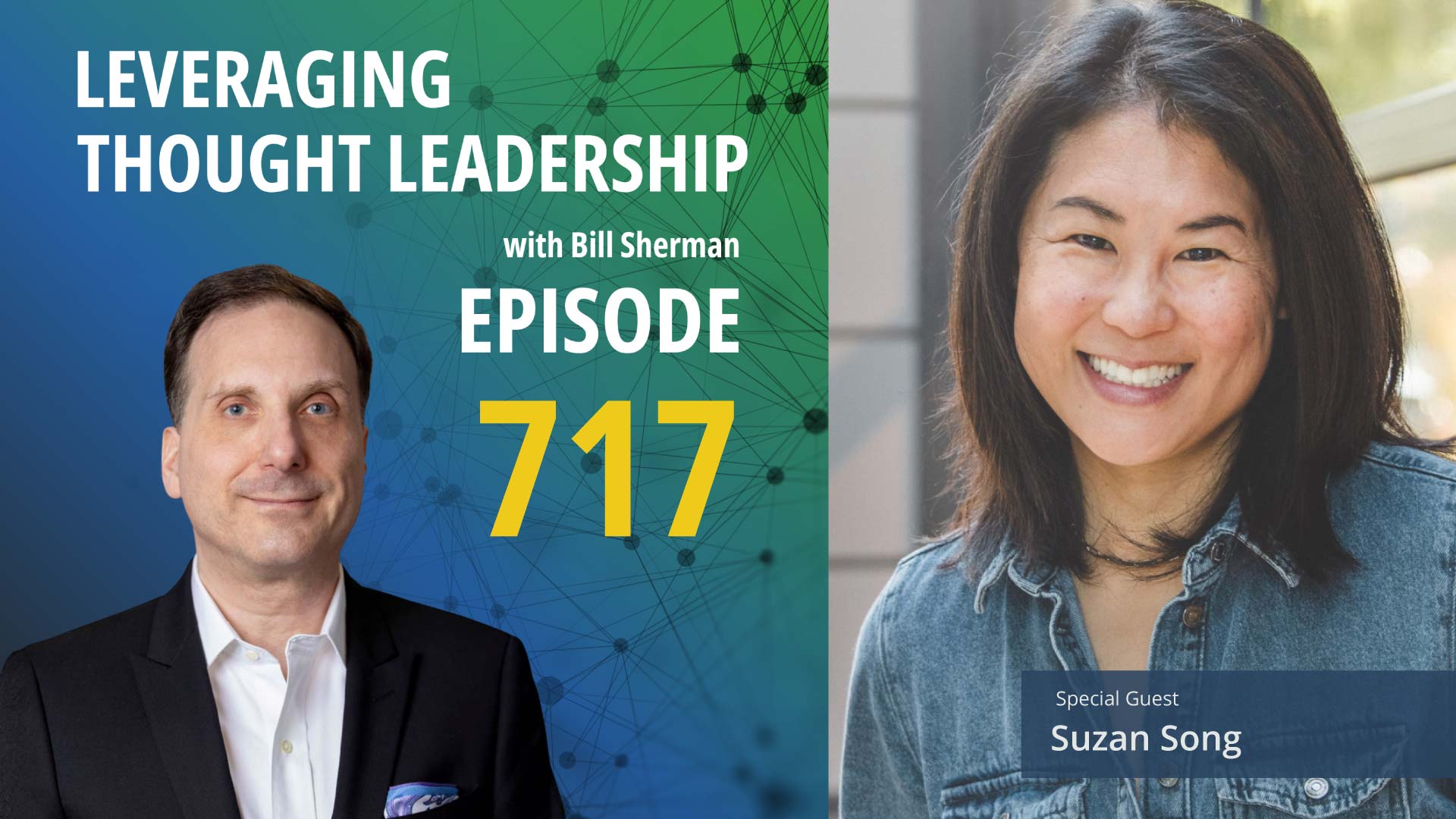



A conversation on suffering, resilience, leadership, and the search for groundedness during hard times.
How do we navigate suffering, instability, and uncertainty without losing ourselves? This episode explores resilience, agency, healing,
human connection, and the practices that help people find meaning and move forward through life’s hardest challenges.
What if suffering is not a detour from life, but one of the places where meaning begins?
In this episode of Leveraging Thought Leadership, Bill Sherman speaks with Dr. Suzan Song, MD, PhD, about instability, agency, and the human search for groundedness when life breaks open. Her work spans clinical care, global systems, conflict zones, and executive leadership. Her core question is simple and urgent: how do people move through suffering without losing themselves?
Dr. Song shares the deeply personal origin of her work. After losing her father to violence as a teenager, she pushed forward through achievement, education, and service. Years later, while working with former child soldiers in Burundi, she found herself in danger and saw the connection between her past and her work. That moment helped her understand the deeper spark behind her mission.
Her book, Why We Suffer, grew out of that mission. It is not a promise that life can be made painless. It is a practical look at how people can navigate hardship through narrative, ritual, purpose, connection, and agency. Dr. Song challenges the idea that healing is only individual. Across cultures, she has seen that people heal in relationship.
The conversation also explores how instability shows up in leadership. CEOs, executive directors, governments, and communities are all facing rapid change. Funding shifts. Policy changes. War. Burnout. Cognitive fatigue. Dr. Song argues that the antidote to despair is not happiness. It is agency.
Bill and Dr. Song discuss how thought leadership can be rooted in service, not ego. For Dr. Song, the work is not about claiming a label. It is about making ideas useful. It is about helping people, organizations, and systems respond to suffering with clarity, humility, and care.
This episode is a powerful conversation for leaders, authors, speakers, consultants, and anyone trying to turn hard-earned experience into work that helps others. It asks us to look honestly at suffering. Then it asks an even more important question: what can we do with it?
Three Key Takeaways:
- Agency is the antidote to despair. When people face instability, the goal is not to force happiness. It is to find small, meaningful actions that restore a sense of control.
- Suffering is both personal and collective. Hardship affects individuals, organizations, and communities. Healing often happens through connection, belonging, and shared support.
- Resilience is more than pushing through. Real resilience comes from narrative, ritual, purpose, and relationships that help people make meaning and stay grounded during uncertainty.
Transcript
Bill Sherman How do you turn a deeply personal search for meaning into ideas that help others navigate their hardest moments? For Suzan Song, that journey began long before her book, shaped by personal loss, global work in conflict zones, and a lifelong effort to understand how people move through instability. What started for her as a personal question? How do we survive and make sense of suffering? Has evolved into a body of work that spans individuals, systems, and cultures. I’m Bill Sherman and you’re listening to Leveraging Thought Leadership. Ready? Let’s begin. Welcome to the show, Suzanne.
Suzan Song Thanks so much for having me.
Bill Sherman So I want to begin with this question. There are many places where you could focus your time, energy, and effort, right? You have an MD, PhD. You work with people who need help. And you’ve also decided to write a book. How does the book fit into the work that you do? Why a book and why now?
Suzan Song It’s a great question, so I’ll break it down. My work as a clinician is really to help people who are struggling in silence. They’re going through major life changes, transitions from the CEO to the refugee. My work at the systems level, working with multilateral agencies and federal governments, those are working with systems. That are managing through major transformations and change. The book comes in as a vehicle to manage and help all at the individual and at the systems level. Because the through line to all of my work is helping people navigate instability. So what happens when we all want a certain baseline of stability, we want control, we like feeling mastery, but then life happens either at the individual level, maybe a family member. Gets a diagnosis, a medical diagnosis, or at the institutional level, maybe there’s a large merger that happens. But on all levels, how do we manage the upending of our lives? And it’s pretty messy. So I like to help people tease it apart and make more sense of it. So we do find a sense of groundedness within it.
Suzan Song So instability as a concept.
Bill Sherman Let’s start there. How do you, and there’s almost an irony in this question, but I’ll ask it anyway. How do define instability? How do operationalize it? Because I can see a lot of people saying, yes, I feel it. But how do you define? How do you see it from an expert eye?
Suzan Song Yeah. So we have internal and external sources. So the external are the things we might think about, the event that actually happens, the painful event normally. So whether it’s a divorce or a job loss, right? There’s an event that happens. That shifts our instability. Maybe it’s because we wanted it, we created it. Maybe it just happened to us. We have no control over it. But it shakes our sense of self. It disrupts our daily life. And then the earned internal part is the suffering that can come from that. So if there is, let’s say, a job loss, that’s just the event, but it’s the meaning that we put onto that job loss. It’s the things, it’s that ticker tape of thoughts that go through our mind of, oh my gosh, there are 300 applicants for this one job. No one’s gonna want me. I don’t have this experience in this X, Y, Z. And all of those thoughts then lead to our internal suffering. That’s another source of instability. So there are two parts to it, the external and the internal.
Bill Sherman And one can be short time period or ongoing, the external, right? And then the internal is much more likely to be longitudinal if you carry it, right. Yeah, so of all the topics in the world. Why does this one call to you? And how does it resonate with you? And I guess I’m asking here as much your origin story to the degree that you’re comfortable sharing with that. Cause I think that informs very much on a foundational level, why this work matters to you, at least from what I’ve heard.
Suzan Song Sure. I mean, if you were to ask me a couple of decades ago, you know, why I do this work, I would have said it’s something around how it’s intellectually challenging and gratifying, right? And, and have a lot of fancy degrees from fancy schools. And so I would’ve had a very canned approach to that, to answering that question. But I think it actually comes down to, of course, as many things do, our childhood. So I was raised outside of Baltimore, Maryland, and my family had a liquor store. My parents immigrated from South Korea back in the 1970s, and many people came and opened up their very entrepreneurial. So they had liquor stores, flower shops, grocery stores. And so one of the robberies outside of our store went out of control and my father was assaulted and he later died from his injuries. Now I was 15 years old at the time and I didn’t really have a narrative of what had happened. This was both in my family culture, my community, and just the times. People didn’t talk about these things. I didn t go to therapy. There wasn’t a lot of So, I continue to just do very well in school. Thanks. Did start working three jobs in high school. But I went to college, medical school, residency, all my post-grad work. And it wasn’t until I was in Burundi, which is a small country in Africa. I was working with former child soldiers on intergenerational stress. This is my PhD research. And during my third year, one of the former child soldier I was working with turned on me. And he targeted for me, targeted me for money. And so I had to go into hiding and I eventually left the country. But it was there in hiding where I thought, what is going on? Like I am an Asian American woman from Baltimore. Why am I now here in hiding for my life from former child soldiers? Yeah. And the first thought that landed was, oh my gosh, this is a dad. So I had recreated a similar scene of violence that my father had experienced when it was an attempted murder for him. And now, almost two decades later, now I was the one who was in a very similar situation, but I would have control over it this time. And When I put all of that together, something clicked about at least the spark, not fueling all of my work, but at least, the spark. The initial spark. Which is when wondering, how do people get through really hard things? Regardless of the experience, the event itself, traumatic ones or not as traumatic, but how do we people find a sense of self again? And how do they continue and move forward? And my way was just to over function and keep working, keep doing. And that tends to work until a certain point. And then that way of coping tends to not work anymore. I think that’s how I came to this.
Bill Sherman Thank you for sharing that story. It really lays a parallel track to something that we’ve seen many times in people who practice thought leadership. And you referred to it as an echo of childhood. But it also can be the piece that you’ve tried to figure out for yourself because. You’re like, what is this? What am I experiencing? And you consume, you think, you study, and find everything that you can to understand internal, and then realize at some point, oh, there’s value to others as well. I sometimes think that thought leadership, when you use the word suffering or pain, you look at books on a shelf, you’re looking at a library of people’s struggles and challenges on that. What have they tried to understand? And a book is not an easy thing to write. A dissertation is not easy thing. To write, you have to be present. You have to be vulnerable, so. You’re operating on multiple levels, taking this knowledge. You could have chosen one lane. You could be working at a systems level. You could writing. You could speaking. You could practicing. What calls you to work at multiple levels on this?
Suzan Song Yeah, part of it is I think it’s fun to work on multiple levels. I get a little stir crazy if I’m just at one level. But also I see the need to this kind of vertical and horizontal spanning, because if I am working with an individual, well that individual is shaped by the systems and the culture and the practices around that person. In the same way, if I work in the systems level, So let’s say, you know, I. Work for various UN agencies, those agencies themselves are made of people, right? We’re all individuals. All systems are made up of individuals. But also they’re the ones who are creating the guidelines, the policies, the structures for large communities and individuals so that they can actually shape people’s experience of suffering. So, I find the need to work at all levels. Just because they inform each other, to me it seems we can’t just work at one level.
Bill Sherman So let me ask this question. Working at multiple levels, can you share a story of impact where the work that you’ve done at the individual, the organizational level, the global level, people have leaned into an idea and found it useful for them, that they can use it either for themselves or to help others. So. I’ll leave that open-ended as to which level, but I’d love to hear a story too.
Suzan Song Yeah, I mean, the one that’s just coming to mind, and I have to think more about US-based systems, but this is one that was most recent. A donor came and said they wanted to do something to help children in Ukraine because there’s a war going on. So they said, great. My concern in all of my work tends to be the most extreme. And so for children it’s who are the kids that need the most support? And I found in talking to my other colleagues on the ground and different agencies, it’s children in occupied, in enemy occupied territories, in Oblast, in Ukraine. So if you have children in an occupied territory, they have no access to anything. So humanitarian aid can’t get in there. So while a humanitarian organization in of itself can’t get in, because of my contacts and the people I know, I was able to bring together people from all different aspects. So from multilateral agencies to UN to UNICEF to then local community organizations to all work together and get kind of on the ground intel to be able to go in and train up frontline workers who are having a really hard time with. Children who were who they were seeing inside these areas. So then. We developed this training program for frontline workers that gets then absorbed into the government. Now the government takes it at a systems level and they say, okay, we’re gonna span this out. And it starts to shape how people think about children in war time situations, which tends to be their victims and essentially they have no agency and we can’t access them. Well, now it’s, oh, actually we can access them and They don’t have to be a generation of traumatized kids. They’re actually things we can do. And they don’t all have to have a therapist or psychiatrist. These are frontline workers. These are civilian military and fire and police. There’s a lot that they can do, and so it starts to shape the way the community thinks about it, but also at the systems level, the way the Ukrainian government starts to think about it. And that changes then what they invest in and the time, and so now they’re absorbing this program. To go across five plus oblasts across Ukraine. So I guess that’s one going from kind of individual out to the systems level where it’s adopted in a larger scale.
Bill Sherman And what I hear recurring through that example is also you touched on agency when you were talking about your story in Burundi and finding moments of agency. I hear that of the same for the first responders, the firefighters, the people who are there, rather than say, I don’t know what to do, equipping them so that they do. And they can do good, right? And go ahead.
Suzan Song Yeah, and it’s so appropriate for right now in these times because I’m working with a lot of executive directors of nonprofits and CEOs of different institutions who are really struggling with just the constant barrage of changes in workplace and policies and the funding constraints that people are having. And so there’s this level of just. Cognitive fatigue, because they’re so, you know, our brains can only tolerate so much instability. And there’s just constant on our social media and our news, we just, it’s permeating our brains at all times. And I think people get really tired and there’s a sense of despair that can start to settle in. And when we feel that, we want to just shut down, like stop listening to the news. We stop hanging out with some people because we don’t want to talk about what’s going on in the world. But the antidote to despair is not being happy. It’s having agency. And when I work in countries of political protest or violence, you see people out there, they’re not in despair. They’re not happy, but they’re out there and they’re protesting, but they are using their agency to develop and organize. And that, to me, I think is is important for people to recognize that even though when we’re feeling overwhelmed, you know, with all these decisions we have to make, we wanna just isolate, shut down, hunker down, it actually makes us feel worse. And the more we can step into, okay, what are the small steps we can do right now to feel our sense of agency, actually, the better we feel.
Bill Sherman And if I step back… You talked about countries dealing with unrest, certainly. I think about how agency can be both individual and collective in that sense. So my mind went to the color revolutions where it’s not just one person showing up in the square, it’s many. I think the yellow umbrella protest as well, We’re… The everyday device of an umbrella becomes a signal of shielding identity and also agency. And so what I love about this work, not only for its benefit to the world, but it focuses on agency because I think a lot of ideas and thought leadership are presented as should do’s or must do’s. And not to call a BuzzFeed listicle thought leadership, but the one weird trick or the 10 tips. Instead, it’s beginning with the agency of the individual. What can I do? And you’re serving that agency if I understand what you’re explaining.
Suzan Song Yeah, yeah and I appreciate that because I mean the book is really a response to this American way of getting through life which is really focused on our insight and our narrative. You know we’re obsessed with our minds and our thoughts but not everyone needs to go to a therapist when we’re going through a hard time and of course I’m a therapist it’s very helpful. That’s fine, but the book was really to remind people that there are things we can all do we have accessible to us right now, regardless of one’s culture, background, context, we have things that we can lean on, which are these narrative rituals and purpose, that we do have agency over.
Bill Sherman So you talk narrative rituals, purpose, which from my external ear makes me think of culture, liminal, liminal spaces, transition. I’m thinking Victor Turner and Van Genep going back to some of the original sociological work on culture and everybody’s practices and culture different, right? We can’t approach comparatively. Well, we can ask questions of what gives you meaning, right? And we can listen.
Suzan Song That’s right, and that’s Across cultures and context when people feel heard and they feel that they matter I think at the end of the day, that’s that’s always people want we heal truly when we have a sense of belonging and when we feel like we’re part of Something that’s beyond just us through the relational aspect is the way most communities and people heal around the world and And in the U.S. We’re going through, of course, everyone knows we’re gonna get this loneliness epidemic, but I think it’s a paradox of connection. Like we all know it’s good for us. We all know we need, like, but we don’t know how to do it. We don’t have to connect.
Bill Sherman We’re sitting there on our phone scrolling, you know, getting a digital fix rather than going out and going to the park and interacting with people.
Suzan Song Yeah. Yeah. And the social media, it’s this false sense of intimacy. Cause I can go on there and I see these people and it’s like, I know them.
Bill Sherman It’s a parasocial relationship, right? And it’s one directional.
Suzan Song Yeah, and then we’re just feeling empty in time.
Bill Sherman Let me ask a question. And I’m going to present a couple options. And I’m not gonna say that I’m creating a false dilemma because it’s probably a trilemma or more that I am going to to present. Play with the question how you would like. Do you see yourself as a physician first, a researcher, and a practitioner who’s applying research into the world? When you think about identity and how you approach the work, how do you approach it? And which lens or lenses are you using most?
Suzan Song Hmm…It’s a hard one. I would say my identity right now in this moment, and it’s changed over time of course, I would stay as an educator. Even though I’m not actively, I do have professorship and I recently left Harvard a few months ago, but I am not teaching a class or anything right now. But in my work, I’m trying to educate and that’s part of what the book is. It’s trying to, to educate. To help people find ways of just finding a sense of grounding again. I do a lot of speaking as well, and through the Speakers Bureau, I do, that feels to me like I’m educating and I’m of service, essentially. And even in my work with patients in clinical care, I think there’s a level of education, but that’s separate, because I’m not teaching them anything. It’s more them helping to be interested and curious about themselves.
Bill Sherman And this leads, you used the word service. You and I have talked earlier and we had a conversation around, do you see yourself practicing thought leadership? Can you share your initial response on that? Because I remember how you characterized it. So let’s start with the initial and then today.
Suzan Song I mean, I, and I don’t remember in our conversation, but I do not think of myself as a thought leader. In part, I think everybody is in some ways, we all have thoughts and we are all leaders of our thoughts, but also I, all of my work has been around service. That’s how I’m trained, that’s how I’m groomed, especially in healthcare and medicine. It really is around putting other people’s needs first, for better or worse, right? We care for and are in service of others. And… So I haven’t really used the lens of thought leadership. And I spoke to someone maybe 10 years ago around thought leadership and I said, I think I want to be a thought leader. I’m not really sure what that is, but I think want to do it. And she said, you already are. And then I was lost. Then I said well, I don’t know what that it. I don’t know what I’m doing, but. Yeah, but most of my work is, feels when I can be of service, then I know it’s resonant for me
Bill Sherman And there’s a difference between you know, it’s easy to change your LinkedIn profile and say thought later done, right the service, the humility, the generosity, the commitment to advocate for an idea much harder and is an ongoing practice where it takes a lot of work and it has to be something that gives you energy in the morning to do rather than drain you because if you’re like, oh, from three to five, I’m gonna be a thought leader today. That’s ridiculous, right? It’s gotta be wired deeply inside of you that you’re willing to explain ideas that you think matter to strangers. And that’s a weird calling.
Suzan Song It is and I think, and I hadn’t realized that’s how I would characterize my, I mean this whole book would have happened whether or not I had a publisher. This was a book that I, I just had to write. So I was right. This was during the pandemic. I was writing from 11 PM after my kids went to bed and I get up at 5 AM and right before they woke up. It was just the thing that had to get out there. So yeah, I do think I’ve had that drive for a while.
Bill Sherman You talked earlier about how one of our responses to instability is to push hard. Right. And that road can lead to burnout. I think about physician burnout, especially in service. I would define thought leadership as a practice of when it’s done well from a grounded place of service. However, you’ve got to balance the same level of energy because if you phone it in, you serve no one, right? And you talk about writing. After the kids go to bed and before they get up, when I was writing our book, I’m caregiving for my two parents who were in their eighties, right? Both with memory issues at this point. And so I’m writing evening or I’d been writing evenings and weekends and trying to juggle that, you know, when mom stepped over, you, know, and needed something didn’t No matter where I was in my… Writing her thoughts, my attention focuses on her, right? And there was a little part of me that said, No, no, no. I’m busy writing. That can wait. I’ll fixing the remote batteries till later. And you have to step back, right. So you said the book would have happened regardless of a publisher or not. I want to poke there for a minute. Why, why this book?
Suzan Song You know, after the incident in Burundi where I found myself in hiding, I came back to the U.S. And I couldn’t continue the work. I thought I would just stop all this humanitarian work. And I wanted to write a book then about my experiences, but it was too close and I had all these other things I was doing. And so then, you know, 10, 15 years later, now it’s during the pandemic and I have young kids. My kids were three and four during the Pandemic. And I’m on a lot of physician women’s groups. And before the pandemic came to the U.S., I was seeing a lot of messages from physicians in Italy and in China talking about this new syndrome. These, and we actually, they put up a Google doc. I wish I could find it somewhere, but it was a crowdsourcing of, these are the vent settings, these are how long you pronate, the clinical management of this new that syndrome. And so I knew early on that it was coming. And I lost a couple of physician colleagues in the very early days of the pandemic before we had that PPE protective gear. And so, I thought, I can’t go out like this with my kids. They know me just as a mom. They don’t know anything about my past work. And I wanted them to learn from all the people that I had met. But also Maybe I’m just not a good mom, but it doesn’t, my goal is not for my kids to be happy. What I really want for my kid to know is that life’s hard. It just is. And that’s okay, that’s the framework, is that, life is hard, but there are things we can do to get through it and find joy and not lose ourselves. And so the book was really written for them. And there’s something about, like you were talking about caretaking and also finding time to write the book. I found it actually is very helpful to have these small moments of time, not hours on end, but this finite period where you have to get something done. It helps the creative process in some ways because it forces you to just get it done. Mm-hmm. And so for me, it was that. I was working full time, taking care of the kids full time and also writing the book when they were sleeping. But it fueled me because I thought I just got to get this out there for them in case something happens.
Bill Sherman And that’s a remarkable motivation. How- do my experiences carry on, my story carry on so that others will know and can learn from what I have learned, right? And you talk about something for your kids. You don’t want them to be happy. You want them to be ready and equipped for the world, right. And I have a question. Question may or may not be on point, but as you said, you have Korean heritage, Korean American. Does the concept of Han come into this? And if I see you smiling, if you could explain that, because you’ll probably do better than I would for the listener, and connected I’d love to hear.
Suzan Song Oh, I’m so impressed you know these concepts. Yeah, so Han is this word that doesn’t really have a definition in the English language, but it’s essentially that there is pain and suffering in the world, pain and suffering in our communities that we all collectively experience. And it is a deep pain that includes like anguish and anger and despair. And a lot of it came through the Korean War. When many families were put into like concentration camps or prisoners of war. And so there is this sense of helplessness and this deep anger and despair. And so we call it Han. But Han is almost always, if Han is on one side of the hand, on the other side of the hand is Jung. So Jung is a concept of, it’s a collective type of healing actually. Where people really, and again, there’s not a similar definition, but people take care of each other. So we experience Han, the pain and suffering collectively, but also we take care of each other and we can intuit and just experience each other and understand that we’re suffering and also we’re there for each other, and so it’s Han and Jung go very hand in with each other. But it is… This premise that we collectively experience suffering and we collectively experienced healing and togetherness.
Bill Sherman And so I looked at the title of your book. It’s a why we suffer, not will we suffer. Not if we suffer but why. And in your explanation of Han as well as, hey, I don’t want my kids to strive for happiness necessarily. I want them to be prepared. The suffering in life, and it’s hard to compare anyone suffering laterally to different people. And maybe you’ll disagree. Suffering exists and it’s how we respond to it as individuals or communities that make us what we are.
Suzan Song Yeah, that’s exactly it. That’s suffering. Even though we don’t want it to happen and we don’- of course, it’s hard to embrace it, but suffering is a part of life and there’s you know It’s an invitation to us all to learn more about ourselves and about others and to connect more with our community. Right, this goes back to the agency. There are things we can do to use suffering when we’re experiencing it.
Bill Sherman And, as you said, not letting others suffer alone. We just thought of one of the biggest things that I learned.
Suzan Song Because in the US, so many of us think that when we’re going through a hard time, we have to deal with it individually. And what I’ve seen across the world is that healing really happens in relationships.
Bill Sherman I think that’s a fantastic place to leave the conversation, Suzanne. We could probably talk for hours. I want to thank you for joining us today and wish the best for you and the work that you’re doing because the world most definitely needs it.
Suzan Song Thanks so much for having me.
Bill Sherman Okay, you’ve made it to the end of the episode, and that means you’re probably someone deeply interested in thought leadership. Want to learn even more? Here are three recommendations. First, check out the back catalog of our podcast episodes. There are a lot of great conversations with people at the top of their game in thought leadership, as well as just starting out. Second, subscribe to our newsletter that talks about the business of thought leadership, and finally, feel free to reach out to me. My day job is helping people with big insights take them to scale through the practice of thought leadership. Maybe you’re looking for strategy or maybe you wanna polish up your ideas or even create new products and offerings. I’d love to chat with you. Thanks for listening.
