
Founder Readiness: Measuring the Leadership Risk Investors Miss | Logan Yonavjak | 716
The Leveraging Thought Leadership podcast is created by Peter Winick and Bill Sherman and produced by Thought Leadership Leverage.
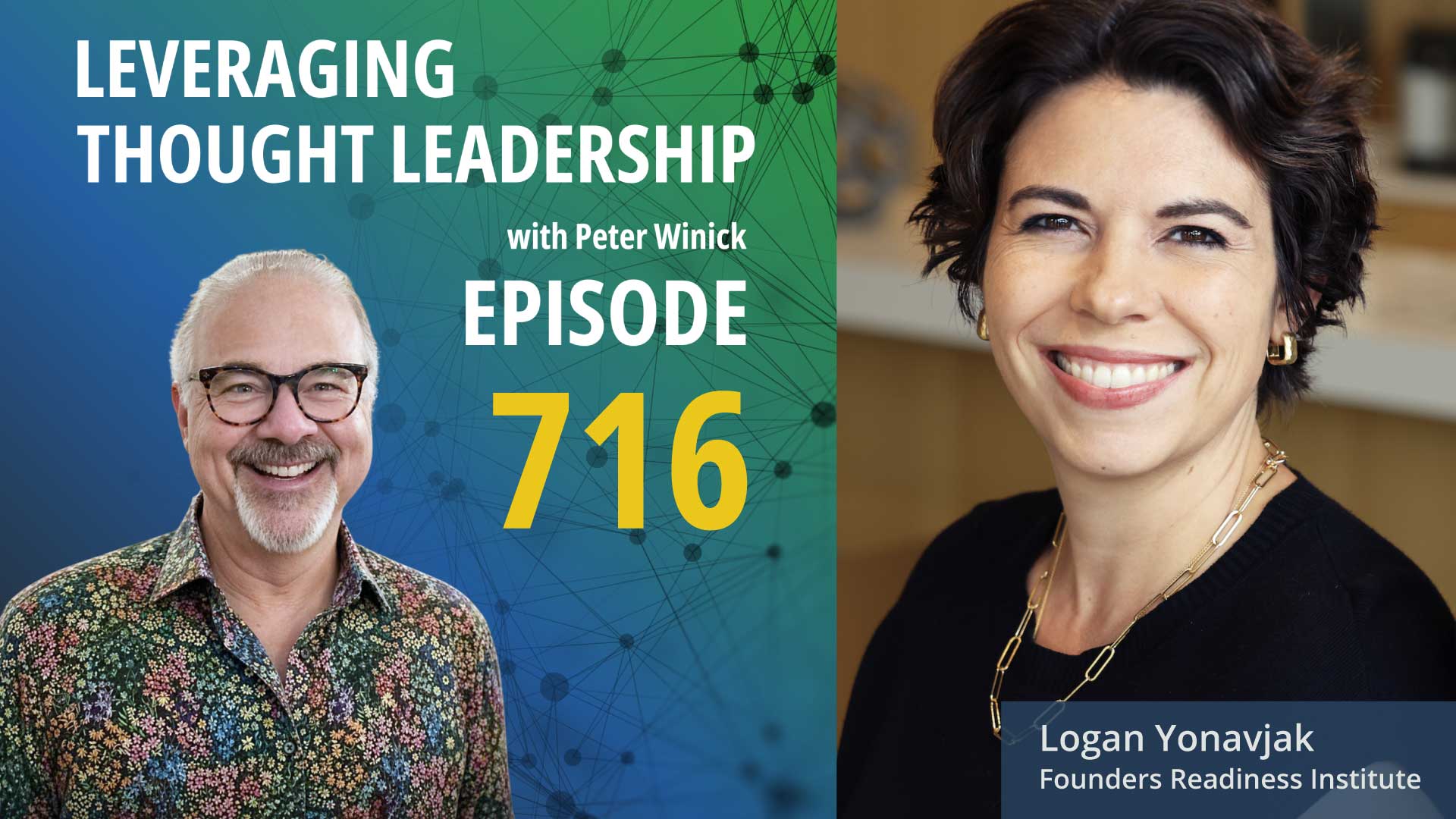



Why leadership development may be the missing link in execution, growth, and investment success.
This episode explores how leadership capacity, founder readiness, and people analytics can help reduce execution risk as companies scale. It also examines the challenge of turning complex thought leadership into a viable business by validating the market, identifying the right buyers, and building trusted paths to adoption.
What if luck is not random, but designed?
What if the biggest risk in a company is not the strategy, the product, or the market—but the leader’s ability to grow fast enough to match the business?
In this episode of Leveraging Thought Leadership, Peter Winick sits down with Logan Yonavjak, founder of the Founders Readiness Institute, to explore a bold idea: leadership capacity can be measured, developed, and used to reduce business risk.
Logan’s work sits at the intersection of people analytics, vertical development, AI, and executive performance. She is building tools that help investors, boards, and leadership teams understand how founders and executives think, behave, and respond under pressure.
This is not traditional assessment work. It is not about labels. It is not about personality typing. It is about readiness. Can a leader handle complexity? Can they adapt? Can they scale with the company? Can they make better decisions when the stakes rise?
Peter and Logan dig into why founder readiness matters. Many companies do not fail because the idea is weak. They fail because leadership breaks under scale. A founder who can lead seven people may not be ready to lead seven hundred. Logan’s work helps surface those risks earlier—and gives leaders a roadmap to grow.
The conversation also explores the business side of thought leadership. Logan shares how she tested her market, interviewed more than 125 venture capitalists, and learned that curiosity does not always equal a buyer. That insight pushed her to refine her positioning and focus on private equity firms, corporate boards, and middle-market companies where execution risk is already a costly pain point.
For thought leaders, this episode is a sharp reminder: great IP is not enough. Science is not enough. A compelling model is not enough. The market decides. The buyer decides. And the best founders listen, adapt, and move.
This episode is for anyone building a thought leadership platform around a complex, emerging, or category-defining idea. Logan shows what it takes to turn deep expertise into a practical business tool—and why the right go-to-market strategy matters as much as the idea itself.
Three Key Takeaways:
- Leadership readiness is a business risk issue, not just a people issue. Logan’s work reframes founder and executive assessment around risk, scale, and execution. The core question is whether leaders can grow at the same pace as the companies they are building.
- Thought leadership needs market validation, not just strong IP. Logan had science, a model, and a compelling idea. But after speaking with more than 125 VCs, she learned that interest does not always equal buying behavior. The market pushed her toward private equity, boards, and middle-market companies.
- Strategic partnerships can shorten the sales cycle for complex ideas. Because Logan’s work requires education, trust, and context, Peter highlights the value of distribution partners and champions. The right partner can reduce friction, accelerate credibility, and make the idea easier to buy.
If Logan Yonavjak’s episode made you think differently about founder readiness, leadership risk, and scaling, Jim Adler’s episode is the perfect companion listen. Logan explores how leadership capacity can be measured before it becomes a business risk. Jim brings the investor’s lens, showing how startups use thought leadership to build credibility, earn trust, and strengthen their market position.
Together, they reveal what it really takes to move from promising idea to durable business. Listen to Logan for the human readiness behind scale. Listen to Jim for the investor perspective on startups, value creation, and thought leadership.
Transcript
Peter Winick And welcome, welcome, this is Peter Winick. I’m the founder and CEO at Thought Leadership Leverage and you’re joining us on the podcast which is Leveraging Thought Leadership. Today my guest is Logan Yonavjak. She is a financial services professional. She’s a social entrepreneur. She’s an author. She’s and angel investor. And has just a really interesting background which we’ll get into here. So welcome aboard Logan, how are ya?
Logan Yonavjak Thanks so much Peter, great to be here. Thank you.
Peter Winick So how did how did this happen? Because as one of the things I find in doing the work that I do is it’s usually not linear, right? You know, you ask certain professions like, oh, how you got here and you can kind of figure out the answer. But how did all this happen, how did we get to be here today?
Logan Yonavjak Yeah, I think the story is actually a really interesting one. And to your point, not linear. And there’s a through line, but I wouldn’t say it’s right here. So my original career interest was actually being a psychotherapist when I was in high school. I was very interested in Jungian psychology and understanding human motivation and potentially doing the therapy route, maybe even clinical psychology. And I got really persuaded by the environmental movement early in my career. I was, I grew up in North Carolina and there’s a lot of sprawl development where I grew and I was introduced to a lot of topics around climate change, et cetera. I did a wilderness, a three month wilderness course out of high school. So I was sort of exposed to conservation work and I decided to take my career in that direction because I felt that it was an imperative for me. I felt very drawn to supporting those efforts. And so I took a financial route basically thinking if I can help direct more capital to land conservation, to climate change efforts, then perhaps I can have more of an impact that way. So I learned how to be a financial professional and investment professional. I went to business school. I worked for several private equity firms and then. Kind of started making my way to earlier stage investing and, um, more startup work. I started finding that the technology, the innovation that was around climate that was in climate tech or ag tech, forestry tech was more of my interest. And then a lot of where I’m at right now came from observation about people and teams. And so I found that a lot of the teams I worked for were were functional and some of them were dysfunctional. There was a variety of different leadership styles that I thought were useful or not aligned. And so I kind of going back to my original like high school interest, I thought, is there a way that we could leverage leadership analytics and people analytics in a more effective way to create innovation teams, to create leadership constructs that would actually be more meaningful and seeing some of that.
Peter Winick So say more about the analytics piece, because I think oftentimes when we’re talking about sort of people analytics in HR in the workplace, it’s things like stack ranking or efficacy, or it’s somewhat heartless, if you will, and a little like, meh. That’s an interesting word, yeah. But that’s not the angle that you’re taking at this, right, like, so what is the lens by which you’re looking through sort of the leadership analytics, because… Yeah. Team efficacy is typically a people issue, not a numbers issue.
Logan Yonavjak Yes. And so I would say, well, our lens is leadership capacity and human development. So the body of work that we’re drawing from is very much on adult, it’s called vertical development. And it shows patterns in how people evolve and how they think, behave and act over time. And there’s really an evolutionary process that happens within the psyche. And we’re measuring where someone’s at in that process. And It’s a very holistic approach. And we’ve honed it in for the context of business and leadership, primarily for executives, to see how they’re gonna think, behave, and act under pressure and with complexity over time. And we’re making the case that, you know, AI is bringing in even more complexity into our system. And so by identifying leadership leaders that are really able to manage this level of complexity, we can have hopefully better leadership at the helm that can then drive better innovation outcomes.
Peter Winick Very cool. So then, take me to the book then. Then there’s a book? Because you don’t have enough going on here?
Logan Yonavjak Oh, we have I’ve been a published author in the past, but we would love to publish where the beginning, you know, more beginning stages of our startup. So I think the thought leadership pieces are coming together. But we are that’ll be in the future.
Peter Winick Got it, okay So what does it look like in terms of, you know, you’ve got the Founders Readiness Institute, so to me that sounds somewhat self-explanatory, right? Because a founder goes out there and the typical path is a founder or two come up with ideas, concepts, minimum viable, then they go to shop the market. And usually the investors are looking at probably more than two things, but if we simplify it, they’re looking at like, wow, this is a cool idea, and do I trust these people? Do they have the capacity? The ability to become what they don’t know they need to become if this thing is to work the way they’d like it to, right? Because I would argue that most people don’t become a founder and say, and you know what? In two years, I’ll be a total jerk or I’ll be a raging narcissist or whatever. But like, if you’ve been on the other side of it, you’re like, OK, what are the things that we could look out for? So I love this concept of founders readiness as a concept, right.
Logan Yonavjak Yeah, it’s like risk flags and markers like any, you know, when you’re forecasting any business plan or product, go to market strategy, there’s going to be risks involved. And so when someone’s trying to scale alongside their company, you know, they might start off at a certain level of development and they’re going to be asked and pressure tested over time. And there’s gonna be cracks that that show up that might have been more visible if you’d looked earlier on. And that’s what we’re making the argument you can do. Is actually see some of these patterns emerge through our transcript analysis that you can watch over time. And then ultimately, if you wanna still make the investment in the team or the team wants to work on themselves, there’s a pathway, there’s roadmap. And I don’t think most leadership analytical tools offer that roadmap as much.
Peter Winick Really a risk management issue from the standpoint of the investors right because too often the founder or the founders implode or just don’t have what it takes to lead a thousand person team when they could lead a seven-person team or whatever right. So it also sounds like it’s not destiny right. Like if you if you pick up these things on the assessments and stuff that you’re doing, people could be aware of their weaknesses and work on Is that?
Logan Yonavjak Yeah, that’s the idea. I mean, I think it’s also not that lower stages of development are necessarily bad. I think where people are and recognizing where they might sit in the trajectory of a company development too, like those who are more execution focused, you know, and have a certain level of development and coachability or purposeful agility, which are two things we measure, they might be fine at the very early stages, but then they need to Um, you know, a new CEO or new team needs to be brought in for that scaling portion. And so there’s all sorts of ways to think about it, but we’re, we’re measuring six different dimensions just to love it grounded a little bit. We pulled these from the research. Um, my co-founder is a psychologist and data scientist. And so he’s, he’s been studying this work for 25 years. And with AI, we were now able to do a lot of automated analysis. But we called the literature looking at, you know, which constructs are really identified as predictive, more predictive for future startup success. Things like follow on investment.
Peter Winick Investment. Stay there for a minute. So yeah, from a validity scam point, you know, there’s science underneath this, right? I’ll just Oh, yeah, absolutely. Right. So this that we know what the six are, we know why we pick those six, as opposed to 66 others that we could have picked, etc. But now I want you to sort of, you’re wearing two hats, right, you’re the thought leader, and you’re this CEO in this entrepreneurial venture. So now you’ve got it. And I think, oftentimes, not oftentimes, but there are times where someone comes out with something and it’s a solution to a problem that nobody cares about. How are you validating it in the marketplace that actually, you’ve got the science, but just because you have the science doesn’t mean there’s a market for it. Oh yeah, absolutely, I mean. How are testing that to go, okay, I’ve got to goods, is this a problem needs to be solved that someone would pay money to be solve that I need to position in a certain way just to have the conversations, because it’s not like you’re in a space where somebody’s looking for, okay, a founder readiness assessment. Per se, right?
Logan Yonavjak Well, you do a couple of things there, and I’m very transparent about these things. I appreciate the, you know, business side of this, because, yes, you can have and this happens all the time, like founders fall in love with their product. And it’s like, well, is it really solving a pain point? And so we’ve talked to over one hundred and twenty five VCs. That was our primary target initially was.
Peter Winick They’re the buyers right are they’re either the buyers or they’re gonna mandate that someone go through this right? Yeah
Logan Yonavjak So that we have an incentive for the founders to take it
Peter Winick But when you say talk to them, was it a structured interview? Was it like, OK, and what was the gist of the interview and what were the outcomes of that process, because I love that.
Logan Yonavjak Yeah, well, I mean, to get a little bit in the weeds, I use a process called the unbiased interview. It’s a prompt and AI prompt engineering where you like design questions that will really focus on getting to someone’s pain point. And so that was the majority of the initial customer discovery, if you will, and the rest have been sales calls. So I use some of the same techniques, but I would say the, you know, the latter of the conversations have been more of a. Let me actually try to sell to you. What I found is that VCs actually aren’t an ideal customer for us, and there’s a couple reasons why. One is they have very informal decision-making processes. They have small.
Peter Winick Right, Gunfeel, yeah.
Logan Yonavjak And a lot of them pride themselves on the gut feel. And so it’s just an informal decision-making buyer. A lot of curiosity and a lot of like, oh, this would be really interesting. But then when it comes to actually, you know.
Peter Winick Okay, that’s a good learning though. So if you have been a great learning and they add behind that was great. And then you go, okay, but the VCs for whatever reason, good, bad or ugly, they’re just not it. There’s not what’s plan B.
Logan Yonavjak Yeah, so we’re moving into private equity boards, like corporate boards and middle market companies in the financial services industry to start just because that’s where I have most of my network. But really with the idea being that we’re solving execution risk as a pain point, like 40% of middle market companies when they make a promotional decision, it doesn’t work out within 18 months. And working out is a variety of things, doesn’t mean they get fired, but they’re not meeting their deadlines. They’re not needing their strategic execution needs. And so that costs like 1.5 times a base salary. So we found that was about 270K per hire or per promotion. And so if you look at the numbers there, these companies have existing HR functions. They’re familiar sometimes with assessment tools. So. Much better buyer than what we initially started with. So some great learnings there as a founder on my end.
Peter Winick Got it. Cool. And what is the current go to market play now?
Logan Yonavjak Yeah, so we’re focusing on private equity firms where they have done B2B SaaS or technology sales usually like software. And so they have a familiarity with just the space and we can incorporate ourselves into their portfolio companies. And then some larger corporates and corporate boards are where we are focused right now.
Peter Winick So one of the risks I’ve seen thought leaders take on, sometimes willingly, sometimes unwillingly, is you’ve got something that’s cutting edge, that’s revolutionary potentially, that’s really, really cool. Which is awesome. That’s what we have. Yeah, yeah, yes, yes. I’m just, I mean. Yeah, but that means on the other side of it, right, like if I’m selling something that people are used to buying, PR services, you know, payrolls or whatever, I don’t need to spend a lot of the sales cycle educating people on what it is, why it is why you need it, et cetera. And guess what? You’re not getting paid for that. So how do you condense the sales cycle because somebody might engage with you and say, wow, that’s really cool. Let me have another call and another call and another because they’re learning something, which is fine. But when you connect that to a sales cycle, because you have a buyer that’s I wouldn’t say they’re not sophisticated, but they’re now educated in this domain. How do you thread that needle? Because that could be tough.
Logan Yonavjak I think a lot of it’s qualifying who you’re the lead that you’re talking to more up front like are they the decision maker, do they have budget, are they in a position where they’re actually in a sales buying cycle for something like this. Those are just some of the key learnings from my own experience. But I think working through trusted partners is how I’m finding the most traction. So people who take our assessment and then are champions for us and going to some of their colleagues who. They no need this type of work. So I’m thinking of one individual in particular who has taken our assessment and now she’s talking to three corporate boards and a very large corporation on the chief people officer side to get our technology embedded in their systems.
Peter Winick We found a lot of chance really cool. So a lot of folks go down the route of a strategic partner, distribution partner, because I’m going to guess that you’re probably not a marketing whiz or didn’t wake up one day and say, wow, golly gee, I can’t wait to build.
Logan Yonavjak I wish. I wish. It just right downloads would come. But yeah, no, it’s there’s a lot of different skill sets involved here. I’ve been, you know, there’s cold email outreach and all the automation work and lead magnet. I mean, it it’s dizzying for a founder in many ways.
Peter Winick So if you could secure, if you, if you could break that down and say, okay, well to, to thrive as a company, we would need what I’m just making is, you know, a hundred clients a year in order to get there. Here’s all that activity. I can do the math backwards and go, oh my God, that’s a hell of a lot of emails and LinkedIn and whatever. But there’s another way to do this. What if we got two or three or four, a handful of, of, uh, strategic distribution partners that got who we are that have already, uh an installed user base made, they’re selling a suite of other product services and offerings and this is either an Zellra and add on or you’re riding that wave we love that you know in terms of the work that I do because it cuts it cuts the cost of cuts the cycle you’re connecting with trust. I’m another partner and it’s easy to manage three or four relationships other than deal with the churn so it seems like that’s the route you’re taking.
Logan Yonavjak That’s been the big light bulb moment for me. It’s interesting because I come from a lot of my career, I’ve sold financial products to institutional buyers. And so the work is very much like these strategic partnerships, these longer, bigger contracts. And so in many ways I’m reverting back to my sales experience. I thought it would be more of this. Kind of like managing, you know, tons of leads. And I was doing that in the beginning, but then I reverted back to this approach because it is, for an early stage company, it’s been one of my biggest insights about sales, is what you just mentioned.
Peter Winick Got it. Love that as we start to rap here any other Thoughts learnings etc that you would have say for you two years ago. There’s someone out there now Maybe probably doing different IP or thought leadership, but could say, you know are thinking right now like wow That’s where I am now or that’s where was a year ago. What would you what’s the wisdom you might share with them? No pressure, but it’s got to be life-changing for this
Logan Yonavjak It’s going to be life changing. Well, I think your own internal resilience is so important because your mind mindset about where you’re headed and these different perspectives that come in, being able to hold multiple levels of complexity and actually stay objective about what you’re seeing from the market has been probably my biggest learning because in the beginning, I really had this. Desire to change venture capital and to bring in these people analytics tools. And I realized that it just wasn’t.
Peter Winick That’s a small feat. I’m just going to change venture capital.
Logan Yonavjak Well, I wanted I wanted to embed a layer of people analytics in and de risk some of the investments because I want to see better innovation outcomes. I’m a systems thinker and I was like, oh, this is so cool. And then the reality of just the buyers themselves and how they function, I was, like, I just had to step back and be like, this isn’t the direction we need to go anymore. And of course, you hear about pivots all the time. And then when it comes to you actually doing it, it’s like, OK, well, I have to stay objective here. This is what the market’s telling me. And I think that it’s the sobriety of that experience.
Peter Winick I think that’s really the big one, or one of the big ones from today, is that you could think whatever you want, and your friends could think whatever they want, your advisors could think what they want. The only thing that matters is what does the market think? It’s hard to maintain objectivity relative to that, but three, four, five, six types of buyers that make perfect sense for you tell you, yeah, but no thanks. Time to rethink it, right? So it doesn’t mean that, you know, I love the way that you pivoted and you didn’t do a total crazy pivot and now you’re in the direct-to-consumer space. It’s like, okay, I need to think about this piece of the process. How do I get to whom? Right? Right. And what does that look like? Because your instincts were right. I think it was just more of a slight directional shift as opposed to a radical pivot of, okay, now we’re gonna be in the, you, know, package goods business or something silly.
Logan Yonavjak Oh, yeah. Well, I also think there’s an art to letting go of a dream, you know, and just there’s a knowing when you have enough information to make a decision. Like, there are still VCs we’re talking to who are excited about this, but they’re not the place I should spend most of my time. And so there’s always people who are going to tell you, oh, get more information, get more information. It’s like you have I think the onus is on the CEO to be like, no, it’s time to move. And so. I think it’s really developed my own leadership abilities. I’m more confident in my own decision making.
Peter Winick Well, this has been great. I appreciate your time and thanks for sharing your journey with us, Logan.
Logan Yonavjak Great. Thanks, Peter. Thank you.
Peter Winick To learn more about Thought Leadership Leverage, please visit our website at thoughtleadershipleverage.com. To reach me directly, feel free to email me at peter at thoughtleadershipleverage.com, and please subscribe to Leveraging Thought Leadership on iTunes or your favorite podcast app to get your weekly episode automatically.
