
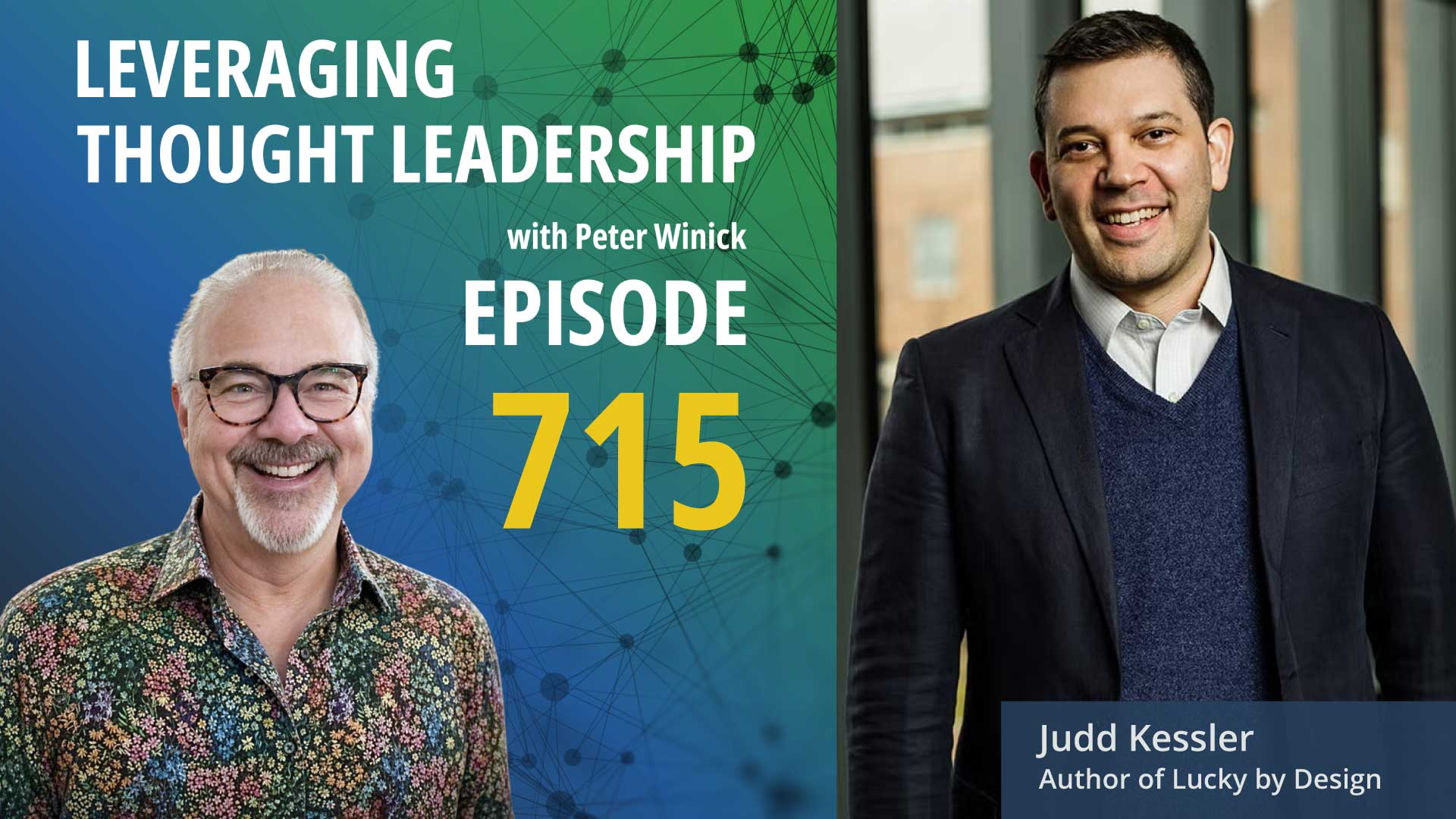
The Economics of Getting What You Want | Judd Kessler | 715
The Leveraging Thought Leadership podcast is created by Peter Winick and Bill Sherman and produced by Thought Leadership Leverage.



Turning Market Design into Practical Thought Leadership
This episode explores hidden markets, scarce opportunities, and the rules that shape who gets access. It shows how better systems can create fairer, smarter outcomes in work, life, and organizations.
What if luck is not random, but designed?
In this episode of Leveraging Thought Leadership, Peter Winick sits down with Judd Kessler, Wharton professor and author of “Lucky by Design: The Hidden Economics You Need to Get More of What You Want.” Judd’s work brings market design out of the academic journal and into daily life. He studies the hidden systems that determine who gets access, who gets opportunity, and who gets left waiting.
These systems are everywhere. School programs. Job assignments. Consulting projects. Ticketing platforms. Government services. Nonprofit resources. Even your own time and attention.
Judd’s thought leadership gives leaders a new lens. First, see the market. Then understand the rules. Then decide whether those rules are helping or hurting the outcomes you want.
For organizations, this is not theoretical. Poorly designed internal markets create frustration, waste, and inequity. Better rules can improve allocation, retention, performance, and trust.
Peter and Judd explore how a book can move academic insight into practical use. They also dig into the harder work after publication: building an audience, entering the cultural conversation, and turning expertise into influence.
This conversation is a sharp look at how thought leadership scales when it makes invisible systems visible. And when it gives people the tools to redesign them.
Three Key Takeaways:
- See the hidden market. Many opportunities are shaped by invisible systems, from school programs and job assignments to access, attention, and scarce resources.
- Design better rules. Poorly built systems create frustration, waste, and unfairness. Better rules lead to smarter outcomes.
- Make ideas practical. Strong thought leadership turns complex concepts into tools people and organizations can actually use.
If this conversation made you think differently about the hidden rules that shape behavior, go back and listen to our episode with Luke Battye.
Both episodes explore how people make decisions inside systems they often do not see. Judd Kessler looks at hidden markets, scarcity, and the rules that determine who gets what. Luke Battye looks at behavior change, design thinking, and how small shifts in context can change what people do next.
Together, these episodes give you a sharper lens for understanding systems, incentives, and behavior. You’ll walk away with practical ways to design better outcomes for customers, teams, and organizations.
Transcript
Peter Winick And welcome welcome welcome. This is Peter Winick. I’m the founder and CEO at thought leadership leverage and you’re joining us on the podcast which is leveraging thought leadership today my guest is Judd Kessler. He’s the inaugural Howard Marks endowed professor at the Wharton school at UPenn he does a lot of interesting research combining laboratory and field work for market design public economics labor economics behavioral economics etc. He teaches undergrads and MBAs, and he’s got a book out, which I am almost finished, called Lucky by Design, The Hidden Economics. You need to get more of what you want. So welcome aboard, Judd, how are you? Doing well, thanks for having me. And thanks for almost being done with the book. Well, some could have been done with it early. Like, I’m actually intent to finish it. I got up early this morning to try to finish it and didn’t make it all the way through. But no, it’s a great book. Thank you for writing it. So how does this happen? So I get, like, you’ve got. Demanding schedule right you live in New York you teach a Wharton a lot of time on a track or whatever Three kids the whole deal what drove you to write a book and what more importantly drove you write this book
Judd Kessler Yeah, this book was kind of in me for a while. I’ve been at Wharton for 15 years. And mostly when you were an academic, your main audience is other academics. So writing, yeah, writing articles that nobody, that nobody reads. Hopefully some people cite, but the insights that I was learning in my research felt like they had more practical uses. And so… When I got tenure and the publisher or parish kind of pressure is we’re a little, we’re led up a little bit. Uh, it’s like, all right, maybe it’s time to communicate some of these ideas to folks who actually could make their lives better as a result of them learn how to see hidden markets in the world, learn how to navigate through their rules and then figure out the strategies to succeed.
Peter Winick Stay there a minute. I want to point out that oftentimes when academics write non-academic things, like things that people actually read, you pick it up and you go, oh, geez, he’s an academic. But what I say is the book is real. It’s readable, right? Because I often feel when I read, which is not often, academic journals and such that, oh here I go again, I’m the dumbest guy. This is not written for consumption. It is written reflecting
Judd Kessler Yeah, no, there’s the goal is to do as little flexing as possible. There’s some embarrassing stories in the book about me. So I, you know, I don’t know, uh, I dunno that, uh it’s as big a flex as one might hope. But the, this desire to make the book approachable so that anyone, even people who are not. You know, didn’t study economics when they were in college or, or, you know, don’t want to read an academic home. I wanted it to be approachable. I wanted people to pick it up and immediately get that this is going to be helpful for you and it’s not going to feel like being in class. And actually that was, it gave me a little bit of writer’s block at the beginning of the process because I, I did know how to start the book in a way that would be accessible in the ways that I wanted that would communicate what’s at the heart of the book. But without. Being, you know, pedantic. And I finally, like I cracked it. It was midnight. I was laying in bed. I sprung up. I was like, I know how to open the book. I had just taught my youngest daughter, who was four years old at the time, how to play rock, paper, scissors. Right. And that was an important lesson for her because that was one of the hidden market rules that we used in our house to decide, you know, which TV show to watch, what to have for dinner. And she would watch her older siblings make what, to her, were totally incomprehensible hand gestures at each other until she understood how to play rock, paper, scissors and understood the rules. Once she understood it, then she could figure out what was going on. She could get why her older sister was happy and her older brother was sad at the end around. But then she played for the first time… Against her, her sister, and she just threw scissors on every territory and their sister’s like, okay, I get this. I’m going to throw a rock. Now my youngest like scissors at the time she was learning to cut. So you could see why she did that. But to me, that story was approachable, but it was also an allegory for what the book was about that to succeed in these markets, you needed to. Understand their rules. You needed to know what was going on, understand that, you know, this was a game that had rules that you could learn to play. But then also you needed strategy. It’s not enough to just understand the rules. You have to know what it is. Even before the
Peter Winick understand the rules, there’s a couple of examples in the story where you have to be aware that there’s even a thing. Oh, yeah. So what is there a lot a lottery for after school programs or Shakespeare in the park or whatever it is. So one is you got to know like, okay, how do I get what I need to get? Okay, oh, there is a set of rules. Okay. How do I obey the rules? Bend the rules honor the rules maximize the rules whatever. And what and think through like you said, what are the best strategies to play which are applicable, right? So… Are there other? Well, let me put it this way for you as a thought leader, right? So you’ve got academia is sort of the profession. Yeah, we’ve got author in as part of that thought leadership portfolio. Is there other things that you’re doing in terms of speaking, advisory consulting?
Judd Kessler Yeah. So I’m starting, the book was like my coming out party. That’s how I think of it as a, so I am starting to kind of tiptoe out and do more of those other kind of in the world types of action that are, you know, supported by the thought leadership or consistent with that. So helping organizations, uh, actually one of these is in the book of my like kids after school program where it’s a first come first serve race to click to be the first one to sign up for the desirable after school classes. The parents hate it. I mean, they will send, you know, what’s that messages and text each other. Oh, gauntlet day is happening. Everybody has to cancel their plans. They’re sitting there. And, uh, you don’t, our schools after school platform, like it has never yet crashed when people are going on. But as, after I wrote about this, I learned this was a problem that lots of schools have, and I started getting, you from folks who are trying to solve this problem for their school and trying to help them integrate, okay, let’s think about better ways to do this. Let’s use lottery-based systems rather than first come, first serve. What would that look like? Some folks are trying do it on their own. They’re reinventing bad mechanisms. It’s interesting to see in real time how people respond to this. Having talked with.
Peter Winick The company is engaging with you to help figure out, hey, we have this thing. What’s the best way to allocate this when we know demand is going to outstrip supply, other than increased prices, which is classic economics.Judd Kessler Yeah. So the conversations I’m having are a real combination of nonprofits, government, and, you know, private sector firms that are looking for better understanding how the ways that they allocate, like if I have conversations with the consultancies around their staffing, just like, you know, you have this, this is a hidden market. We have lots of folks who want to work on specific projects who want to do work in specific industries. Who want to work with specific people, and it’s a complicated array of preferences. And are we doing the kind of right, do we have the right market rules for our organization, kind of the meeting of needs of the clients and of the consultants. And are, we kind of max maximally getting what we can out of the consultants that we have. You know, and, and the important thing when you approach each of these markets is to say, all right, what is the actual objective? Like you obviously want to deliver good work for your customers, for your clients, but like, do you want to satisfy the preferences of the consultants or do you know that like this consultant needs that kind of experience and it’s a little more paternalistic?
Peter Winick So you could add another variable and say, yes, we want to satisfy the client that’s non-negotiable. We want to develop the consultants on the dime for the client. We want an increased retention, right? And certain consultants have expressed that they’re less likely to want to travel long distances or something. So you’ve got to put all those in the mix and say geez, how do we weigh those? How do we weigh all those variables, right?
Judd Kessler Exactly. And, and what I’ve noticed when I’ve had these conversations, and it’s possible that the folks who are interested in talking are the ones who are seeing problems with their internal hidden markets. And so that’s why we’re having the conversation is they think that there’s a problem, but lots of the conversations that I’m having reveal that folks are designing mechanisms, kind of Either through historical accident or somebody had an idea that seemed good at the time, but the situation has changed. And so there’s not as much reflection on what are the rules that we have in place to do this allocation.
Peter Winick And are the rules up-to-date? Are the rules-up-to be? Consulting 101 was get on a plane Sunday and come home Thursday. That’s just the way it was. And then we had this COVID thing, and it’s like, actually, there’s other ways to deliver, right? There’s other ways you get value. There’s others ways to less wear and tear on the consultant. So I want to ask you on the book side, because the book’s been out a bit now, right. Is it a year? Less than a year. No, less than a years. So almost five months. So I was talking to a publisher friend Recently And the person was telling me that one of their authors just submitted the manuscript and the author said to the publisher, awesome, I’m in the end zone. And the publisher said, actually, you’re at the 50 yard line, right? Meaning the work, there’s different work. Some would argue it’s as hard or harder work on the post publishing marketing piece. Tell me about sort of the pre-pub and post-pubs. Like the writing guide and then the, jeez, I gotta get this out there and talk to. In the next like me all day to try to come out of it.
Judd Kessler The not does not a pain in the neck. This is quite fun. The, the writing bit was different than the kind of writing that I had done before. So I described, you know, academic writing, like a little bit of a chore or having gotten to that point and wanting to reach a broader audience. It is hard to write, you when you spend 15 years writing academic work or 20 years at this point, including graduate school, writing academic work, it’s hard to kind of switch into the, I want to write a book. That’s more approachable and mindset. That was the writer’s block I described, but I had done that in college. I had written for the newspaper. You know, so I had some experience with, with writing in the voice that I wanted to write in. So it just took a while to get that voice back, but yeah, after the, so the writing, the manuscript ended up being quite fun. I really enjoyed that process. Okay. This, so up to 50 yard line, you know, some stumbles at the beginning, but, but enjoy the process. It really is something that in particular, I think academics. Don’t have a lot of experience with when we’re doing the second bit, doing the book promotion, because it’s, you know, it’s one thing to have written something to think that people will will like it if they get their hands on it. But we’re competing with lots of books, lots of sub stacks, lots other forms of media. Yeah. And yeah, breaking through is tough. So I’ve I’ve enjoyed all the conversations I’ve had, but… It’s very different than walking into a classroom when people have decided to come to Wharton, they’ve decided to take your class, they’re gonna listen to you. You know, all you have to do is talk.
Peter Winick I went out at Wharton they’ve never they’ve ever said your I Judd we’re having a slow a slow quarter can you go out there and hustle up some clients some students to yeah
Judd Kessler Yeah, exactly. And, and also, you know, you’re, you know, the, the students are not sure who to listen to. We’re going to have all the classes at the same time. They might talk to, yeah, listen, Adam Grant talk, or they might come to you. It’s like, Oh my God, like it’s not, yeah. It’s a very different environment than we’re used to. So it’s, it’s been nice and interesting and a challenge to kind of do something new. I think that’s something I’ve really appreciated about both, both the first 50 yards and you know what, wherever I am on the right now. On the, on the back half of, of the, of this process, it’s been fun to be doing something new and challenging that I haven’t done before. It’s easy to get complacent if you’re just doing the same thing every day.
Peter Winick Good. So what are the things on the marketing side that you might not have even realized your thing, right? Because what really what you’re competing for is not 25 or 30 bucks for a book, you’re really saying to someone spend five or six or seven hours with and my ideas.
Judd Kessler Yeah. Yeah. I don’t know. I had a conversation with somebody at one of my book events. So it was a book party somebody threw for me. It was a bunch of people from college and their partners and random folks who had come. One of them was like a year and a half behind me in the process. He had just signed the contract for the book. And I was like, Oh my God, I’m so glad I got you at this moment in time. Because if I knew now what I, you know, if I new then what I knew now, I, I do some things differently, like start to, you know, kind of figure out how you’re going to enter the cultural conversation, because the books that everybody reads are the books that kind of already have a little traction going into release. And so it’s harder to generate that after the book is out, right? Like you hope for word of mouth, you hope your podcast, like getting somebody to pick up the book. But, you know, you could start thinking now 18 months before the book is released, like, you know, what are the things that you’re going to be? How are you going to get the word out? And maybe that would help you kind of. Optimize how you spend your time. While you were writing, you know, are you developing a audience? Are you like having contact, you know, getting contacts with people in the media? Like, what is the what is the plan? And it was like both. Kind of disappointing, but also like a relief that he was like, oh, no, no. It’s fine if I’m just going to write a great book and like people, you know. You know, it’s like, all right, that’s it. That was kind of how I felt like no one gave me the straight talk then. Oh, or if they did, I didn’t hear it. But yeah, so I think it’s like the figuring out how to. I’ve been saying enter the cultural conversation, but like become something that everybody is paying attention to. We’re focusing on that’s that I think is like the magic.
Peter Winick Yeah, and I think that, you know, if I were you, I look at your book and say, I think there’s two big things here. Number one, the individual, right, in the marketplace can now, you’ve sort of given us filters and lenses to look through and say oh, there’s a thing here. Oh, there is rules here. Let me think about how best to play it to optimize my desired outcome, right? Like, I didn’t even know about that. I just thought that, like, take a master, you go take a Master of 1002, like whatever. And we’ve all been subject to these things, but we never really gave the thought of who designed these, how to play the game, whatever, right? We’re going to play chess or checkers. We know the rules. We know, the game we sit down and say, let’s play, right. That’s number one. Number two, whether it’s nonprofit government agencies, organization, thinking about the, the pros and cons of how to design these things. Hey, we’ve always done it this way. We’ve always. Okay, well, is there a better way? Is there a different way? Is, you know, technology? How do you use technology and, you know, all those sort of things?
Judd Kessler Yeah. And, and I, I wrote the book, I think mostly for the first audience. I mean, so what you’re 80% of the way through. So I have a little bit at the end about thinking about yourself as a market designer and how you have, you know, we are also the most telling me mostly we, I read the book for the folks as market participants, trying to navigate through, figure out the rules, get what you want in all of the, the markets that you gave us name, but, but many more labor markets, dating markets, school admission. And then there is in each chapter kind of how could market designers do it better. So you’re in an organization or you’re working at a nonprofit or you know, you interact with some government agency and you see the system that they’re using. You think this is terrible. It has to, it has to be a better way. There probably is a better and if you are involved, you can kind of start thinking carefully about it. You can read the book and maybe on your own, figure out what the right tweaks or solutions are. You can contact folks like me or other people who do this. And make things better for the markets, uh, that you are involved with. And then in the book, towards the end, I also emphasize like you are a market designer for markets that you control. So a, a hidden market that needs these market rules is just a way of allocating situation where you’re allocating scarce resources and not doing it with a price that rises to, you know, decide who gets what. So, that describes. Things like the market for your time and attention. There’s a limited amount of it. A lot of people want it. Lots of things you could be doing with it. You’re not, I mean, you might be if you’re a consultant or someone who’s, you know, charging for your. Most of us are not saying like, oh, I’m going to, you know, if you pay me enough, I’ll respond to your email and otherwise I’m gonna ignore it. We are developing rules that are determining, okay, whose meetings do we take, whose email can we respond to, who do we, you know, give the time of day and who do, we ignore. And that is a hidden market. We have to develop the rules that we follow. We can decide how strictly we follow them. But that way of thinking, the hope is that you will improve the markets that you are controlling, as well as the markets you’re a part of or participate.
Peter Winick Yeah. And that you have control. There is something to be controlled. Well, this has been great. I appreciate your time, Judd. And thank you for putting something out there that’s interesting.
Judd Kessler Thank you. Thank you for talking to me about it and you know, helping to get the word out as we as we said, that’s the ballgame at this one. You got it. Thank you.
Peter Winick To learn more about Thought Leadership Leverage, please visit our website at thoughtleadershipleverage.com. To reach me directly, feel free to email me at peter at thoughtleadershipleverage.com, and please subscribe to Leveraging Thought Leadership on iTunes or your favorite podcast app to get your weekly episode automatically.
