Permanence: How Leaders Sustain Success Without Losing Themselves | Lisa Broderick | 714
The Leveraging Thought Leadership podcast is created by Peter Winick and Bill Sherman and produced by Thought Leadership Leverage.
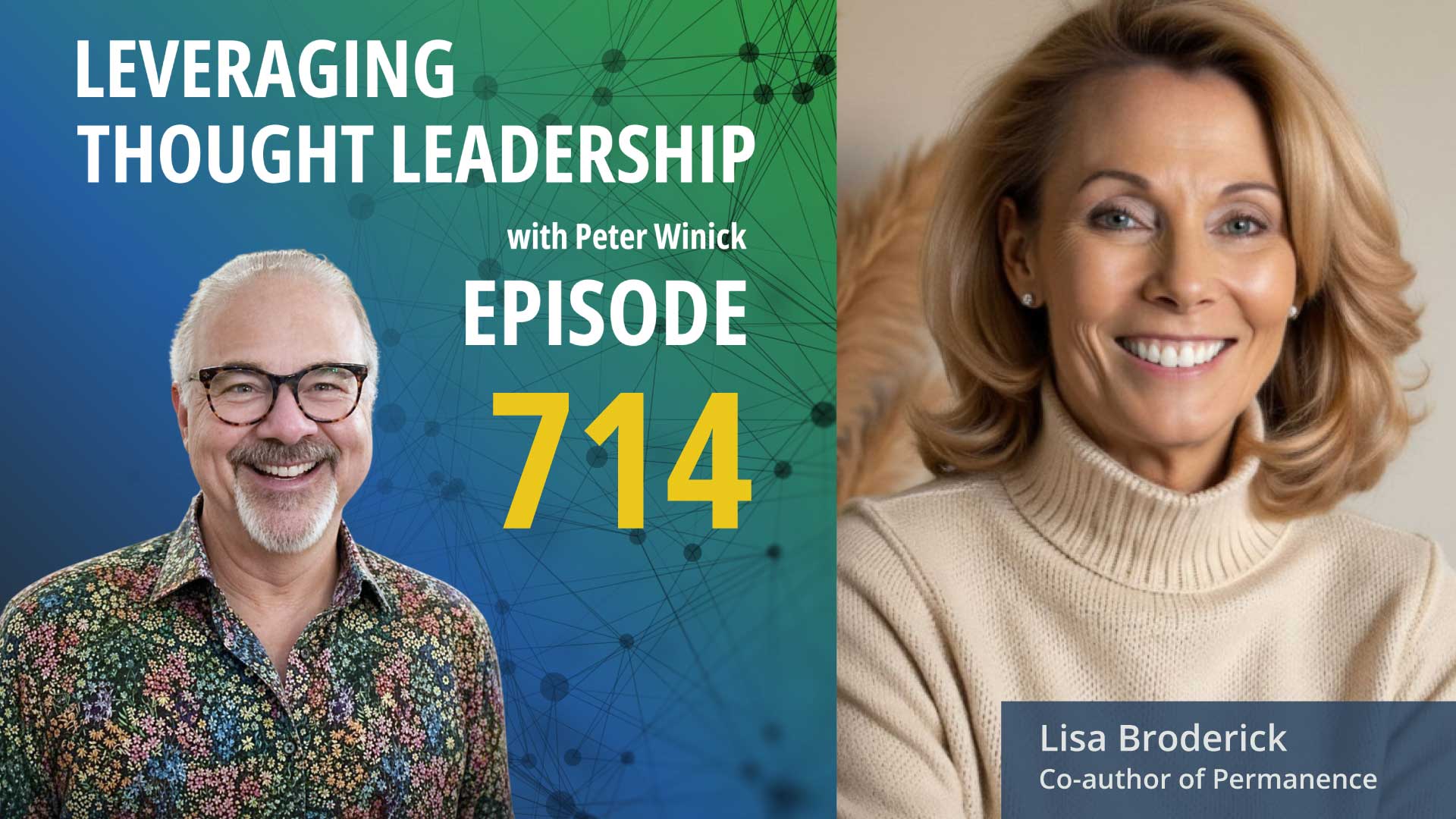



Daily questions, accountability, and behavior change that lasts.
This episode explores how daily questions, personal accountability, and small behavioral shifts help leaders create sustainable success without losing sight of who they want to become.
What if success is not the hard part?
Lisa Broderick, Managing Partner of Conversus Group, and co-author of Permanence with Marshall Goldsmith, brings a practical answer to one of leadership’s most overlooked problems: how to stay the person you want to be after success arrives.
Most leadership advice focuses on achievement. Hit the goal. Grow the company. Build the platform. Scale the impact. But Lisa’s work asks a sharper question. What happens to your behavior, identity, and relationships once the pressure of success starts to reshape you?
In this conversation, Lisa unpacks the power of daily questions. Not vague reflection. Not motivational slogans. A simple, measurable practice that helps leaders notice their behavior in real time. That noticing creates agency. Agency creates change.
The breakthrough is in the wording. “Did I do my best?” is different from “Did I succeed?” It removes perfection from the equation. It puts ownership back in the leader’s hands. And it makes behavior change sustainable.
Lisa also shares how accountability changes everything. Leaders shifted their actions during the day because they knew someone would ask. Not an app. Not a dashboard. A person. That human connection made the work harder to ignore and easier to sustain.
This episode is a powerful look at thought leadership in action. Lisa and Marshall are not just sharing ideas. They are turning research, coaching, behavioral science, and real-world executive practice into a framework leaders can use immediately.
For CEOs, coaches, advisors, and thought leaders, this conversation is a reminder that success can create drift. One small compromise at a time. The right questions can bring leaders back to intention, clarity, and permanence.
Three Key Takeaways:
- Sustainable success requires more than achievement. Lisa Broderick’s work focuses on what happens after leaders become successful. The danger is “identity drift”—small compromises that slowly pull leaders away from who they want to be.
- The right questions create real behavior change. Daily questions like “Did I do my best?” shift the focus from perfection to effort, ownership, and awareness. That makes change more practical, measurable, and sustainable.
- Accountability makes thought leadership actionable. The practice worked because leaders knew someone would ask. Human accountability turned reflection into action and helped leaders change their behavior in real time.
Lisa Broderick shows how daily questions and human accountability help leaders create lasting behavior change.
Adam Fridman takes that idea further, showing how small habits can be built and scaled across teams and organizations.
Listen to Lisa’s episode to understand why change starts with awareness. Then listen to Adam’s to see how daily habits turn into measurable business impact.
Transcript
Peter Winick And welcome, welcome, Welcome. This is Peter Winick. I’m the founder and CEO at thought leadership leverage. And you’re joining us on the LinkedIn live version of the podcast, which is leveraging thought leadership. And today my guest is Lisa Broderick. So Lisa is amongst other things, the CEO of gold Smith advisors. She is an author. She’s a C-suite leader. She’s the co-author of permanence, which is her new book. We’re going to talk about that, that she wrote with Marshall Goldsmith. And here she is to spend some time with us. So welcome, Lisa, how are you? Peter, I am terrific. Thanks so much for having me. Really fun. There’s so much I wanna touch on here because I had so much fun when we were prepping for this. So before we get into sort of my stuff, I wanna get into the origin story. Why are we here and how the heck did this happen?
Lisa Broderick Well, we’re here because Permanence came out about a week ago on February 10th, but going way back in 2023, Dr. Marshall Goldsmith called me up and he said, Lisa, I want you to do a research project for me. Now, if you know Marshall, he is the originator of executive coaching around the world, the preeminent CEO coach in the world. And so that research project could have been just about anything. But of course, I said, Marshall, What do you have in mind? And he told me what he wanted. He wanted me to call a cohort of his leader clients who are among the most influential leaders in the world for a year, every weekday, and ask them a set of simple questions about their life that Marshall had devised, and then also some questions that they may want for themselves in order to affect behavior change. And so these leaders agreed to do it, and I did it. And for the next year, I chased them around through trips, and snowstorms, and weather events, and delays, and sometimes dinners with heads of state to ask them their six daily questions, as Marshall calls them. And what we learned was very interesting to follow these leaders for a year. Couple months in, and by the way, I was keeping the data, I’m keeping the data. I’m an economist by training. Now I’m working in executive coaching, so I’m really interested in this project. So I’m keeping the data and so he’s keeping the data one is a number one is closer to no. And a number 10 is closer. So every day I’m keep the data. I’m calling them. I just listen, no judgment. If they needed to talk, then I’ve, then I would talk with them. And, uh, throughout the whole year. So the first couple of months all over the map, you could imagine, right? All, all noise, no signal. We start to get to about six months and they start to coalesce all of the numbers for the entire cohort at least above five. So five would be halfway. Then we’re going more and more and we’re continuing to do it and they’re hanging in there and I’m hanging in there. And we get to almost close to a year and the scores all coalesced around nearly perfect. Of course anybody can have a day, right, a day that’s not great. But mostly for the six questions and the questions about their lives, they were coalescing around it and it was phenomenal. So Marshall and I started to look at the data and then we asked the cohort, we asked the individual leaders, what their experience was. And that’s where the really remarkable, remarkable results came. So first of all, we asked them, when you’re doing your daily questions and you’re thinking about it throughout the day, why do you think your scores got better over the year? And they all in a different word said the same thing. They said, I changed my behavior in real time because I knew you were gonna call me.
Peter Winick Stay there a minute, though, because, yeah, stay right, so, I mean, this is the same theory of, you know, why do we hire a trainer when we know what to do at the gym, right? It’s because, well, we’re paying somebody and they’re going to be there at 5:30 in the morning and we can’t let them down. But I want to go back a little bit. So when you read Marshall, definitely Marshall’s work and lots of other thought, yeah. It all makes sense on the page, right. So Marshall has written about this before. Here’s the sick question, these six questions, ask yourself these six questions every day, or have a coach to like, so this is not a new concept per se. And I love that the moving this from totally theoretical, like this could have been an abstract, like, Hey, here’s an idea to your deep in the, I couldn’t get deeper than in the applied than you did of chasing them down during dinner and saying, Hey you know, it’s Lisa, you got to eat again. You do your best to be happy today. Yeah. Right. Right. Did you do your to be happier? Okay, so one is. You know, it’s just really, really cool to go from, okay, this actually works. And there is something in this age of technology and AI, you can easily, you know I could probably do an agentic AI and create the app version of this in nine seconds today, but different because it’s easy for me to disappoint my phone. That’s a thing. It is, it is not a person. But after. You know, hearing from you every day, I’m not going to blow you off. I’m going to look at that on my caller ID, you know, voicemail, whatever. So yeah, talk about the. I love what you learned, but what’s the impact of maybe a case study drawn the impact these folks in terms of where they started, what’s different, how it impacted their life, their business, how they lead, how they matter.
Lisa Broderick Well, it’s great you brought up a trainer because the same dynamic exists there. And that is people don’t wanna suffer the shame and embarrassment of not having tried their best, but that gets back to the genius of the questions. So it’s not just that you’re doing it, it’s what the questions are. So years ago, Marshall with his daughter, Dr. Kelly Goldsmith, who’s a wonderful professor at Vanderbilt University, she and Marshall developed this approach and it was her idea. Marshall was working on daily questions and she said, why don’t you change them into, You know, instead of Was I happy today? Did I smile during meetings? You know, was I kind to coworkers? We did an active question. An active question is, did I do my best to smile today? Did I do best to be kind to co-workers? And here’s the difference. The difference is, at the end of the day, I could have said, did you smile? Were you happy? All this kind of stuff. And they may have said yes, no, yes, no, and we move on to the next day. But if the question is did you do your best? They didn’t want to suffer the shame and embarrassment of having to admit they hadn’t even tried.
Peter Winick So stay there, because that brings to light some of the beauty that is the art and science of only something an organizational site could do, right? Because you might say, well, the question is, did you smile today during the meeting? And you go, yes, smile. But was it a smirk? Was it like a really like, did your do your best? That could only mean one thing because you weren’t in the room. They could, they could lie to you. Why would they? Right. But like, it forces someone to be introspective. The nuance of a great question from, from an org site perspective is the difference between sort of an outcome and a, I smiled at the meeting, but yeah, it wasn’t my best. I was a little cranky or I was a little distracted or whatever. That’s, it’s, that’s a, just a really cool example of why we hire the right people to write music.
Lisa Broderick Well, and also in framing the question that way, it removes the failure from it. You know, it’s not success oriented, it’s sustainable behavior focused. So that’s number one. And number two, life happens. So you’re doing your best to smile in meetings and you spill coffee all over yourself, you know, in the morning and then you got coffee on your shirt all day. And so did you smile in all your meetings? No, under the circumstances, did you do your best? Yeah, you did. You made the best of it, which is something Marshall would say. And so it just lets people, it lets people have life happen to them while actually creating sustainable behavior change.
Peter Winick So I’m wondering if during this process, how many people were you calling?
Lisa Broderick I wouldn’t be able to reveal that it was a cohort of leaders and names have been changed to protect the changed, the people who achieved permanence.
Peter Winick Okay, so there’s a decent amount of people. A decent amount people. Yeah. Were there patterns that either you picked up and brought to their attention, or they picked up? So it could be like, hey, Peter, when I call you on Fridays, you’re particularly grumpy or everything, you know, I call on Fridays and I know you have your staff meeting on Fridays. And that’s something that you typically, it stresses you out or whatever. Or the folks, some of the folks come to those own realizations of the patterns that they
Lisa Broderick Have a great day. Well, you’re absolutely right. And permanence and the daily questions is all about noticing. Right. When you notice your behavior, you have agency, right? Awareness gives you the opportunity to change. And so yes, we talked about patterns. Mondays are typically not great. Fridays are better, right. It’s things you hear all the time about the work week. But there were things that happened in their lives with regularity that we could relate back to the data. And then because they notice, And when you noticed, you’re able to choose actively, proactively, and so they were able to choose, oh, this is Monday, I’m going to do X, or my staff meeting’s on Thursday, I’m gonna do this. And it helped them, it fostered even greater behavior change because they noticed the consistent small behaviors and the patterns that resulted in either them becoming the person they wanted to be in that moment or not.
Peter Winick And I’m assuming for most of these folks, they have the agency to make those changes. Like maybe we better to pull the staff meeting to it the morning versus the afternoon or whatever the.
Lisa Broderick Yeah, but you can’t change Monday, right? Or you know, you’re and you’re let’s say you’re commuting to work, right. So you get there on a Tuesday and leave on a Thursday because you’re flying somewhere to actually go to an office. So there are things that were immutable about their behavior. But again, back to noticing, it doesn’t matter what you notice, just notice gives you the power to choose change.
Peter Winick So I want to talk a little bit about the book, so it’s achieved some status already in its short period. So Amplify is your publisher. I’ll tell you a little because I’m always fascinated around the process, right? So how did this get written in terms of, were you and Marshall doing jam sessions? Was it most like.
Lisa Broderick Well, yeah. So after that, so the data came in, that was 2023 to 2024 that year. And then we did something because we’re both data scientists. Half of the cohort stopped and the other half continued. Oh, yes, what happened? The cohort who continued to do it remained better. And the cohort which didn’t do it self-reported that they did not. So that was very interesting. So having having all that real world data, and it was leaders, and having done AB, after the fact, Marshall said, we’re writing a book. We’re gonna write a book about the application of daily questions for this research study and what people can get out of it. And so again, I went off to another great adventure, writing the book. And so it was so easy to write, it almost wrote itself. Marshall talks a lot about this in his work. I mean, he has so many different things he talks about in relationship, in relation to sustainable behavior change and also his other famous works. But some of them just needed to be included in the book. So for instance, plan or you versus do or you. Plan or you, I get up in the morning, it’s the first day of the week, it’s first hour of the day, the first of the month or day of year, and I have big plans, and this was me. Big plans, I’m gonna do this, I have a planner, I’m going to put it down, I’m make all my things that I’m doing to do. Take a nap, I am tired. And then the cat’s sick. And then my kid came home from school. And then, you know, my partner’s spouse has to fly to Germany, whatever happens, right? And there goes your plans out the window. The do or you is different. So the book includes all of these different works, all of this different thoughts and thought processes that Marshall’s had over the years in one single place so that is literally a compendium of every single angle you could look at doing sustainable behavior change through daily questions.
Peter Winick So let me ask you a question then. So one of the things I’m taking away from this is A, it works, right? And if you stop it, it works if you do it. It works if you do it, right. If you stop and it stopped working, right, we know the value of the carefully crafted questions, right could a couple of people read the book and say, Hey, let’s be question buddies or something and do this on the road.
Lisa Broderick That is a great question, and the answer, of course, is yes. So it’s one thing. So the book starts out and it lays out, first of all, it tells the origin story, which is hilariously funny. And then it starts talking about what these questions are, and then it goes deep into the questions and gets people doing their own questions. Then we talk about how to actually do it in daily life. And in daily live, someone to do this with who understands you and who will reliably call you, and if they’re smart. You will, on that conversation, you’ll do questions with them, which is the buddy system that you just started and you can also do if you have a, if you have a professional coach, this is an outstanding activity to do with a professional coach. Imagine the behaviors you’re working on with the coach. Let’s say you did a 360 and it covered some behaviors that you really want to, uh, to make sustainable in your life in order to change that coach knows it, they go into daily questions, the daily questions are asked, they follow you over time. If you fall down or falter or not that great that day, you can talk about it with them. So there are a lot of ways to do it.
Peter Winick And there’s also technology. The follow-up to that then. So the folks that you were calling had the benefit of not just a world-renowned coach, but a data scientist, like, okay, if I had to design who would be the perfect person on the planet to do this, it’s probably you. Maybe there’s a whole new plug-in.
Lisa Broderick That occurred to me also.
Peter Winick Right. Then the question would be if it’s just a buddy of mine and we’re both committed to each other and we don’t take these things lightly, whatever, do I have to document the data on every call? Like, do I to do all that stuff?
Lisa Broderick You know, it’s best, I’ll tell you. And so we have, first of all, in the back of the book is a blank journal, get started right away. We are both people who, as Marsha would say, what are you waiting for? Get started. So, you know, and the scale from one to 10 is very useful. You can do it on a spreadsheet, you can do on a piece of paper. You wanna know two things. Did you do it? Did you your daily questions? That’s all that matters. Did you get better or worse on whatever the question was? So in that sense, you do wanna keep some of the data. The 1 to 10 scale is so you can be more precise, because we were doing it for a reason, and we recommend people be precise. It’s so easy. They’re blank on the website. You can download blank pages.
Peter Winick It doesn’t, how would I put this? So of the questions, my guess would be, but I could be wrong, that it becomes fairly obvious, fairly quickly in the process. What are the things I need to focus on? Or does it bounce all over the place, depending on the kind of day or week or month I have.
Lisa Broderick Well, it bounces all over. Remember, there are six foundational questions. Did I do my best to be happy? Did I did my best define meaning? Did I my best set clear goals? Did I do best to make progress toward those goals? Did I to my best build personal relationships today? And did I do to my to be fully engaged? So those are the foundational questions, and after that, the questions, I mean, I have heard some just remarkably profound questions. Did I best to forgive my parents? Right. Did I do my best to forgive myself? Right, right. Did I make angry or destructive comments? I mean, people went deep. And those and so for any of those questions, let’s say they’re, you know, nine or 12, they’re six foundational, they have six of their own. Those, they could be all over the map. And Marshall and
Peter Winick I just want to understand process. So the six foundation, everybody gets those. Yes. Variable ones that I would get to pick might come from a 360 or might come something I’ve identified as an area that I want to work on and yours would be different than mine.
Lisa Broderick Yes, and I continue to do this work today with clients for whom I’m a coach. And so we develop the questions. We pretty much review the questions every six months in order to change them. Because when you start getting tens consistently, move on, grow
Peter Winick Right. Interesting. Anything else relative to because it’s that you know the answer that you gave me like the book just wrote itself is not the typical answer I get…
Lisa Broderick Nice job. Yeah?
Peter Winick Yep.
Lisa Broderick Marshall is a gift, right? He’s just so much material and he’s just, so he enjoys life and he is literally a treasure. And I think about the book, the sounds, you know, and I’m the, you know, the co-author. The book is a treasure, the treasure in the sense. It’s very, it’s small and compact. You can do it right away. It is all of Marshall’s teaching. Marshall and I are speaking it, speaking in it, in the first person. So, we’re literally addressing the reader, and the audiobook is hilarious because it’s the both of us. So really fun for the audiobook. Right, but you know that here and here’s why we wanted to do it and why marshal want really wanted to address it So this this process of permanence and daily questions. It’s about a problem that doesn’t get talked about enough in leadership circles Leadership conversations are all about how to achieve success, right? Almost none of them are about how, to stay the person you were after you got successful none So then what do you do? And of course, you’re always striving and growing, but then you’re going backwards. Sustainable success has not been a topic in leadership conversations. And that’s what permanence is.
Peter Winick No, and I like that framing because a lot of times like, okay, if the objective is X, make a company public, do this, grow the market share, whatever. It’s almost implied for a lot of type A leaders at by any means necessary at any cost within reason, right? So then they get there, they get the brass ring and they’re exhausted. They’ve had a heart attack. They’re 50 pounds overweight. Everybody that works for them thinks they’re like, wow, there’s a lot of damage in the wake. Like that’s not real permanence, right. That’s not.
Lisa Broderick No, it’s not. It’s the opposite. And so even, so let’s talk about you. So something we talk about is identity drift. Let’s talk about you and your growth just as an example. So you have this wonderful show and as your audience grows, so does the noise in your life, right? You have expectations you have to meet. There’s validation. There’s all kinds of things that happen. Eventually for everyone, they subtly shift who you are. Into someone that you may not want to be, as you said, 50 pounds overweight, having a heart attack. And it’s not dramatic. It’s one small compromise at a time. You didn’t eat right today. You didn’t spend the evening with your kids and you promised to, you worked all weekend. And so this book is really about that. It’s incremental. It is addressing the incremental creep that happens to all of us because of our success. Right. That we can not only stay that way but become more successful because we have a replicable tool.
Peter Winick Yeah. And I think it’s the, this is sort of the, the cost of success or the trade off of yeah. Certain times we have to sacrifice certain things. There’s only so many hours in the day, but you can’t permanently be in sacrifice other in order to achieve an objective or an OKR or something.
Lisa Broderick No, we all but we all do and actually the book covers what Marshall calls the success culture And the comparison culture wow and the two together are deadly So success culture everybody wants to be successful and where do they see it on social media? And they’re and then what are they doing? They’re comparing themselves, but what goes on social media in many cases some fictional version of someone’s self where they are Absolutely flawless in their complexion and everybody’s beautiful and nothing bad ever happens because who post that And all, and suddenly you are, I, we, everyone is comparing themselves to them. It gets you really down. And so you just, you know, you can’t even become that successful person. And so knowing, knowing these things, noticing these things and taking action. Because when you have choice, you have agency in order to not fall into that trap of comparison culture and not fall in to the trap of success culture and be your own person. And then permanence allows you to define who that person is that you want to be and then become it.
Peter Winick Fantastic. This has been great. I appreciate you taking time out of your day to come on board and share your journey and your story. Absolutely. I wish you permanent success with permanent.
Lisa Broderick I hope so. It’s aspirational. Every title should be aspirational, right, Peter?
Peter Winick Yeah, I love that. I love that. Thanks for everything, Lisa. Good to see you. Thank you. You too. Bye bye.
Peter Winick To learn more about Thought Leadership Leverage, please visit our website at thoughtleadershipleverage.com. To reach me directly, feel free to email me at peter at thoughtleadershipleverage.com, and please subscribe to Leveraging Thought Leadership on iTunes or your favorite podcast app to get your weekly episode automatically.
