
Why Your First Book Should Be Self-Published | Lynn “Elikqitie” Smargis | 750
The Leveraging Thought Leadership podcast is created by Peter Winick and Bill Sherman and produced by Thought Leadership Leverage.
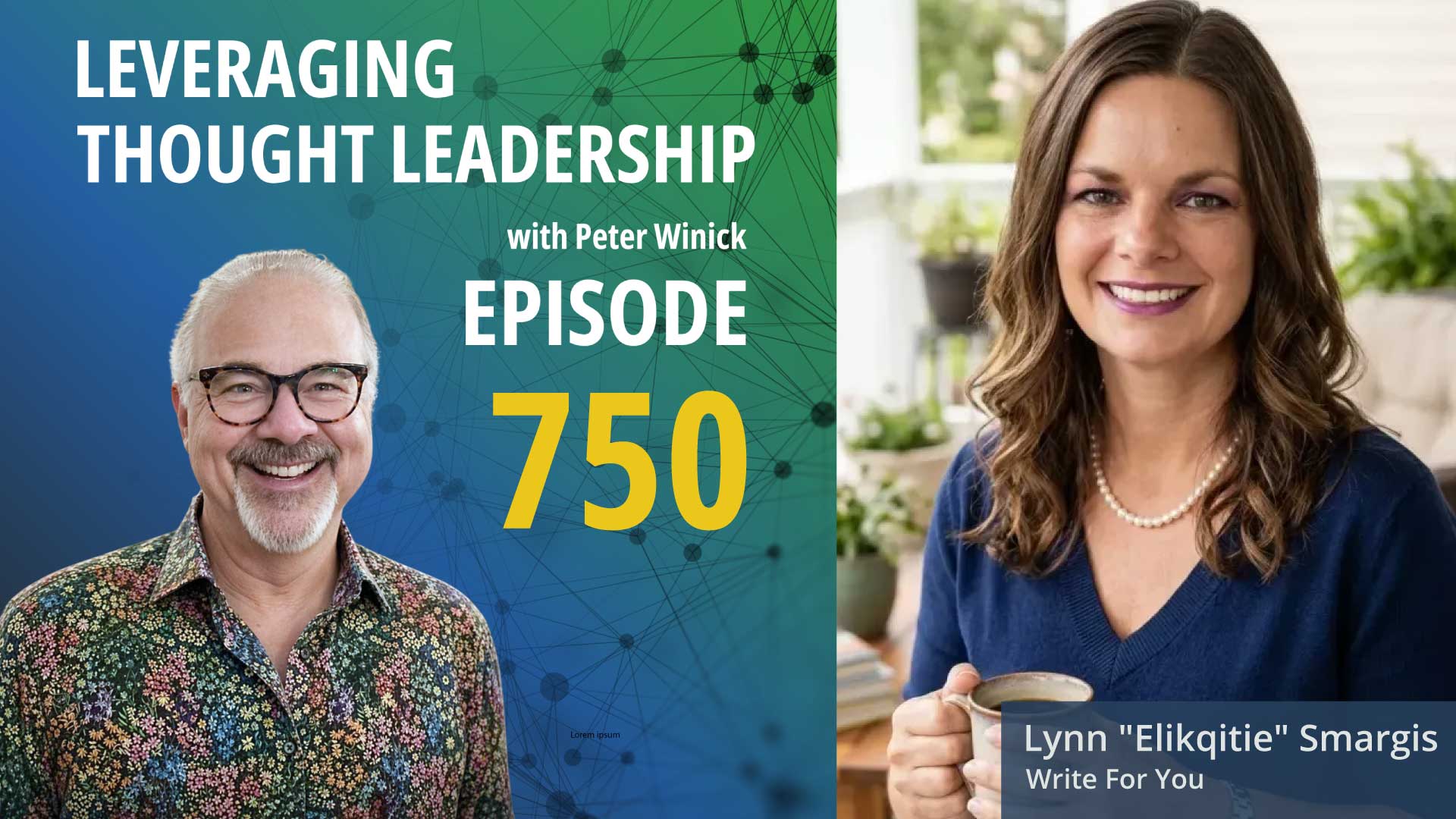



Ghostwriter Lynn “Elikqitie” Smargis on ownership, predatory contracts, and publishing on your terms
Self-publishing has never been easier, or more confusing. This episode explains why first-time authors should consider self-publishing first, how AI is changing the rules, and what to ask before hiring a ghostwriter. The takeaway: protect your ownership, your reputation, and your wallet.
One author sold 260,000 books and still hasn’t earned a dime from them. The problem wasn’t the book. It was the contract.
In this episode, Peter Winick talks with Lynn “Elikqitie” Smargis, a seven-time published author, ghostwriter, podcast producer, and founder of Write For You. They discuss what it takes to get a book into the world without getting burned along the way.
Lynn makes a bold case: self-publish your first book, no matter what. Traditional and hybrid publishing aren’t bad, she says. But doing it yourself first teaches you how publishing actually works. That knowledge matters before someone else’s lawyers write you into a corner or take over your Amazon KDP account. Peter has seen first-time authors land near seven-figure deals, so he pushes back on the “always.” The exchange that follows is a useful stress test for anyone
weighing their options.
From there, the conversation turns to book goals. Most executives and speakers aren’t chasing the bestseller list. Some want a calling card that turns into warm leads. Others want a legacy piece for the people who matter to them. Each goal needs a different strategy, even though the writing process looks the same.
Then there’s AI. Lynn explains why traditional publishers won’t tolerate any of it, to the point of pulling a contract because an editor used it. Peter argues there’s a real difference between “AI wrote my book” and “AI helped me research it.” They agree on one thing: the “five sessions and out comes a manuscript” approach is a fast way to damage a reputation you spent years building.
The second half of the episode is a practical guide to building your book team:
- What should you ask a potential ghostwriter?
- Why is “I write every genre” a red flag?
- Why does personality fit matter more here than with almost any other professional you’ll hire?
If you’re an executive, consultant, or speaker thinking about a book, this conversation will help you ask better questions. It will also help you spot a sales pitch dressed up as advice.
Three Key Takeaways:
- Self-publish first to learn the business of books. Going through the process yourself means you understand contracts, own your KDP account, and keep creative control. You can always pursue a hybrid or traditional deal for a later edition.
- Define the goal before you write a word. A lead-generating calling card, a bestseller push, and a legacy book all involve writing, but each needs a different strategy, budget, and marketing plan.
- Hire for process and fit, not promises. A good ghostwriter can clearly explain their process, specializes in your genre, and will push back on your ideas. Walk away from anyone who limits communication or upsells services you don’t need.
Lynn’s conversation is a reminder that a book is a business asset, not just a manuscript. Every decision, from who publishes it to who helps write it, shapes what that asset can do for you. That idea runs through The Thought Leadership Handbook: How the Experts Elevate Their Big Ideas—And How You Can Too, by Bill Sherman, Peter Winick & Naren Aryal. The book draws on more than 700 conversations from this podcast, and part three focuses on where the publishing industry and thought leadership intersect. That gives you the strategy behind the publishing choices Lynn describes. Learn more at thoughtleadershiphandbook.com, and order your copy from Amazon, Barnes & Noble, Bookshop.org, or directly from Amplify Publishing Group.
Get Your Copy of The Thought Leadership Handbook at:
Amazon
Barnes & Noble
Bookshop.org
Amplify Publishing
Apple Books
Transcript
Peter Winick And welcome, welcome, this is Peter Winnick. I’m the founder and CEO at Thought Leadership Leverage and you’re joining us on the podcast today, which is Leveraging Thought Leadership. Today my guest is Lynn Elikqitie Smargis, which I think I got that right, did I Lynn?
Lynn Elikqitie Smargis Yes, you got it.
Peter Winick Nice. I’m gonna quit while I’m ahead and I’ll give you a little bit of background on Lynn. She’s a six-time published author She’s at ghostwriter. She is a podcast producer and she’s the founder of right for yourself publishing So she’s pretty much a go-to resource for professionals thought leaders and executives who are Navigating the overwhelming world of self-publishing and need a trusted guide who’ll give them powerful straightforward advice without the runaround So without further ado no run around. Let’s just do it Lynn. How are you?
Lynn Elikqitie Smargis Sounds good. I’m doing well. How are you, Peter?
Peter Winick I’m doing great, so I think let’s just start, you and I were chatting a little while ago, or a couple days ago, whatever it was, about sort of the world of publishing, self-publishing. There’s so many choices today, and it’s so, I don’t wanna say, on the one hand it’s easier than ever, but it’s also really confusing. So what is it that you tell a potential client like sort of early on to lay out what the landscape looks like?
Lynn Elikqitie Smargis Yeah, I know. It’s sort of that catch-22 where it’s easier than ever to publish a book, but there’s so much information out there. It is like, where do I start or what’s my next step? Yeah. So typically what I always tell people is you always want to self-publish your first book, no matter what. And the reason I say that is because traditional publishers and hybrid publishers have a lot of. Like really, really, really good contract writers that write people into corners. Like it’s like perfect example is a gal I met at a conference a few weeks ago and she spent she had sold two hundred sixty thousand books and hasn’t made a penny on it yet because her contract was so predatory. So if you’re starting to write a book, like you want to, I would say self-publish, I would also recommend just figuring out what idea it is that you have and who your avatar is gonna be. And that’s where you really need to start if you are working on publishing your own book.
Peter Winick Got it So we’ll get to the avatars in a minute, but I always question things that start with always, right? So like, always self-published. So I’ve got lots and lots of clients over the years and I’ve had first-time authors come out of the gate with six, almost seven-figure deals. I’ve folks that have self-Published, but because they picked the wrong vendor, if you will, it was really awful-looking and didn’t do well and hurt them from getting a gig in the future. So why is it that you’re so, I don’t wanna say adamant, but like. I mean, that always is a strong statement. Why do you believe that to be so?
Lynn Elikqitie Smargis I say for your first book, and the reason I say self-publish your first book is because a lot of the mistakes people get themselves into when they’re going with a traditional or hybrid publisher could be avoided if they knew the publishing process. And if you self- published your first book, you know, the publishing process, you have your Amazon account already set up. Because one of the things I see a lot of hybrid publishers doing is literally taking over people’s KDP bookshelf and they have no access to their own KDP account. So if you self-publish your first book a lot of the big pieces that I see of mistakes that I see people make when they’re publishing their book can be avoided if you just self-Publish your first Book because Kind of you kind of been in the trenches, right? You know what it’s about. You own all your stuff. You know, what it is like to own your your own book. And then you can always make a second edition with a hybrid publisher if you choose to go that route. But I like that I like the also the creative freedom you get from being your own publisher and having complete creative control. Because when you do, if you make a mistake, it’s like, okay, it’s your mistake. If someone else has complete creative control over you, it’s their mistake on your work, which I have a really real, that rubs me the wrong way. And what do you say about…
Peter Winick Most first-time authors, when you talk about the process and what’s going on, they’re really, really, really hyper-focused on, I don’t know, the silly part, like writing a damn good book.
Lynn Elikqitie Smargis Uh-huh.
Peter Winick But I think there’s so much more to it in terms of all the details and the ISBN and your author pay, there’s like, I mean, I just went through it myself, but there’s many things that you wouldn’t even think are things that have to get done. And a lot of people, I don’t know if they wanna do all that stuff. So how do you maybe get the best of both worlds and think about self-publishing but have a partner that can take care a lot the stuff?
Lynn Elikqitie Smargis Yeah. And that’s actually what I do, Peter. So I because I actually have published another book since I sent you my bio. So, I’ve now published seven of my own books. And then I published books for people like at least three or four books a year or help or, you know, book coach more people as well. So what I I do is I work with my clients to get them past all of that stuff, answer all their questions, get them to the finish line. Faster with less stress and more way more efficiently than if they did it on their own, because I know all the pros and cons I know. And not just like, hey, you follow the same framework everyone else does. Like we have a framework that I follow. If you’re ghostwriting with me. Yeah. If I’m book coaching you or you come to me, you know, you have your rough draft half written or whatever it is. Right. Wherever point you come. To me. I based on what I know about your book and your book goals and why you want to use your book and things like that, right? Like I might have a different approach for you than another client who has completely different book goals or similar book goals, but a different purpose for their book.
Peter Winick All right, so let’s talk about book goals, because most people would say, well, that’s a silly question, because the goal is to sell a lot of books, which I don’t believe to be true for most people most of the time. So put them into a couple of buckets, maybe, of what are the top goals or the most common ones that you’re working with clients on.
Lynn Elikqitie Smargis Yeah. So for me, for my clients, because a lot of my clients are like executives and speakers, thought leaders. Most of their goal is just to use a book for the calling card, right? So their purpose is to make a really good, well-written book that they can hand to somebody and create a warm lead from. So that’s one goal to have. And some people do have a goal of selling a lot of books, and that’s a fine goal to halve. But if you do have that goal, know that you need to spend a lot time in a good marketing program and know your audience really well. But another goal for some people, some people just want to leave a legacy. Like some people just want to write their book, put it out there, give it to their friends and family members and leave a legacy. And that’s perfectly fine as well. That’s a whole different goal and a different approach than if you’re using your book to sell it for a business purpose or if you are trying to make, you know, the bestseller list on the New York Times. So there’s three completely different goals, but everyone’s doing the same process, which is writing a book.
Peter Winick Got it, and what is it? What are you seeing now? That’s Different than you might have seen say five or ten years ago either from a process Standpoint or a marketing or distribute like what’s what’s different?
Lynn Elikqitie Smargis Well, obviously, the big elephant in the room is AI, right? Like a lot of people think they can use AI to just copy and paste and write a book. I would highly recommend against that for copy and pastes like use it as a tool. Yes. Like for, you know, author titles or like, hey, can you tell me if I duplicated any content in this chapter? Like, it’s fine for that kind of stuff. But anything that’s detailed, not good for self. So that’s definitely one thing that has changed in the traditional publishing. Circles if you have used any AI in your book or your editor has used any I I they will literally pull your contract I have talked to someone who has a friend who had a contract pulled because her editor used AI I’m not sure if she knew that
Peter Winick Isn’t that you know, I find there’s a spectrum there of if I said to chat Give me 3,000 words based on these three things and blah blah blah And it did all the work and I just can’t be tasted that I get that that’s that’s not genuine. That’s not real That’s a thoughtful right? But if I’m using it for editorial Like how is that all that much different than then? You know, remember Luddites arguing against spellcheck 25 years ago, right? Right. Well or grammarly or what like come on like
Lynn Elikqitie Smargis It basically for traditional publishers comes down with a copyright risk, right? Like they do not want, they want zero copyright risk. So in order to have zero copyright risk, you have to have all human created content.
Peter Winick That’s really interesting, but as an author, and this is where the traditional publishing world and authors, their objectives, their goals, they’re just not aligned, right? Because the author wants to write the best book they can. I wouldn’t say with the least amount of effort, because that’s not so. They wanna write the book they they can, and why wouldn’t you use the tools available to you if it makes it a better product? I know, you know, like my use of AI for our book was basically, it was like, in my mind, it’s like I had six research assistants that worked for free.
Lynn Elikqitie Smargis Uh-huh, yep.
Peter Winick That I couldn’t have afforded or wouldn’t have spent the money or time or energy to hire that to do the level of detail work and all it did was point things out for us in terms of our podcast transcripts to go back and say this is an interesting like it’s just labor right like like if I were if I had a traditional publishing deal I it just seems silly to me they wouldn’t let me do that because of it’s a risk management thing
Lynn Elikqitie Smargis Yeah, it’s traditional publishing. It’s like, yeah. And traditional publishing is very like draw the line. Like you’re either with us or you’re not. Like it’s not, there’s no gray, no gray sections with traditional publishing, Peter, for sure. Hybrid publishing is definitely more lenient. I have had edited books with a hybrid for hybrid publishers and as like, you know, a service I do for them. And yes, I mean, I can see where their clients use AI and where they don’t. And so But for the most part a lot of people who are on a hybrid publisher, they mostly don’t use AI to write the book I know a lot AI or hybrid publishers are will not take you on if you’ve just used AI to copy and paste your book But at the same time, obviously if you’re self-published you can do whatever you want with your book But I would never still not recommend copy and pasting just because it’s just basically crap as you probably know
Peter Winick For years, this podcast has explored how thought leaders build, influence, and create change. Now, Bill Sherman, Nara Nariyal, and I have put the experience into a new book, the Thought Leadership Handbook. It’s available now. Learn more at thoughtleadershiphandbook.com and order it today at Amazon, BNN, Bookshop, or directly from Amplify. Stay there a minute. So I think the one of the trends that I’ve seen in the last It was happening before sort of the the AI boom if you will, but definitely more so in the past 12 18 months are all of these and I won’t name names But you know, you could write a book in five minutes or right. You know, there’s these AI tool-based Well, we’ll have the AI thing or bot or whatever You’ll do five sessions with you It’ll ask you a bunch of questions and on the other side comes a manuscript as if you were making sausage, right?
Lynn Elikqitie Smargis Exactly. Yeah. Like just throw all the ingredients in the insta pot and then out comes chili.
Peter Winick Right so so that’s like the air fryer method of writing a book and I always look at that and say wait a minute like You’re putting your name on that. You’re hoping to win business because of that. Your hoping to Increase the value of your brand your reputation your like there’s all this other stuff and people aren’t stupid You know people look at and go slop right like we we know it in a millisecond when we read an article on LinkedIn That’s AI slop. Why would why do people do that? Like I don’t I mean I guess
Lynn Elikqitie Smargis I think because people feel like it’s an easy way to become an author, but honestly, to your point, Peter, I have talked to, I can’t tell you how many people I’ve talked to that said they’ve been to a keynote or a speech and they picked up the book that they were given for free. They looked at it, saw a bunch of mistakes all over the place and literally wouldn’t even take a free book. And that definitely hurts your reputation. And I like in writing, you’re just using AI to write your book like the Jurassic Park movie, right? Like when they, when, what’s his name, I’m blanking his name but the chaotician. And he says, you know, we kept making dinosaurs and making dinosaurs, but nobody ever stopped to ask, should we be doing this, right? And that’s the question authors need to ask themselves is do I want to risk putting my reputation on the line by having AI write my book? And we all know once you damage your reputation, it’s insanely hard to get it back. I would say for me, heck no, I would never copy and paste AI and write a book from that. Crap material to be honest. I’m like nobody wants to read that stuff. It’s just boring.
Peter Winick So if I’m someone out there listening that fits into your avatar or my avatar of maybe they’re a senior, that’s not someone that says the first way they introduce themselves is I’m a writer, but they’re about to embark on or considering embarking on this journey of becoming an author to drive their business, build their brand, all the things that we talk about. What are some things that you would suggest that they question in a potential partner, whether that’s a publisher, a ghostwriter, a public, you know, because there’s a whole now army of folks that are happy to help you, assuming you’re an object, right? What are some things to ask when you’re putting together your dream team?
Lynn Elikqitie Smargis Yeah, they’re actually that’s a great question, Peter. And thank you for asking me that. Like there’s several questions I would ask. Like one is how often and how can I communicate with you, right? If someone is really like, like I have talked to people, Peter, who said, like, oh, yeah, my ghostwriter said I can only communicate with them twice. That’s that’s. A big flag, right. Like if you can’t email communicate with your ghostwriter, like, you know, during normal business hours. That’s one thing to ask them. Another thing I would ask them is, is are they do they have experience in your genre? So like I only do nonfiction, ghost writing, developmental, online editing. I I partner with people who do other work as well. So I can refer people so they don’t have to, you know, continually interview business only people. So I would asked them, like, do you have other people in your network? They can also offer services also like what’s your experience with? You know, your genre. And if someone says I write all genres, that’s a big red flag run the other way. Yeah. Like you don’t want someone who writes all genres. Like I write fiction for fun, but I don’t do it professionally. So that’s
Peter Winick But that’s different though, because when you’re talking to a client, you’re saying, listen, this is what I do for a living, right? I write books like people like you for fun. I might do sci-fi or fantasy, but whatever that’s cool. But it’s also for fun, you might bake sourdough bread. It’s like exactly a good bit to know about you. But it is not why I would hire you or not.
Lynn Elikqitie Smargis Right, right. And then the other thing I would say is, like, like if you’re asking the person questions about the process and they can’t answer you, they can answer you clearly, that’s a huge red flag as well. Like, I can tell you.
Peter Winick Okay, so stay there a minute, because you just hit the P word that’s big. Process. Right, everybody, not everybody. Lots of people think that writing is this woo-woo, artsy, creative, I gotta sit there cross-legged and get in the zone, but process is important. And by the way, your process could be very different than 10 other ghost writers’ processes, but it’s the one that you’ve developed that works for you working with your types of clients. So I love the process question, right? So. Maybe it would even be something like, well describe for me the process and how can I be a good client when we work together? Something along those lines.
Lynn Elikqitie Smargis Right, yeah. So like ask them about their process because if they can’t answer what their process is or it’s like not clicking with you, that’s a big like just that’s not a good fit for you or if their personality isn’t a good for you. Okay, so stay with that.
Peter Winick Okay, so that’s that’s the that’s a big one. So yeah, this whole clicking personality thing. So I’ve been around this space long enough to realize that ghostwriting one guy’s opinion is one of the strangest professions from the standpoint of like, here’s a long list of professionals I
Lynn Elikqitie Smargis I agree with you, and I’m a ghost writer.
Peter Winick Out these profession, you know plumbers like if there’s something wrong with my toilet and I hire a plumber unless they’re really abrasive or out of control. I kind of don’t really care about their personality, I don’t maybe I don’t care if they have one but sometimes something about this the intensity of the relationship and the personal nature of the relationship that You just remind me of my third grade teacher and her evil red pencil. And I don’t even know why. But from the get go, I’m not going to like you. Or it has nothing to do with, are you qualified? Like, everybody else you hire, are they qualified? Do they have the skills? Have they done a project like this before? Check, check, check. PMI or check and tell you, here’s the checklist of how to hire somebody to do a task. But ghost writing, there does need to be this vibe, this fit that like, hey, we actually have fun doing this. This is kind of interesting, whatever. Yeah. How do you check for fit because you don’t want to work with people that would drive you crazy either.
Lynn Elikqitie Smargis Right, right. Yeah. Like, well, well for how I do it is I always jump on a path of publishing discovery call with somebody and just talk to them on Zoom. And I usually know within the first two to three minutes if we’re going to be a good fit. And the reason why you want to be a good bit with your ghostwriter, Peter, is because this person is literally going to be your BFF for the next six to 12 months. And your book, you know, as far as it’s, you know. Yes, it’s process. Yes. It’s a business book, but it’s still your framework. It’s still you’re process you’re putting on paper. It is your life work that you’re putting in this book. So it does have a lot of emotional ties back to you. So I have to say, I’m not just a ghostwriter. I’m also like a book therapist and a coach and like all the other things as well rolled into it. And I do often.
Peter Winick Break down for me you said I know within the first two three minutes if it’s a fit now that to me to some degree is the curse of the expert right because if I’m interviewing a ghostwriter I might maybe you’re my first or fifth ghostwriter i’ve talked to you’ve been on the other side of this and there’s hundreds so when you know within two or three minutes give me a sense of the checklist that your brain is going through to make that determination because you’re not just looking and say oh Peter’s wearing a purple shirt I don’t like people with purple shirt they’re jerk at. But maybe you are like, but what are what are the things that you’re looking for asking for listening for? Yeah, two to three minutes to make that
Lynn Elikqitie Smargis Yes. And I am going to, I’m going to preface this with because I am my personality. These are what these things I’m looking for. I’m obviously like other ghost stories look for other things. So yeah. So what I look for is someone who is open to collaboration, not someone who like, I mean, and if someone was to just give me their content and say, Hey, write my book. I’m fine with that too. But what I really like is someone who’s collaborative like they are. They’re really passionate about their work. They’re open to sending me ideas. I mean, you know, obviously they’re open to my ideas as well. But also to someone who can take constructive criticism, right? Like if I say, hey, I this is what this is what I don’t like about it. And this is why I don’t like about it, that they disagree with me. That’s perfectly fine. But if you’re like, I don’t want to hear any of your criticism, I just want you to write what I want you to write, that’s not a good fit for me.
Peter Winick I’m not I’m That’s taking vacation, right? That’s not, okay. So collaborative, open-mindedness, feedback, awesome. And a lot of times, because you’re dealing with very senior level executives, the air gets a little thin up there. They’re not used to people necessarily. I mean, they say they want people to challenge them and blah, blah,blah. Right, but what people say and what people think. Yeah, but if you’re just placating them, you’re gonna be a co-conspirator in creating a mediocre product.
Lynn Elikqitie Smargis Right, right. No, I never play key people. And that’s what that’s part of my brand. Peter’s like the no BS, no fluff. But I do tell people like, okay, here are your options, right? And I lay out all the options for them. I answer any questions for them and then ultimately, it’s my client who gets to make the decision if they want this or they don’t want this, whatever it is that we’re talking about, right, but I will always educate people on all the different options that I know of and then they can make a decision based on that and then get back to me on how they want to move forward. So That’s what I love about the collaborative process is like me educating my clients on the different options they have and then they make the last call on what they want.
Peter Winick Got it. Well, this has been fun any other parting words of wisdoms or tips or hints or question to throw at someone listening that sort of
Lynn Elikqitie Smargis Yeah!
Peter Winick Like hey, I might be writing like this is really interesting what you know fill in the unknown unknown
Lynn Elikqitie Smargis I would. Yes, I would say the one warning I would give everybody who’s listening to your show, Peter, is that if it sounds too good to be true, it probably is. We all know that adage. But but the caveat to that, too, is people who are who know you’re writing a book because you posted it somewhere on social media, they know you are excited. They know you emotionally invested to it. And they’re going to use that to try to get you to spend probably more money than you need to on whatever service they’re trying to pitch you. So I never do that with my clients. I ask them a bunch of questions and I only give them what they need. Like I’m not overselling my services. So if you’re, you talk to somebody and they’re trying to sell you like, you know, four different things you don’t need and you’re telling them, no, just walk away. Like do not feel like bad about hurting their families and walking away. Cause there’s so many people out there that are predatory in the publishing world anymore. You have to be really, really careful on who you talk.
Peter Winick I think that’s right. I like that. And I think there’s, you know, capital P, predatory and lower P, right? So a lot of, be it traditional or definitely some of the hybrids, they’re in the business of selling services to authors. That’s their business, right. And yes, they shouldn’t be selling you things that are not good for you or wouldn’t help you or whatever, but dot dot dot caveat emptor, right, like you still have to understand like, Hey, tell me, it’s okay to ask. Like, why do you think based on what you know about my goals and my objectives. That that marketing thing that you suggested or buying a book airport buys or whatever is a good thing for me and it might be because sometimes you don’t even know that something’s an option. So it’s okay to look at it, but don’t feel pressured to say, oh my god, they sent me a menu of 22 things and there’s only one that I like, right or one that fits my needs. I think that I think it’s wise. Good stuff. This has been fun.
Lynn Elikqitie Smargis Yeah, thank you. No, thanks for having me on. I really appreciate it, Peter.
Peter Winick To learn more about Thought Leadership Leverage, please visit our website at ThoughtLeadershipLeverage.com. To reach me directly, feel free to email me at peter at ThoughtLeadershipLeverage.com, and please subscribe to Leveraging Thought Leadership on iTunes or your favorite podcast app to get your weekly episode automatically.
