
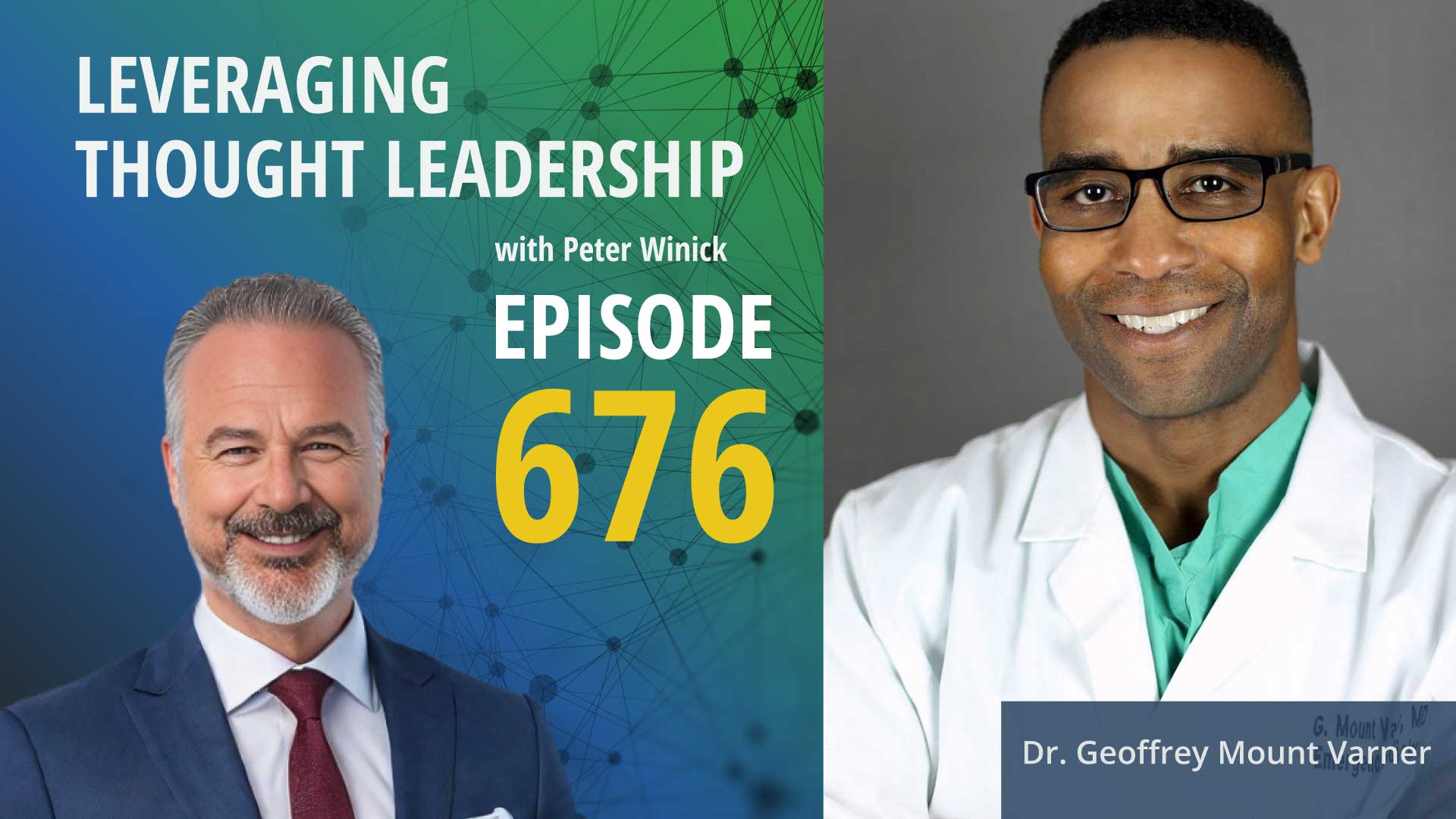
The DPD Framework: How to Decide Faster and Lead Smarter | Dr. Geoffrey Mount Varner
The Leveraging Thought Leadership podcast is created by Peter Winick and Bill Sherman and produced by Thought Leadership Leverage.



The leadership advantage of acting with clarity, confidence, and purpose.
This episode explores how leaders can make faster, smarter decisions under pressure by applying structured frameworks drawn from emergency medicine. It highlights the dangers of indecision, showing that delayed choices are still decisions—with consequences. The discussion focuses on how to prioritize decision-making energy, train decisiveness as a skill, and build teams that support clarity and accountability in high-stakes environments.
What happens when life-and-death decision-making meets the boardroom?
Today our guest is Dr. Geoffrey Mount Varner—a physician, author of “FAST DECISIONS: Think Fast. Be Bold. Be Fearless”, and leadership expert—shares how his experience in emergency medicine led him to develop a powerful framework for decision-making under pressure. As the former head of Washington D.C.’s emergency Ebola response, Dr. Varner learned that hesitation can be deadly. Today, he brings that same clarity and urgency to the world of business leadership.
Dr. Varner explains how most leaders waste valuable “decision energy” by treating every choice as equally important. His approach teaches executives to quickly identify which decisions deserve deep thought and which can be made in seconds. At the core of his DPD framework—Deep Breath, Pause, Decide—is a deceptively simple but scientifically grounded process that empowers leaders to quiet emotion, activate intuition, and make confident, timely decisions.
He and Peter Winick dive into how the corporate world often rewards inaction—where delayed or avoided decisions are seen as safe career moves. Dr. Varner argues that indecision is, in fact, a decision—and one that can cripple organizations. He offers practical, repeatable ways for leaders to break through analysis paralysis, train their teams for agility, and create a culture of accountability and speed.
Finally, Dr. Varner reflects on his own transition from medicine to thought leadership—transforming his crisis-tested experience into a business-ready system. Through books, speaking engagements, and workshops, he’s building a new generation of leaders who make better choices, faster. Because in both medicine and business, the ability to decide well can be the difference between success and failure.
Three Key Takeaways
- Decisiveness Is a Trainable Skill.
Great leaders aren’t born decisive—they’re trained. Dr. Varner’s DPD framework (Deep Breath, Pause, Decide) helps leaders manage emotion, engage intuition, and act with confidence under pressure. - Not All Decisions Deserve Equal Attention.
Leaders often waste energy treating minor choices like major ones. Dr. Varner categorizes decisions by consequence—low, medium, and high—so leaders can spend their time where it matters most. - Indecision Is Still a Decision.
In business as in medicine, delayed action carries risks. Dr. Varner reminds leaders that avoiding decisions is itself a choice—one that can stall progress, weaken accountability, and erode trust.
If you found value in this episode’s focus on making faster, smarter decisions under pressure, you’ll want to check out “Making Better Decisions Through Thought Leadership” with Thomas Lahnthaler. In that conversation, Thomas explores how the strategic use of thought leadership isn’t just about ideas—it’s about preparing teams for inevitable crisis-points, creating choices rather than waiting for them, and harnessing collective insight when the pressure’s on. Listen to both episodes back-to-back to unlock how frameworks + mindset + action combine to turn uncertainty into advantage and hesitation into leadership momentum.
Transcript
Peter Winick And welcome, welcome, this is Peter Winick. I’m the founder and CEO at Thought Leadership Leverage, and you’re joining us on the podcast today, which is Leveraging Thought Leadership. Today’s gonna be fun, or I think it’s gonna fun. We have with us today, Dr. Geoffrey Mount Varner. He is a medical doctor, an author, a speaker, a thought leader, a whole bunch of things. So by day, when he’s in his scrubs, he’s an ER doctor, but he’s created this whole framework model methodology that’s backed up by a couple of books and other things that he’s done on making decisions, split-second instant decisions. And what I love is one of the things I love about what I do from a thought leadership perspective is when someone takes their domain expertise from one field, right, and moves it into another field. So in this case, we’re going from medicine to business because the answer to too many things in the corporate world is, oh, we have to make a decision, let’s form a committee and we’ll come back in 18 months and figure it out. Yes, I probably don’t want that to be happening. If I was unfortunate enough to be lying on a gurney and you’re looking over me. Now, you know, I don’t know, do we is he having a heart attack? Is he not? Do I give him this medicine? Do I not? So tell me how did the I assume it wasn’t because you had an abundance of time on your hand practicing medicine that you said I think I should start writing books and doing all that. But how the spark go up at where the light bulb come from here.
Geoffrey Mount Varner Well, thankfully and thank you very much for having me on your show I love the work that you do the light bulb happen actually when the mayor of Washington DC Appointed me to be in charge of the emergency Ebola response many many many years ago I was also in charge for all mass casualty in Washington DC And the reason why that stands out is that I was working with the chief of police the chief The the health minister as well as the this all the top cheese And what I’ve learned is that their decision process, some of them had an optimal one, others hesitating. And in some environments, you can’t hesitate. And so when you mix those, what I found was there’s a pathway that needed to be created to merge for when a decision is a time structure or time involved decision and one when it’s not. And least importantly, people just need to spend time on the most important decisions.
Peter Winick So I love that. So when you move into business, right? So, so one is, let me take that up a notch. There’s a lot of work done on fast brain, slow brain, and then sort of the, the, an expert, you know, like there are times where you could wheel your car into shop and that mechanic just knows by that little weird noise that it made exactly what it is, not because he’s impulsive or not doing the work, because he seen that same problem a thousand times before and worked on that same situation. So how do you advise people in the business environment? When to go quickly and when not to because quick isn’t your work isn’t binary that says everybody should just do everything quickly. That would be Daniel. Right. So I would be
Geoffrey Mount Varner These decisions in three broad categories, one of the low consequence, those are what to wear, what to eat, they don’t matter. You should spend no time in those. I’m gonna get back to that one. Then you have the medium ones. Where there are slight consequences, they are reversible. If you choose a job, buy a car, okay. But then the ones with major consequences such as who to marry, where to live, those have major consequences. And so it’s okay to spin. Time on those. But what ends up happening, Peter, is that people spend an equal amount decision energy on all three categories. And then finally, once you wrap pressure of time on there, it becomes even more interesting. And from the emergency medicine point of view, and from the leadership point of you, I would encourage leaders don’t spend any time on those decisions that are low consequence, the ones that don’t matter.
Peter Winick So how much of this is based on an individual’s personality, style, and history? And I’ll tell you where I’m going with that. I have friends who I’ll, you know, haven’t seen in two, three days say, Hey, what’s going on? Oh, I went out Saturday morning, decided to buy a car, bought a car. It’s getting delivered today. Awesome. Great. Then I have other friends where they’ve been thinking about buying a car for three years, right? And they research every article and every this and every that. They’ll never buy the car. I mean, at some point they will. It’s ready fire aim versus ready aim fire. How much of that is trainable, teachable versus someone’s just conditioned or leans in a certain way.
Geoffrey Mount Varner Well, it’s both. Most people, it is binary, people not this or that. You’ve got to put them in the right environment. And so most of those skills are teachable and they’re like a trainable. The question is, are they transferable? But most importantly, that you hinted at is, do they want to be trained? Do they want be taught? Because some people are just, they’re light where they are, they don’t move, they’re very confident and they have no interest and learning our new A, our new skill.
Peter Winick And what would be something that gives someone that interest, right? Like, so if I’ve always been, which, which I’m not someone that overthinks, overanalyzes, whatever, and doesn’t get to a decision quickly, is there something where maybe there’s a consequence from not deciding quickly enough that said, geez, you know what, this isn’t really serving me well anymore.
Geoffrey Mount Varner I think it goes down to their purpose. If they know what their purpose is, it makes their decisions easier. But let me go back to your question. People should understand, and I find this with leaders a lot, no decision is a decision. A delayed decision is decision. Many times, leaders will put stuff off and say, I will decide later. Well, wait a minute, the environment may change. The circumstance may change and your delay may require someone who’s less
Peter Winick But stay there in a minute, in your domain in medicine, you’re about to walk into a 12-hour shift in the ER, you can’t, I mean, just the environment there doesn’t allow for no decision or delayed decision. There is an expectation, because literally lives are at stake, that you will make a decision, or if you’re delaying a decision it might be to get a lab result, you know, it’s based on something, but it’s not like, yeah, I’m kind of not sure to do what to do with that Peter dude, let me ponder that for a couple of weeks. Like you have to make decisions, right? So you may need more clinical data, et cetera. But I think culturally in a lot of organizations, no decision and delaying a decision is actually a career strategy for a lot of people because they don’t want their name tied with it. Right? What if it’s, it doesn’t, this project doesn’t bode well for my career. Or what if it doesn’t work right? Or this product launch or whatever. So I think there is a culture of sort of intentional delay or not, because a decision means you’re accountable to who decided that the buck stopped here. I made that decision. So tell me how you see that in the corporate world because that’s where you’ve decided to spend a lot of time these days.
Geoffrey Mount Varner Yeah, and that’s where I have spirit time. Where I see that, I think that as a leadership issue. Meaning that what I’ve noticed is the high performing leaders, the executive levels, they usually don’t have that delayed decision-making instrument. It’s those that are directly under them. And if they allow those that are directly under them to do that, that’s a reflection of their leadership. But here’s the deal. They can be trained. But you’re right. There’s a swath of people who their goal is Maintain, don’t decide because I’m not accountable. But what I will argue, I don’t have the data is that those on the higher end, they’re not of that because they made decisions to get them to where they are.
Peter Winick So let’s sort of double click a little bit on some of your work, right? Because it’s one thing for you to stand there and say, Hey, I’m an ER doc. I make quick decisions all the time. Cause it’s life and death. And I’m like, all right, well I’m going to actuary like, or I’m a whatever, I am a lawyer, I know whatever. You know, I’ve looked at some of you work and there are models and methods and frameworks and systems that you’re relying to help you do that. Talk about how you develop those and what you’ve seen as benefits to those that choose to embrace them in the corporate world.
Geoffrey Mount Varner Well, thank you for that question. For those who choose to develop in the corporate world, first they’ve got to recognize to increase your decision-making skills is not a overnight process. There’s a framework, there’s time. But for instance, if you want to improve it right now, I have something called the DPD framework. And that simply is you take a deep breath. The reason why that is so important is because most of our decisions, 94% of our decision are emotive. They’re based upon our emotions. Taking a deep breath gives you access to two parts of your brain. Your locus coerulus, which slows your heart rate down, and your amygdala, which is the emotional part. It allows you to slow down. You pause, pause. Now you decide, but let me tell you why the pause is so important for everybody. Our subconscious keeps a permanent record of everything. If you pause, it allows your subconscious to weigh in there. We often call it… Insight, intuition, that’s real. So just taking that deep breath, pausing, and then deciding is something you can do now. And I’ve seen leaders with the highest ends of government actually do that. Because sometimes I see that even they get flustered if they have not been trained in high level, especially high level decisions where time.
Peter Winick So I would assume that not only does that lower your heart rate, get your brain to be in thinking mode, but it also potentially neutralizes the external factors of the environment you’re in, right? If noise, loud, trauma, pressure, the boards calling on you, whatever that is that’s inflicting pressure, but it’s kind of knocking out that heat of the moment stuff to say, I know in my brain, the right capabilities or the best that I have is in there, I’ve got to optimize that brain. It’s kind of like stretching before a workout, right? Like it sounds like it’s similar to that. If you teach yourself to do that, it becomes part of a routine. Is that a favorite? You’re right.
Geoffrey Mount Varner Everything in life. Repetition means everything. What you do regularly, you get good at it regularly. And so you practicing that. And then as it relates to leadership, the people you put around you played a unique role. So I always talk to leaders and say, your leaders who are below you, that’s a reflection of you. Because sometimes you may need someone to step in and give you advice or give you insight. And so if you have formed a weak leadership team, guess what’s gonna happen? Your decision. It’s probably going to be weaker than what it needed to be, or maybe slower.
Peter Winick If you’re enjoying this episode of Leveraging Thought Leadership, please make sure to subscribe. If you’d like to help spread the word about our podcast, please leave a five-star review at ratethispodcast.com/LTL and share it with your friends. We’re available on Apple Podcasts and on all major listening apps, as well as at thoughtleadershipleverage.com/podcast.
Peter Winick So I want to segue now into some of your decisions, right? We’ll get a little meta here. So life is good. You could be a practicing MD for as long as you’d like to be. You’re really good at it. You’ve got these accolades in, in, DC and such. But now you’re spending part of your time and maybe more of your time in the future or whatever, not practicing medicine, but being a practitioner of thought leadership. How did you make those decisions? And what are the things that have been surprising and rewarding and What’s that look like? Because that’s an unknown place for you to some degree.
Geoffrey Mount Varner I kind of earlier, once you define your purpose, and I think that you’ve, that you’re seasoned enough to know that when you have a purpose, it shapes all of your decisions. And so my purpose is to make sure that people have the skills that they need to make good decisions. Because at the end of the day, and most people don’t like to admit this, we are products of our decisions, but only the successful people like to emit that. And so if you train yourself, on making decisions is key, and then this is key. Most people, they make a decision and write it wrong. Don’t view it that way, you know, because nobody’s God. You don’t choose to make a wrong decision. It’s, am I right or have I learned here? Like I never lose, I never loose. Either I win or I’ve learned a lesson. And part of that is mindset. So my mission is to make sure that we have the most prolific leaders. Who can think and make decisions. And also the stu-
Peter Winick But so stay there a minute. So I could chop the doctor part off of your name. And totally that makes sense to me. But how do you wake up one day? I mean, you spend years and years and years studying and practicing what you do and being top of your game. It seems to me and oftentimes, and the reason I’m asking the question is. It seems obvious to you, but it doesn’t seem obvious to me how practicing medicine and this isn’t that far of a leap.
Geoffrey Mount Varner Great question, Nate. So I have a first book, and this is key, it’s called Training Your Mind for Split-Second Decisions. That framework from being in the ER, being in charge of Ebola, being in charged of like mass casualties. But then you are such a wise man, fast decisions happen. And that came from my life. You know, having prostate cancer, have you come back three times, have 114 doctor’s appointments within 18 months. It force you to make decisions. And these are fast delight decisions because at the end of the day, you can say, I’ll think about a doctor. Then guess what that means? It means you may not get another appointment for another couple of months. And when it comes to advanced stages of many diseases, there are no absolutes. So you have to have a framework for thinking about it. And so as we saw, I’m going through there, I recognize, hey, decisions If you have to have a framework, because at times it won’t be a perfect environment. You won’t have the right mental mindset. And when I say that, you may be stressed. You may be worried.
Peter Winick When you’re dealing with your own medical issues, you may even be in a place where you resent having to be in the position to even make the decision. I didn’t ask for this. Let’s sit a sermon there, brother.
Geoffrey Mount Varner That’s true. But if you’ve got a framework, it makes it easier. But you are, you nailed it. You’re getting over the fact like, how did I get here? You know, and then you’ve gotta be careful when you have a decision, which is why I talked about leaders and the people around, because then you got it, you got to, you have to be careful about who you discuss your decision or your upcoming decision with. Cause not everybody is equipped to advise you.
Peter Winick So let’s talk about the business model here, right? Because the business mode of being an ER doc is pretty simple, as I would assume. As a non-ER doc, find an ER, get them to hire you, and say, hey, doc, you’re it, right. And obviously, there’s people that manage the business side of that, but it’s pretty clear what that looks like. Moving into the world of thought leadership, there’s about 100 decisions that you could make, might make, you should make, shouldn’t make, et cetera, in order to be successful. And I think a lot of folks from the thought leadership side. Because they’re coming at it from a place of passion, sort of aren’t as savvy or focused or intentional on the business side that’s important to them. And if the business doesn’t support you, then you can’t support it. Because you- Yes. So what are the things you’re finding easy and what are things you find challenging as you move into the business side of thought leadership?
Geoffrey Mount Varner Yeah, again, your wisdom stands out. People talk about writing books as being difficult. No, that’s the easy part. That’s the easier part. Even the marketing gets easy. It’s making that leap from, okay, this is not about book sales, because as you know, books don’t make money, but they give you credibility. But next is the whole speaking circuit. And that does well, but those are one shots. So now that’s creating a whole ecosystem around you. So that means horses That means events, that means intensive sessions set up. So creating that and understanding how to do it, I think that that has been the challenging part, but it’s been fulfilling. Just learning, I’ve got a business coach, learning about it, it’s interesting. I think what I would highly, what I wanted to comment on is that to do while you’re working is a little more difficult too.
Peter Winick Yeah, I think that’s totally true. And you also don’t want to be doing so much of the business that you only get to spend a small portion of the time that you have allocated towards this, not doing the stuff that you love, which is getting on stage, talking about it, researching it, right? Because that’s what drove you to do this. You didn’t drive, you didn’t tell me, you know what, I wanted to learn how to market courses. That’s why I’m doing this, right. Right, or I wanted learn how to… Successfully price myself as a keynote speaker and how to get that all done. But if you don’t figure that out, you know, all of that, because that’s not fun, that’s now why you’re doing it. So how do you balance that tension?
Geoffrey Mount Varner That’s a great question. I balance it, I try to do things in parallel, but what I’ve found is is that if one part of the step slows down, the whole system slows down. What I tried to do is I set goals. So right now the goal is to get the book, the speaking, the course you have set up. And then most importantly, the team, having a team makes a humongous difference. And so I’ve always been big on, I don’t wanna be a smart person on my team. Right now, unfortunately I have to be because smart people cost a lot more money, but having reliable teammates has been very helpful. And when I say that, I really mean my admin team, follow up, boom, boom. But the goal is to add the next hire will allow me to be the talent because they’ll help manage the business.
Peter Winick Love it. Love it.” So this has been fascinating. I appreciate your time. I kind of want to take advantage of the opportunity. There are people like you, right? Top of their game, professionals, whether it’s in medicine or law, whatever other field is that they’re, you know, top of their career, top of their games, top whatever, but something is calling them, like this purpose thing that you had. So I want to do more of that. What would you say to that person or maybe another way to ask this, what would you to you. Five or 10 years ago when you started this journey.
Geoffrey Mount Varner I would say, move towards your purpose. And let me answer another question there. Many people say, well, what is my purpose? Well, I would encourage people to get up at three or four o’clock in the morning when the house is quiet and ask yourself, what do you enjoy doing and how do you wanna lead the world? And somewhere in there is your purpose? Now, this is the key part. While you have gainful employment, start working on your purpose. I’ve seen people say, I’m gonna quit my job and then I’m going to start this. No, keep your job starting. And you know when it’s time to leave, your job is when business is blowing up so much on this private side that your job has interfering. Then that’s a sign.
Peter Winick That’s the opportunity cost math because I’ve worked with medical doctors, other professionals, et cetera. They say, listen, I really love this thing, but it’s costing me a lot because every time I’m not doing what I get paid to do and I get paid a lot and I’m a, you know, I’m a partner in a law firm, I make two grand, whatever. But you got to be able to neutralize those things to say, wow, this thing is paying me equal to or greater than what my profession is. Then it becomes kind of a no-brainer until you do that or, or, you know, or you, you want a trust fund or something. Well, this has been awesome. I appreciate your time and your transparency. Love the energy, and thank you for sharing your journey with us, Geoffrey.
Geoffrey Mount Varner Thank you very much for having me as well.
Peter Winick To learn more about Thought Leadership Leverage, please visit our website at thoughtleadershipleverage.com. To reach me directly, feel free to email me at peter at thoughtleadershipleverage.com, and please subscribe to Leveraging Thought Leadership on iTunes or your favorite podcast app to get your weekly episode automatically.
