
The Trusted Advisor: How a Wisdom Book Became Business Language | Charlie Green | 744
The Leveraging Thought Leadership podcast is created by Peter Winick and Bill Sherman and produced by Thought Leadership Leverage.
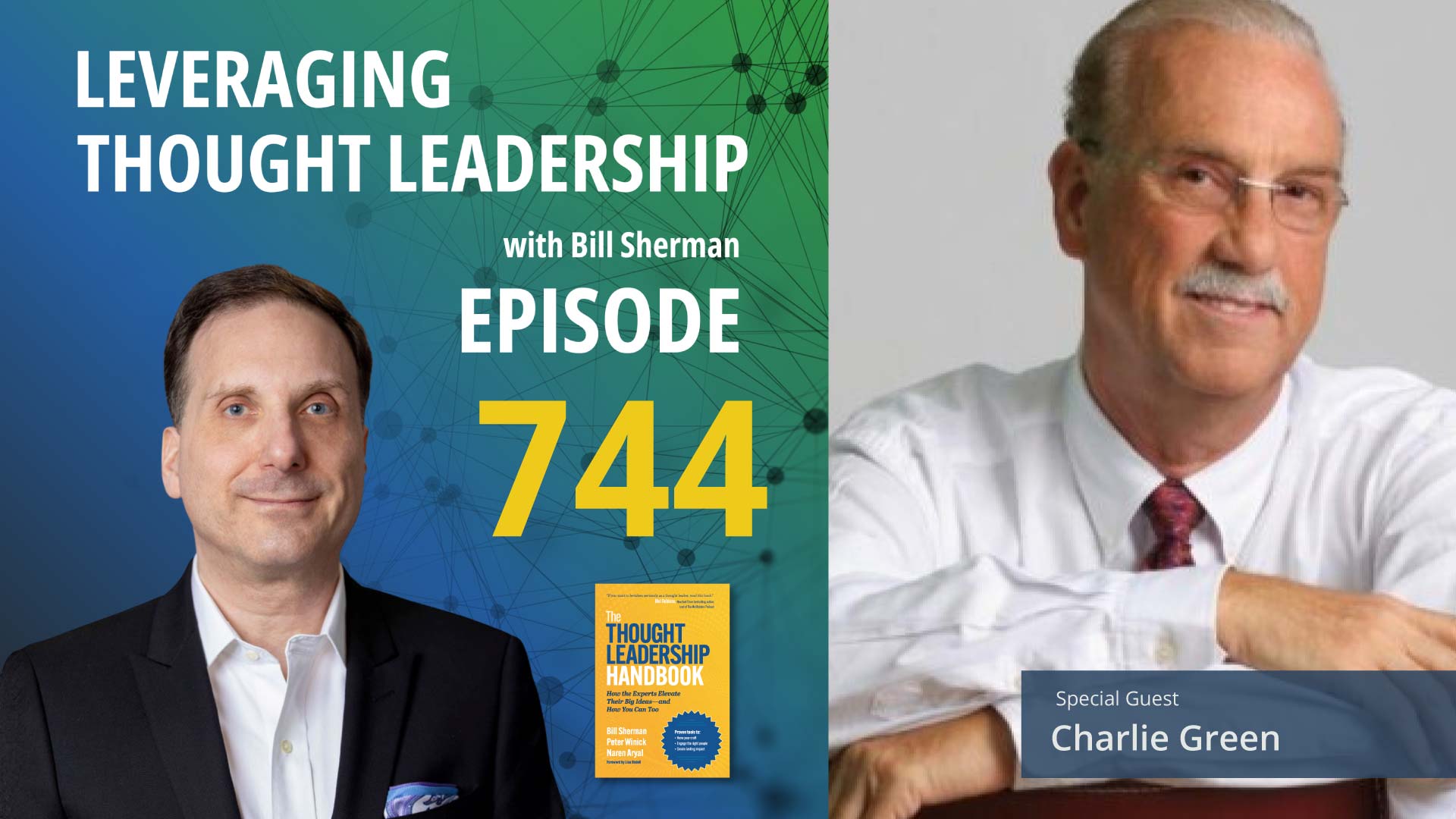



Charlie Green on repetition, fresh delivery, and the duty to share “little-t truth”
How does an idea become part of a field’s everyday language? This episode traces the origin of a classic framework on trust, why expressing an idea matters more than protecting it, the case for repeating yourself, and the duty to share hard-won wisdom with joy.
Publishers turned it down. They said there was no data and no market for a “wisdom book.” Twenty-five years and roughly 700,000 copies later, The Trusted Advisor is still on consultants’ shelves, and “trusted advisor” has become so common that many people use the phrase
without knowing where it came from.
In this episode, Bill Sherman talks with Charlie Green, co-author of The Trusted Advisor, founder of Trusted Advisor Associates and former New York cab driver, about where one of the most durable ideas in professional services came from. The story starts with luck. Two business school friends were trading consulting stories over coffee when a chance meeting with David Maister fixed their publishing problem in one phone call. One flaw in an older model, which Charlie had to fix, became the trust equation, the part of the book that stuck
with readers.
From there the conversation moves to bigger questions every thought leader faces. Should you protect your intellectual property, or treat ideas as part of a shared commons? Charlie is blunt: “Don’t be too full of yourself.” He argues that the idea itself is a bit overrated and that the real advantage is in how you express and package it. Charlie, a former philosophy major, also explains why defining your terms precisely helped turn a loose concept into something people could use.
Bill and Charlie also look at “little-t truth,” the practical, imperfect wisdom that helps people handle hard conversations and build relationships. They talk about the duty to share it, and the humility to accept that your audience doesn’t owe you its attention. They explain why repeating yourself is necessary rather than redundant. Charlie shares how he gives the same talk hundreds of times and still finds it fresh.
The conversation ends warmly. Charlie talks about the signs that his ideas have landed, including a phone call showing the book had been passed down to a second generation. Bill closes with a personal thank-you that shows just how far an idea can travel.
If you’ve ever wondered whether your ideas will outlast you, or whether you’re saying them enough, this episode is for you.
Three Key Takeaways:
- Expression beats ownership. Very few ideas are truly unique. What sets a thought leader apart is how clearly, memorably and usefully they communicate an idea, not whether they’ve trademarked it.
- Define your terms, then repeat them. “Trusted advisor” was already a common phrase. Giving it a precise meaning, and repeating that meaning consistently, is what made it a shared language others could pick up.
- Repetition is not redundancy. Just because you’ve written or posted something doesn’t mean your audience has read it, let alone absorbed it. Like a stage actor’s thousandth performance, each delivery is new for the people in front of you.
Charlie Green’s story of how The Trusted Advisor went from rejected “wisdom book” to everyday business language is the kind of journey Bill Sherman, Peter Winick and Naren Aryal map out in their new book, The Thought Leadership Handbook: How the Experts Elevate Their Big Ideas—and How You Can Too. Charlie draws on Bill’s “little-t truth” from the book in this episode. The book also covers the episode’s other big lessons: define your terms precisely, keep repeating your ideas, and accept that ideas don’t speak for themselves. It draws on
more than 700 conversations from this podcast and gives you the frameworks, case studies and tools to move your own ideas from insight to impact. Learn more and get a free chapter at thoughtleadershiphandbook.com, and order your copy today at Amazon, Barnes & Noble, Bookshop or Amplify Publishing.
Get Your Copy:
Amazon
Barnes & Noble
Bookshop.org
Amplify Publishing
Apple Books
Transcript
Bill Sherman Ideas can spread far beyond where you expect and shape lives long after you retire. The words you coin while facilitating a workshop or writing a book may become part of the field’s language. But there’s no guarantee that will happen. It’s a long journey from the first expression of an idea to success. Today, I speak with Charlie Green, co-author of The Trusted Advisor. Founder and former CEO of Trusted Advisor Associates and former New York taxi cab driver. In today’s episode, Charlie and I talk about the origin story of a powerful idea, the term trusted advisor and the trust equation, how they found a route to publication, transformation impact within the professional services firms and entered the general business lexicon. Success wasn’t certain. Charlie shares how they struggled to find a publisher for a wisdom book at a time when publishers wanted data-based business books. And now, Trusted Advisor, first released in 2001, remains relevant and evergreen. I’m Bill Sherman, and you’re listening to Leveraging Thought Leadership. Let’s begin. Welcome to the show, Charlie. Thank you, Bill. Pleasure to be here. So I haven’t had your book trusted advisor on my shelf longer than I have known you because in the transition for me, going from academia into the workplace, I came across trusted advisor and I marked it up was like I was in grad school at the time. Right? Notes in the margins underlining. Right. Here’s my question. How did you come to write a book about trust with Maester and Galliford? And did you have any sense of where this was going to be going? Your career.
Charlie Green Uh, the answer to the second question is no, I can expand on that. But, uh, I mean, the quick answer is it was a lot more serendipitous and unplanned and random than one might think. What happened was that Gelford and I were the same age. We were classmates in business school and stayed friends. Maester was a couple of years older than us. He’d already written a couple books, but we, all of us were in our, I think forties at the time. Early 50s and all of us had experience as consultants and Rob and I started kicking around ideas and loosely organized around experiences you know this happened and that happened and what does this mean isn’t that a cool story and it gradually began to coalesce around the idea of trust and the notion of a trusted advisor and I think Gelford ran into Mace through I mace for a little bit. Gelford ran into him at some event. And described to them what we were thinking about because we hadn’t been able to find an agent or a publisher. It was early information. And Mason said, well, you know, I’m kind of thinking the same territory for my next book. If you guys want to collaborate and make me lead author, I will solve your publishing problem. Well, that took a nanosecond to say yes to, you know? Welcome lead author. And boom, you picked up the phone, called Simon and Schuster and we had a book deal and we started writing it. Maester was the logical one to defer to as, you know, project manager, and he’s a very organized guy. So we kind of put it together and, and the thoughts developed as we wrote it. Um, we had lots of pieces floating around, you know, in retrospect, the choice of trust as a topic was terrific. I mean, we have no idea. It’s kind of like, think about how many pop songs are written about love. You know, it’s, it, it it’s hard to go wrong. There’s a, there’s a lot of stuff there. And trust, you know, is in that territory, covers a lot of sins. And coming from consulting, it’s not hard to find a lot of examples of trust gone wrong, you know, and a few could trust gone right. So we have plenty of material to draw from. And we approached it, I think, kind of as a wisdom book. In fact, that’s why we’d gotten rejections from publishers earlier. At the time, the reigning paradigm of books was good to great and. Search of excellence. It was data based in many ways. And they said, there’s no data here. And we said, well, yeah, it’s true. It’s a wisdom book. And I said, Well, there’s no market for that.
Bill Sherman That’s a wisdom book with pattern and story. Yeah, right.
Charlie Green Now the one thing I’ll say that fits in a more conventional narrative is the notion of the trust equation, which is probably the most famous part of the book, the part that grabbed people. And that came a little bit from a group called Synectics in Boston ages ago that developed a thing called the trust equations, which we ran into at the firm Rob and I both worked for, Jim and I consulting. And at the same time, I thought there was something brilliant about it and there was something flawed about it. The flaw was… That it purported to be about trust, and it should have been about trustworthiness, which is half of trust. So we fixed that flaw, but the genius of it was that these guys had come up with a way of expressing elements of trust in the form of a mathematical equation, which there may not be data to it, but it has the appearance of statistical quantitative data. And not only that, it wasn’t just A plus B plus C plus D, which is boring. It was XYZ over Q, which I have found.
Bill Sherman Yeah, credibility plus reliability plus intimacy divided by self.
Charlie Green Self-orientation correct and I think in retrospect people find that fascinating the fact that there’s a denominator which means part of this goes the other way so you know having fixed the equation to focus just on trustworthiness we flushed it out a bit we kept that core idea and that I think you know that that’s had legs and we did later add some data we made a self-assessment based on it but the original thought it had the appearance of being a data-driven book. It wasn’t, but it was enough to make people think, you know. Cool, there’s something solid about this. So, I’m rambling here a bit, sorry, but it was largely fortuitous, and as Rob and David and I went on in our careers, of the three of us, I am probably the one that said, “‘Gee, this trust thing really has legs. “‘Let me see where this goes.'” And I kind of followed my nose and wrote two other books. Rob and Dave continued to write books too, but they were more tangential. The trust. So we’re still united around the trusted advisor, you know, any of us can speak to it and we speak to each other. But, you know, again, I’m probably the one that built more of a career around it. And in retrospect, that was a good call. And the book has, you know, over the years, I think it’s 700,000 copies or something, so it’s had legs.
Bill Sherman Yeah And certainly embraced by many of the big consultancies as well. It still is. That’s right. I would say one of the things as well as trusted advisor has entered the general business lexicon. Yeah. And there are people who I have personally heard use that term without knowing you, maester and Galper. Right. And it’s sort of the Kleenex problem, right? Did that ever. Right.
Charlie Green It’s a good question. No, it doesn’t bother me. Uh, and, and this leaks into if I’m sure I know in your book, you talk about how you develop ideas and promote them and protect them and intellectual property and all that, and I’ve evolved a certain point of view, which is to hell with the lawyers, don’t over worry about IP it’s all publicity. And it’s a, it’s giant, uh, open marketplace out there. If you have an idea, lots of other people have the same idea. There’s really very little that’s unique out there The real question is, can you express that idea and communicate that idea better than other people?
Bill Sherman Ain’t no way that other people will find relevant, useful, and memorable when they need it most. Right? Exactly. So something simple like the trust equation, even if you’re under cognitive load and you’ve got a client relationship that’s sort of on the rocks, you can stop thinking, go, what do I need to do?
Charlie Green Yeah, exactly. It’s a good little check. You’re right. It’s very handy device for checklists and action orientation. All that stuff. Go ahead. I was going to say many other people have, uh, you know, written on trust and it, and a lot, I just got an email this morning from a friend of mine saying, Hey, this guy looks like he, you read your stuff and I responded. Great. You know, great minds think alike, you know, no problem. I think people who fought leaders in particular to your issue obsess way too much over the protection of intellectual property. And I just think, don’t be too full of yourself. There’s very few unique ideas.
Bill Sherman I’m not surely because i look at thought leadership from the lens of the knowledge comments right yes what knowledge are you putting out into the world for people who if they find it useful can take it and it’s the whole question of you can do a keynote for 10 20 30 50 thousand dollars you can’t do a book for in hardcover 30 ish dollars Right. I could do a Ted talk and that’s essentially free. If somebody has an internet connection, right. It’s the same ideas, right? Yeah. And so if you don’t put the ideas out into the world and make them available to your audience, they’re never going to come to you. They’ll only come to others. And so I, I have the mindset that you can put knowledge out into the commons for people to use and make a good living.
Charlie Green Yes I think so too. And it, you know, to continue that the thought there, what makes it a better living or, you now, maximizes your living or makes it better than others is really in your packaging and delivering communication. The idea itself can be expressed in very boring and non-commercial ways. So having the idea itself is a little bit overrated. I mean, at the time, even when the book came out, we looked into copywriting the term trusted advisory. It was already Kleenex. It was an ad by Merrill Lynch at the time and a couple other. It was a common usage among lawyers, among banks, investment advisors. So we gave up on that idea pretty quickly.
Bill Sherman But you also defined what it meant, because I think even if it was used beforehand, you didn’t have a common language as to what a trusted advisor was.
Charlie Green That’s true. We, you know, marked it out, made it, and this is, I’ll go back a little bit. I was an undergraduate philosophy major, and while that was largely useless for the first 20 years of my career, what it did give me was a passion for precision in language. And I just, you know, I’m intolerant for ambiguity and unclarity. And not that, not that Rob and David didn’t contribute that either. They did. But we all, I think, shared, you and be clear about what it is that we’re saying. So you’re right, took a messy fluid concept and made it a little more tangible.
Bill Sherman Well, precise define your terms, right? And be able to repeat them consistently. Cause if you can’t repeat them consistently, guess what? Nobody else. Nobody else will either. You’re right. Yeah. So you spent a career talking about trust. Yes. And you still do today. I think you’re still speaking on that. Yeah. What fires you up on this topic or how do you keep it fresh? Because If you told many people you’re going to be talking about this topic for the rest of their career, they’d almost wince or go hide under the blankets, right? Yeah. You’ve done it with a level of joy. How do you approach it?
Charlie Green Well, first of all, you’re right, I do. I’m, you know, 90% retired now. I still have one active client that I do some regular stuff. But for the most part, I hang out and talk to people and whether it’s guesting on podcasts or joining little ad hoc groups or just, you know, connecting with people on LinkedIn. So I basically give the same talks for free. And so it’s not money that’s motivating it. I think, you knows, some people’s careers or areas of expertise are relatively dry. I know a guy who’s an expert in commercial finance defeasance, which means, as I understand it, refinancing large commercial debt packages. Now, I don’t know. Someone has to do it. Someone has do it, and he is a passionate guy. I’m not sure whether even he would view that as a life passion. I mean, it’s the kind of thing I could see hanging up your hat and saying, well, that was good, nice living, goodbye. Trust is different. And I think for everybody, certainly for me, it’s huge. It’s rich. It’s about the human experience. It’s, about how human beings interact with each other. It, you could see it reflected in artificial intelligence in, in the, you know, debates about Trump, trust in government. It’s the topic just enriches any conversation. So it’s endlessly fascinating and I’m passionate about it. I really think that if people got better. At trusting and being trusted by other people, the world will be a hugely better place. So partly I’m a proselytizer and partly I, uh, partly just, uh I’m passionate about it. It’s, it’s an energizing. It’s a wonderful topic. I got lucky. I picked a good topic.
Bill Sherman Well, and that’s something I hear when I talk to people who really have found their lane on it is they see opportunities to talk about it or see how it manifests in the world. If you were to ask me, I see thought leadership everywhere. I bet. I was going to say, you probably answer it the same way, wouldn’t you? Yep. Yep. So i’ve spent twenty years in the field like you didn’t plan to get in here. And, but have had the privilege and joy of working with people who not only have earned expertise through experience and have insights and have taken it to scale, but I’ve gone into their intellectual addicts, if they will, if you will, right, seeing the half-formed ideas, the potential ideas they explored as well as got to see that spark in the eye to know. Oh yeah, you love this. You wake up in the morning and you’re, you’re excited for what the day will bring rather than dreading it. I don’t think I’ve seen people with that Monday morning dread when they find their lane on thought leadership.
Charlie Green Yeah, that rings true. Yeah. Yeah, you know, let me ask you a question if I may I because we just touched on software You know your experiences is similar to mine And I you you wrote something in your forthcoming book that stuck with me you use the metaphor of Plato’s Allegory of the cave and the shadows in the cave, and you talk about it I forget the language but three levels of sort of truth There is perfect absolute brilliant truth that the philosophers look for there’s con jobs like Bernie Madoff and in the middle There’s this imperfect attempt to arrive at some truthness, if you will.
Bill Sherman So and that’s where we speak to truth. What is the meaning of life? Yeah. Is there a God? Yeah, how what is a life well lit? Those are philosophical questions, right? Every idea has a journey, but not every expert knows how to move that insight to an audience and create impact. That’s why Peter Winnick, Niranariyal, and I wrote the Thought Leadership Handbook. It’s a practical guide for finding your path and building the thought leadership systems that help ideas scale. Learn more at ThoughtLeadershipHandbook.com and order today at Amazon, B&N, Bookshop. Or amplified. Thought leadership hangs out in the realm of little t-truth. Yes. I need to have a difficult conversation with someone. Right. How do I do so? Right. I need increase trust with a client. Is there a way I can do that? How do build relationships with colleagues, business partners, etc.? That’s the domain of little-t-true. Anyway, go ahead, because I think I cut you off before the question.
Charlie Green Not at all. I like the little t truth is a good way to put it. And it strikes me and I’d be interested to hear your take on it. That’s kind of how I look at what I’ve done too. I don’t have all the answers. I don’t have all of the big picture answers, but I like to think I can enlighten a lot of conversations with a little drop here, a little drop there, little piece of wisdom, a little insight here, there, a metaphor, a story, an anecdote that makes people go, Hmm, that’s interesting. That makes sense. Let me try that. And I find there is no end of opportunities to bring that kind of little t truth to bear. I wonder if you see the same.
Bill Sherman I do. Uh. One, I think when you have a little tea truth and you have the opportunity, and not everyone does, but when you the opportunity to share it and to make it part of what you do, you have a duty to speak and to share that little tea-truth, right? I mean, you can live a life well-lived and go, wow, that person is a great negotiator. That person’s very trustworthy. Right? Yeah. But there’s a value add when you say, here’s how I do what I do, and here’s you can’t too, right? So I think that’s important, followed then by when you share it, you can elevate a topic that needs to be part of the conversation. So either take a bit of a different spin and say, well, why aren’t we talking about this? Or look over here, This fits in. And that ability for pattern recognition is deeply human, necessary. And I think that little T truth allows us to see little pieces, ripples, sparkles, gems, whatever you want to call it, right? You see the world and you see the sparkling of trustworthiness. Right. I see the word and I see if the sparkles of thought leadership. Right. Are they always right every time? No, every situation. No.
Charlie Green Anyway, go ahead. Yeah, well, you said a word in passing there. I don’t know how intentionally, but use the word duty. If you have that kind of small t truth, you have a duty to share it with other people. I resonate with that. I think that’s true. And again, I’m not always right. You know, just same as you. But I’m right often enough and I don’t t confuse it with arrogance. I don t think I have the answer to everything. But I do think I have a pretty good insight with a basis. You know, for talking about a lot of things. And I’m right often enough that it’s worthwhile sharing it. And if it’s worth while sharing, my God, I do have a duty to share it. You’re absolutely
Bill Sherman Right. I agree with you. And the piece on that is it’s not just the duty to speak. You have that obligation, perhaps self-imposed in some ways. I mean, it’s not a legal duty, but to put the idea out in the world, but you don’t have a right to an audience. Your audience gets to decide, is it relevant to them or not, and if they do, right. If not, they scroll by, they walk out from the keynote and go grab coffees and beignets at the conference. There’s a million different ways. And I think back about Walt Whitman’s When I Heard the Learned Astronomer, and the The latest in what they know about the stars. Listener in the poem just sort of gets bored, gets up, walks out, looks up at the sky. That’s a valid response in thought leadership, right? Yeah. We don’t have to reach everybody.
Charlie Green No, that’s right. You sprinkle the seeds and some of them take root and some don’t and if they grow, you don’t even necessarily see it, but that’s okay. That’s the way things are.
Bill Sherman So, Charlie, I’ve got a question for you. You spent now a career plus years into retirement speaking with strangers. Yes. People you may only see or engage with once, some who have become close friends, some who have been become colleagues and some you just pass the message once and hope it lands. Yeah. Thank you. What has that meant to you and how has it shaped you?
Charlie Green An interesting question i don’t think anybody’s ever asked me that i i like that um… I think that, uh, well, I love the message of trust. You know, I like being a messenger. I occasionally confuse it with the desire to be famous, which is, you know, when I catch myself doing that, I try to slap it down, but I think it’s, it’s more motivated by, I just think it was a fascinating subject. And part of it is I believe that we underestimate how easy it is to create trust with other people. And I love doing it. Know we can we can form some form of not even shallow connection with people very quickly, people you’ve never met. So I love kind of practicing that. I love sharing the message. I love people light up and say, Oh, that makes sense. You know, I’ve seen that in my life. Wow. That’s cool. There’s a moment of shared realization, which I find a very fulfilling. So I have no trouble talking about this message with strangers. I’m gratified if it clicks, even with a few of them. And, um, I’ve learned over time, don’t take it personally. If people walk out and just look up at this guy, that’s fine too. Part of the lesson is don’t take yourself too seriously. You know, it’s not like a God’s messenger on earth with the salvation message to save everyone now. And you’ve
Bill Sherman also spend time talking with other people who are focused on trust as their body of knowledge and expertise, right? It’s not my way or the highway. No, no, I keep learning stuff all the time from others. Yeah, that’s exactly it too is there. I’ve always seen a curiosity from you in terms of how does this work? Not only in fields beyond your own, but even within something you’ve studied for years, because you could say. Yeah, this is the trust equation. It’s the way trustworthiness works. It’s done.
Charlie Green Yeah, and which would be, which would be arrogant and wrong. Just to take the trustworthiness component, you know, as opposed to the trusting component, which is the other part of trust. Just within trustworthness, the trust equation that we wrote is not the only model of trustworthies out there. And there are other people, including some more famous in academia than we, who’ve written their own models. What I have noticed is that they all do share one thing in common. And they all have at least one element of what I would call rational, quantitative, behavioral, and at least 1 element of whatever call emotional, non-rational, intuitive, that kind of thing. So all the models do seem to have a little bit of both, which, you know, trust is not … You know, Ronald Reagan used to say, trust but verify, which is a joke. If you have to verify, it’s not trust, it is probabilities and statistics. So it seems, you know, just that insight that the commonality that all the people write about this have is the following. That’s really cool. And how did they get that? I got that by reading and talking to other people and they still offer insights to me. And often I think, Oh, I know that one. But occasionally I’ll think, oh, I never thought of that. That’s pretty cool. I mean, otherwise I’m just an arrogant, you know, shut off to the world. No good.
Bill Sherman Well, and I hope listeners can hear the joy in your voice as you talk about this, right? Because one of the things that I often say about thought leadership is do the work, find the joy, right, in that there’s a lot of work, whether it’s sitting in thinking time, working on a book, preparing a keynote, et cetera, but there’s lot of joy in this. Yes.
Charlie Green Do you find that to be true across all the thought leaders that you’ve worked with in many, many hundreds over the years? Is that a common theme or is it rare?
Bill Sherman So I would say for those who persist at it, right, they find the joy because they’ve dialed in and the carrier of the idea takes joy in the idea. It’s a symbiotic relationship in some ways where the idea changes you, how you look at the world and I’ve also seen it as proud to parent in some ways when you get postcards back from your idea. You see it making impact places and it’s like, oh good, other people found that useful. Because like you said, many ideas have existed for a very, very long time. We choose to carry them over a period of time in our lifespan and speak for them. Because. One thing I’ve learned is, ideas do not speak for themselves. Law has the term res ipsa loquitur, the thing speaks for itself. I haven’t seen that. If you stay silent, good ideas just don’t spread and win out. And that’s part of the duty to speak, because there’s so much AI slop that’s out Yes, so much that’s unclear or as you said charlatans, mount of banks and snake oil sellers, right? Where they give you an idea and you’re like, Charlie Brown in the holiday special at Halloween. I got a rock, right, right. You want ideas that are useful. And if we stay silent and have that little t truth, useful idea, and don’t share it. What wins in a noisy world? It’s not the little t-truth idea.
Charlie Green Yeah, I love that. That’s that very much describes how I look at things. So it’s interesting to hear you see the same pattern across other people.
Bill Sherman Vastly. And Joey shows up in different ways, right? I mean, some people have a childlike sort of wonder, some could talk for hours on the topic. And some, you know, they’re on book number 30, because they’re still trying to share something, right, and find the right way to Press it.
Charlie Green Yeah, exactly. You know, I remember early on in my career, after the trusted advisor, I started writing quite a bit about the trust equation because again, people were interested in it and so on. And Maester who, you know, again, lead author on that book, he said, why are you writing about the trusted equation? I said, we already wrote about that. And I said David, just because we wrote about it doesn’t mean everybody read it or that they read it and connected and got all the stuff that you and I think about in it it bears some repetition tweaking constantly changing because you never know how it’s gonna hit somebody and and in one of the few cases where I’d say David was wrong
Bill Sherman David’s usually pretty wise. I love that point on repetition because I would say we emerging thought leaders as well as maybe some established, there’s this concept of, well, if I posted about it on LinkedIn, I shouldn’t be repeating myself. And it’s like, do you think everyone, all 8.5 billion people read that, let alone everyone in your target audience. Right. Let, let alone absorbed it in all the ways that you, and were they paying attention at the time or were they busy? Did the algorithm not serve it to them that day? You’ve got to be willing to repeat. And I, I associated a lot with theater where if you go to a Broadway show or an off-Broadway show, whether it’s a drama or a musical, you expect those actors to be presenting, even if it’s the thousands. Version that they’ve done with the same energy as the first one.
Charlie Green Yeah, absolutely. And, and, and I think, you know, actors find a way to do that. They don’t give it’s a thousandth time and they still feel that freshness. And I don’t think, I don’t know that many actors, but I don’t think they have a problem doing that. And likewise, I give the same talk, you know, hundreds of times. It really is the same stuff, but I’m fired up every single damn time because it’s a new group of people, you know, and it’s fresh. This has never happened before. Being.
Bill Sherman In front of these people. This audience, you get to share it with them. What questions might they ask? How do you make an impact in a little way with this group and the time that you have? Exactly. Those are huge opportunities. Yeah, they are. Why don’t we ask you one last question before we break. As you think about impact around trust, trustworthiness, What signals have you seen that have said, yeah, this stuck? And what are the ones that you cherish? And then is there something you’re still trying to reach?
Charlie Green For a pact. Yeah, that’s a great subject. You know, I’ll give you one little vignette. A couple of years ago, I got a phone call from a guy who says, you may remember my uncle. He was a client of mine, I don’t know, several decades ago and not a major client, but I remember him and I said, yeah, I remember your uncle. And he said, well, he gave me this book and he talked to me and I’ve built it into my business, but then I thought, oh man, this is generational. This is so cool. And I never would have thought that, but sure. I mean, that’s hugely gratifying, right? To see it spread out there. Another example, I just gave a little webinar yesterday, um, or one of the big four firms who I still have as a client. And I got an email this morning from one of those women who had attended it saying, that was so cool. I particularly like this, that, and the other that I took away from it. Which all of which were key themes. I mean it shows, I mean she really did hear and was listening. And I just, that’s, there’s no better gratification. Somebody got the message, right. And they took the time, which was polite and nice of them to write back to me and say, thank you. I mean, my day’s made, right? That’s what I do. That’s where I get gratification from. So more of that, please. You know, it doesn’t take much. I mean there were 200 people on that webinar yesterday. So one of them wrote me, that it’s okay. Probably 10 others felt the same thing. Didn’t bother to write. Maybe 10 more, you know, felt something like that. That’s okay, that’s fine. I got time, I’ll go talk to another 200 tomorrow. And if I get it to you more, it’s great.
Bill Sherman So, on the behalf of a younger me who picked up your book in a secondhand bookshop because I was still on a grad student budget and learned from it and it shaped how I consult and how I work with clients over my career, I want to say to you, Charlie Green, your has impacted me.
Charlie Green Oh, well, thank you so much. That’s, that’s awesome. And that’s exactly what I’m talking about. That’s to hear that from someone like you. Wow. You know, my work is done here. That kind of thing.
Bill Sherman Fantastic. Thanks for joining us today, Charlie. Thank you, Bill. It’s been a pleasure. Thanks for listening to Leveraging Thought Leadership. If this conversation sparked a question about your own ideas, where are they going, who are they for, how can they scale? Then we invite you to visit thoughtleadershiphandbook.com. That’s the book we’ve written. You’ll find resources from the Thought Leadership Handbook, including a free chapter, the Thought leadership profile quiz. And digital tools to help you take the next step. Learn more at thoughtleadershiptohandbook.com and order your copy of the book today at Amazon, B&N, Bookshop, or Amplify Publishing.
